Introduction
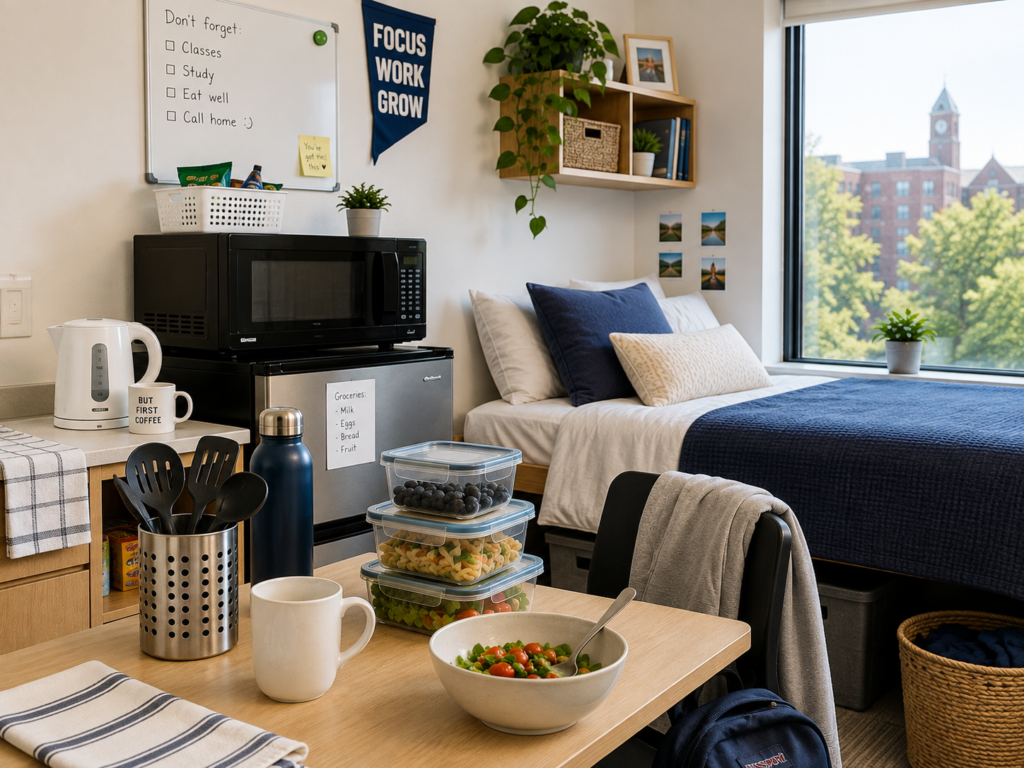
Moving into a college dorm is exciting, but figuring out what to bring can quickly become overwhelming—especially when it comes to kitchen supplies.
Dorm rooms are small, storage space is limited, and many colleges have rules about which appliances students can use. The good news is that students do not need a full kitchen. A few practical essentials can make it much easier to prepare simple meals, heat up leftovers, make coffee, and keep snacks organized without taking up too much space.
The key is to start with items that are compact, versatile, easy to clean, and useful every day.
Before buying appliances such as a microwave, electric kettle, air fryer, toaster, or rice cooker, always check the official housing rules for the specific dorm. Policies vary from one school—and sometimes one residence hall—to another.
In this guide, we’ll cover the dorm room kitchen essentials college students actually need, the items that are nice to have, and the appliances you should check with your school before bringing.
Start With the Dorm Rules
Before shopping, find out what the dorm already provides.
Some residence halls may already include:
- A mini refrigerator
- A microwave
- A shared kitchen
- A stove and oven in a common area
- A communal refrigerator
- A sink or dishwashing area
Knowing what is already available can prevent unnecessary purchases.
Also check the school’s rules for electrical appliances. Some dorms permit certain automatic-shutoff appliances but restrict items with exposed heating elements.
It is much better to check first than to arrive with an appliance that cannot be used.
Dorm Room Kitchen Essentials Every Student Should Have
Dorm living does not require a full kitchen setup. The goal is to choose a few useful items that are compact, easy to clean, and versatile enough for everyday meals and snacks.
1. Microwave-Safe Bowl and Plate
A microwave-safe bowl and plate are two of the most useful items to keep in a dorm room.
They can be used for:
- Oatmeal
- Soup
- Pasta
- Leftovers
- Frozen meals
- Cereal
- Snacks
Choose lightweight, durable pieces that are easy to wash and will not take up much storage space.
For most students, one or two bowls and plates are plenty.
2. Reusable Food Storage Containers
Food storage containers are useful for leftovers, snacks, fruit, sandwiches, and simple meal prep.
A small set of stackable containers is usually enough for a dorm room.
Look for containers that are:
- Easy to stack
- Leak-resistant
- Easy to clean
- Microwave-safe when appropriate
- Dishwasher-safe if that matters to you
Several useful sizes are usually better than a huge set that takes up an entire shelf.
3. Reusable Water Bottle
A reusable water bottle is one of the simplest dorm essentials.
Students spend a lot of time moving between classes, libraries, study spaces, and activities, so having water nearby is convenient.
Look for a bottle that is:
- Leak-resistant
- Durable
- Easy to clean
- Comfortable to carry
An insulated bottle is especially useful for keeping drinks cold throughout the day.
4. Mug or Travel Mug
One good mug can handle coffee, tea, hot chocolate, soup, or even microwave oatmeal.
Students who regularly bring coffee or tea to class may prefer a travel mug with a secure lid.
Choose a simple design that is easy to wash. Complicated lids with many small parts can be annoying to clean in a dorm.
5. Basic Eating Utensils
Students usually do not need a large flatware set.
A simple setup can include:
- 1–2 forks
- 1–2 spoons
- 1–2 table knives
A small number of utensils saves space and makes it easier to keep everything clean.
6. Small Cutting Board
A compact cutting board can be useful for preparing fruit, vegetables, sandwiches, and other simple foods.
Choose one that:
- Is easy to wash
- Stores vertically
- Does not take up much space
- Is large enough for simple food prep
If the student will mainly use the dining hall and microwave, this is also something that can wait until after move-in.
7. Small Mixing Bowl
One medium-size mixing bowl can do several jobs.
It can be used as a:
- Mixing bowl
- Salad bowl
- Snack bowl
- Serving bowl
- Food-prep bowl
A mixing bowl with a lid is even more versatile because it can double as a storage container.
8. Measuring Cups and Spoons
Students who plan to cook or bake in a shared kitchen may find measuring cups and spoons useful.
They can be used for:
- Oatmeal
- Pancake mix
- Rice
- Baking
- Sauces
- Simple recipes
A nesting set takes up very little space.
Students who mainly eat in the dining hall may not need them immediately.
9. Can Opener
A small manual can opener takes up almost no room but can be useful for canned soup, beans, tuna, vegetables, and other pantry foods.
It is one of those little tools that is easy to forget until you suddenly need one.
10. Dish Soap, Sponge, and Dish Towel
Every dorm food setup needs a simple way to clean dishes.
A basic cleaning kit can include:
- Small bottle of dish soap
- Sponge or dish brush
- One or two dish towels
- Small dish caddy if the sink is down the hall
If there is no sink in the room, a caddy makes it easier to carry dishes and cleaning supplies to a communal sink.
Useful Food Storage and Organization
Dorm rooms can become cluttered quickly.
A small food basket or storage bin can hold items such as:
- Snack bars
- Oatmeal packets
- Tea
- Coffee
- Crackers
- Instant meals
- Small utensils
Keeping food together makes the room look more organized and helps students see what they already have before buying more.
Reusable food bags, foil, or food wrap can also be useful in small quantities.
Appliances: Check Dorm Rules Before Buying
This is one of the most important parts of dorm shopping.
Do not assume that an appliance is allowed simply because it is small.
Before buying, check:
- What the dorm already provides
- Size restrictions
- Wattage limits
- Fire-safety requirements
- Whether heating elements are permitted
- Whether the appliance may only be used in a communal kitchen
Mini Refrigerator
A mini refrigerator can be extremely useful for:
- Milk
- Yogurt
- Fruit
- Drinks
- Sandwich ingredients
- Leftovers
But some colleges already provide refrigerators or offer approved rental packages.
Check before purchasing one.
Microwave
A microwave can make dorm life much easier.
Students can use it for:
- Oatmeal
- Soup
- Leftovers
- Frozen meals
- Vegetables
- Rice cups
- Simple snacks
Some residence halls provide microwaves or have specific size and wattage rules.
Electric Kettle
An electric kettle can be convenient for:
- Tea
- Coffee
- Instant oatmeal
- Ramen
- Instant soup
Some dorms allow automatic-shutoff kettles, while others restrict them. Check before buying.
Coffee Maker
Students who buy coffee every morning may enjoy having a compact coffee maker.
However, some schools restrict coffee makers with exposed heating plates.
Check which types are permitted.
Rice Cooker
A small rice cooker can be practical for students who eat rice regularly.
Depending on the model, it may also prepare oatmeal, grains, or simple one-pot foods.
Again, verify dorm rules first.
Air Fryer
Air fryers are popular, but many residence halls restrict them because of heat, electrical load, ventilation, or fire-safety concerns.
An air fryer may be prohibited in individual bedrooms even if it can be used in a communal kitchen.
Always check before purchasing one.
Toaster and Toaster Oven
Toasters and toaster ovens are also frequently restricted because of their heating elements.
Students with access to a communal kitchen may not need to own either one.
Hot Plate or Portable Cooktop
Hot plates and portable burners are commonly prohibited in traditional dorm rooms.
Some schools may allow certain appliances only in designated kitchen areas.
Never assume one is permitted without checking.
What Not to Buy Right Away
It is very easy to overbuy when preparing for college.
Most students do not need:
- Large cookware sets
- Full knife blocks
- Several frying pans
- Multiple mixing bowls
- Large dinnerware sets
- Specialty baking equipment
- Numerous single-purpose gadgets
Start with the basics.
After a few weeks, students will have a much better idea of what they actually use.
Coordinate With the Roommate
Before purchasing shared items, talk with the roommate.
Two students probably do not need two:
- Mini refrigerators
- Microwaves
- Electric kettles
- Coffee makers
- Sets of cleaning supplies
Dividing shared items can save both money and valuable dorm space.
Buy for the Student’s Actual Habits
Not every college student needs the same kitchen setup.
Think about questions such as:
- Will the student have a meal plan?
- Do they drink coffee every morning?
- Will they eat breakfast in the room?
- Do they regularly save leftovers?
- Do they enjoy cooking?
- Is there a convenient shared kitchen?
- How much storage space is available?
A student who eats almost every meal in the dining hall may only need a water bottle, mug, bowl, utensils, and a few food containers.
A student who enjoys cooking may need additional tools.
Wait Until After Move-In for Optional Items
There is no need to buy everything before move-in day.
After moving in, students can see:
- How much storage they actually have
- What their roommate brought
- What the dorm already provides
- Which communal facilities are convenient
- Which foods they actually keep in the room
Waiting a week or two before buying optional items can prevent unnecessary spending.
Choose Items That Are Easy to Clean
College life is busy.
Simple tools are often better tools.
Look for:
- Smooth surfaces
- Simple lids
- Few small removable parts
- Dishwasher-safe materials where useful
- Containers that do not trap food in difficult corners
The easier an item is to clean, the more likely it is to stay clean.
Choose Durable Items Instead of Too Many Items
A few good-quality items can be better than a huge inexpensive set.
A durable water bottle, reliable food containers, simple dishes, and useful kitchen tools can continue to serve a student for several years—and later move with them into an apartment.
Buying fewer things also means less clutter in a small dorm room.
Keep Food Safety in Mind
Perishable food should be refrigerated promptly.
Students should also:
- Wash food containers regularly
- Throw away old leftovers
- Keep the refrigerator clean
- Avoid leaving perishable foods at room temperature for long periods
- Label leftovers with the date when helpful
If a mini refrigerator does not show its temperature, a small refrigerator thermometer can be useful.
Dorm Room Kitchen Essentials Checklist
This checklist is meant to help—not to suggest that every student needs every item.
Essentials
- Reusable water bottle
- Mug or travel mug
- Microwave-safe bowl
- Microwave-safe plate
- Fork
- Spoon
- Table knife
- Reusable food storage containers
- Dish soap
- Sponge or dish brush
- Dish towel
- Paper towels
Helpful to Have
- Small cutting board
- Small mixing bowl
- Measuring cups and spoons
- Silicone spatula or mixing spoon
- Manual can opener
- Food storage basket
- Reusable food bags
- Small dish caddy
- Foil or food wrap
Check Dorm Rules Before Bringing
- Mini refrigerator
- Microwave
- Electric kettle
- Coffee maker
- Rice cooker
- Air fryer
- Toaster
- Toaster oven
- Hot plate
- Portable induction cooker
You do not need to check every box. The best dorm setup depends on the student’s habits, available space, roommate, meal plan, and school rules.
FAQ
What kitchen items does a college student really need in a dorm?
For many students, the basics are a reusable water bottle, mug, bowl, plate, eating utensils, food storage containers, dish soap, a sponge or brush, and a dish towel.
Does every student need a mini refrigerator?
No. Some colleges provide one, offer rentals, or have shared refrigerators. Find out what the residence hall provides before purchasing one.
Are microwaves allowed in college dorm rooms?
Many colleges allow them, but rules can include size or wattage limits. Some residence halls already provide microwaves. Check the official housing policy.
Are air fryers allowed in dorm rooms?
Policies vary, and many residence halls restrict them. Check the school’s rules before purchasing one.
Are electric kettles allowed?
Some dorms allow automatic-shutoff kettles, while others do not. Always verify the policy for the specific residence hall.
Does a student need pots and pans?
Only if the student plans to cook in a shared kitchen or other approved cooking area. Students who mainly use a meal plan and microwave may not need cookware.
Should students bring kitchen knives?
Check the school’s rules first. If a kitchen knife is permitted and will be used in a shared kitchen, it should be stored safely with a blade guard or other protective cover.
How many plates and bowls should a student bring?
For most students, one or two of each is enough. Large dinnerware sets usually take up unnecessary space.
What is one of the most useful dorm kitchen items?
A reusable water bottle, microwave-safe bowl, and food storage containers are among the most versatile everyday items.
Should everything be purchased before move-in?
No. Bringing the basics first and waiting to purchase optional items can prevent duplicates, clutter, and wasted money.
Conclusion
A well-prepared dorm kitchen does not need dozens of gadgets.
A few compact, versatile essentials can make dorm life much more comfortable.
Start with the items a student is likely to use every day: a water bottle, mug, bowl, plate, utensils, food containers, and simple cleaning supplies.
Then add optional tools based on the student’s actual habits.
Most importantly, check the dorm’s rules before buying electrical cooking appliances.
With the right essentials—and a little organization—even a small dorm room can become a convenient place to store snacks, enjoy simple meals, and have a little taste of home.
Coming Up in Our College Dorm Kitchen Series
This is the first guide in our College Dorm Kitchen Series.
- Dorm Room Kitchen Essentials: What College Students Really Need — current guide
- Best Small Kitchen Appliances for College Dorms — coming next
- Kitchen Tools Every College Student Should Have — coming soon
As each new guide is published, these articles can be connected with internal links so students and parents can easily explore the complete College Dorm Kitchen Series.