Introduction
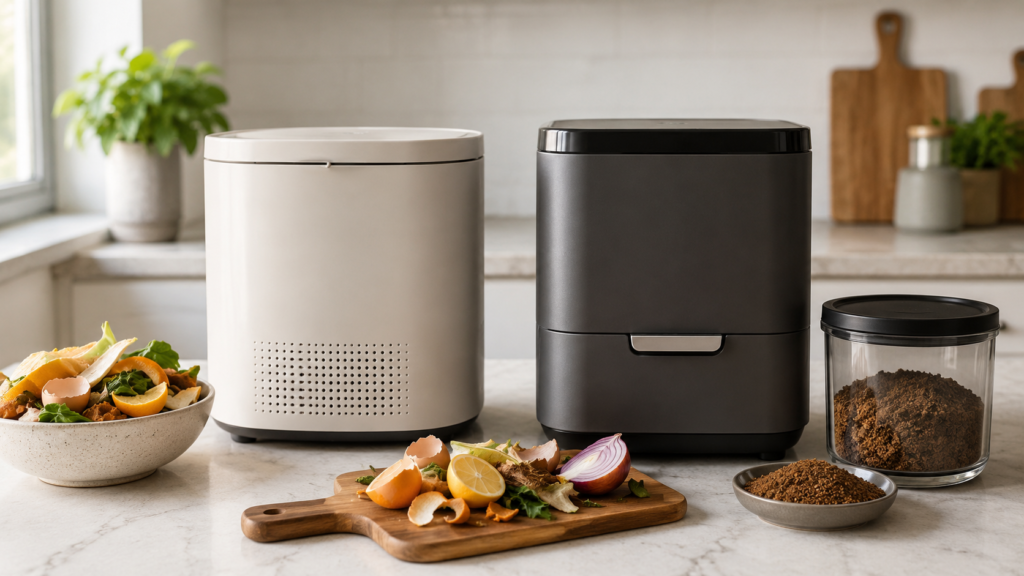
Countertop food composters are becoming an increasingly convenient way to deal with kitchen scraps without keeping a traditional compost pile outdoors.
They sit neatly in the kitchen, help control odors, and can dramatically reduce the amount of food waste going into the trash.
But there is one important thing to know before buying one:
Not all countertop “composters” work the same way.
Some use living microorganisms to gradually break down food scraps. Others use heat, drying, and grinding to reduce food waste into a much smaller, dry material.
Understanding the difference can help you choose the right type for your kitchen.
Quick Comparison
| Feature | Microbial Composter | Food Recycler |
|---|---|---|
| Main Process | Microorganisms break down food | Heat, drying and grinding |
| Processing Style | Continuous decomposition | Individual or scheduled cycles |
| Output | Soil-like pre-compost material | Dry food grounds or pre-compost |
| Can Add Food Daily? | Usually yes | Depends on the model |
| Odor Control | Microbial system + filters | Drying system + filters |
| Best For | People interested in biological decomposition | People who mainly want to reduce food-waste volume |
1. What Is a Microbial Countertop Composter?
A microbial composter uses living microorganisms such as bacteria and fungi to break down food scraps.
Instead of simply drying the food, the appliance creates an environment where the microorganisms can remain active.
The machine may control:
- Temperature
- Moisture
- Airflow
- Mixing
- Odor
Food scraps are gradually added to the microbial mixture, where they are broken down over time.
Some microbial composters are designed to stay running continuously, allowing you to add small amounts of food waste throughout the day.
For example, Reencle describes its system as maintaining a warm, aerated environment where microorganisms continuously break down food scraps.
Advantages
- Uses biological decomposition
- Can often accept scraps continuously
- Produces a soil-like material
- Reduces food waste kept in the trash
- Can help control kitchen odors
Things to Consider
- The microorganisms need the proper environment to remain healthy
- Certain foods may need to be limited
- Large bones and very hard materials may not be appropriate
- The finished material may still need additional curing before garden use
2. What Is a Food Recycler?
A food recycler works differently.
Instead of relying mainly on a living microbial culture, these machines typically use a combination of:
- Heat
- Drying
- Grinding
- Mixing
- Airflow
The goal is to remove much of the moisture from food scraps and reduce their size and volume.
For example, Mill describes its process as automatically drying and grinding food scraps into dry “Food Grounds.”
Lomi also begins by heating and grinding food waste while controlling moisture, temperature, and airflow. The company describes its finished material as pre-compost, rather than finished compost.
Advantages
- Significantly reduces the volume of food scraps
- Helps reduce wet, smelly garbage
- Usually easy to operate
- Processing can be relatively fast
- Convenient for homes without outdoor composting space
Things to Consider
- The output is not necessarily finished compost
- The appliance uses electricity
- Some models require replacement carbon filters
- Cycle times and energy use vary
- The finished material may require further composting before garden use
Is the Material That Comes Out Actually Compost?
This is where the terminology can become confusing.
Many countertop machines are commonly called electric composters, but their finished material may not be the same as mature compost produced through traditional composting.
A dehydrating food recycler primarily removes moisture and reduces the physical size of food scraps.
Some manufacturers therefore describe the resulting material as:
- Food grounds
- Pre-compost
- Soil amendment material
rather than finished compost.
Even microbial systems may recommend allowing the finished material to cure before applying it directly to a garden.
So before putting the output around plants, always follow the specific manufacturer’s instructions.
Which Type Is Better for Odor Control?
Both types are designed to make keeping food scraps indoors more pleasant than leaving them in an ordinary trash bin.
Microbial systems try to maintain conditions that support controlled aerobic decomposition.
Food recyclers reduce moisture—which is one reason the processed scraps become much less messy—and many models also use carbon filters or other odor-control systems.
However, no appliance should be assumed to remain completely odor-free under every condition.
Odor can depend on:
- What foods you add
- How much food you add
- Cleaning
- Filter condition
- Maintenance
- Whether the machine is being used correctly
Which One Is Better for a Small Kitchen?
This depends more on the individual machine than on the technology.
Before buying, check:
- Countertop or floor space required
- Height needed to open the lid
- Bucket capacity
- Noise level
- Electrical outlet location
- Filter replacement requirements
- How often the machine needs cleaning
Some machines are small enough to sit directly on a countertop, while larger food recyclers may be better placed beside a cabinet or kitchen island.
Microbial Composter vs Food Recycler: Which Should You Choose?
Choose a microbial composter if you like the idea of using microorganisms to continuously break down your kitchen scraps and do not mind maintaining a living composting system.
Choose a food recycler if your main goal is to quickly reduce the volume, moisture, and smell of food waste before disposing of it or processing it further.
Neither type is automatically better for everyone.
The best choice depends on what you want the appliance to do.
If your goal is mainly keeping food scraps out of a smelly garbage bin, a food recycler may be very convenient.
If you are more interested in biological decomposition and creating a compost-like material, a microbial system may be more appealing.
Conclusion
Countertop food composters can look very similar from the outside, but what happens inside the machine can be quite different.
A microbial composter uses living microorganisms to break down food scraps over time, while a food recycler generally relies more heavily on heat, drying, grinding, and mixing to reduce food waste.
The biggest mistake is assuming that every machine sold as an “electric composter” produces finished compost.
Before buying, look closely at how the machine processes food, what the finished material actually is, what foods it accepts, and what maintenance it requires.
Once you understand those differences, choosing the right food-waste system for your kitchen becomes much easier.
More in Our Countertop Composter Series
- Types of Countertop Food Composters: Microbial Composter vs Food Recycler ← You are here
- What Can You Put in a Countertop Composter?
- Are Countertop Composters Worth It? Pros, Cons, Odor, Cost & Maintenance