Introduction
A blender and a food processor may look like similar kitchen appliances, but after using both in my own kitchen, I have found that they are useful for very different jobs.
In our family, the blender gets used often for quick drinks. My children like using it for protein shakes, banana milk, and other simple drinks because it can turn fruit, milk, and other ingredients into something smooth in just a few minutes.
A food processor plays a different role in my kitchen. I prefer it when I want to chop ingredients such as garlic or vegetables for stir-fries while still keeping some texture. A blender can sometimes make those ingredients much smoother than I want.
I also realized how practical a blender can be for someone living in a small space when my son chose it as one of the appliances he wanted to take with him to his college dorm. He liked the idea of being able to make something simple without needing a full kitchen.
Compact personal blenders can be especially convenient for this. Some let you blend directly in the cup and then switch the blending lid for a drinking lid, so you can take the drink with you. For a busy student, that kind of simplicity can make a small blender much more useful than its size suggests.
After using both appliances, I do not really see a blender and a food processor as competitors. For my family, they solve different problems—and having both has actually made everyday kitchen tasks easier.
Blender vs Food Processor: The Main Difference
The biggest difference, in my experience, is the texture each appliance gives me.
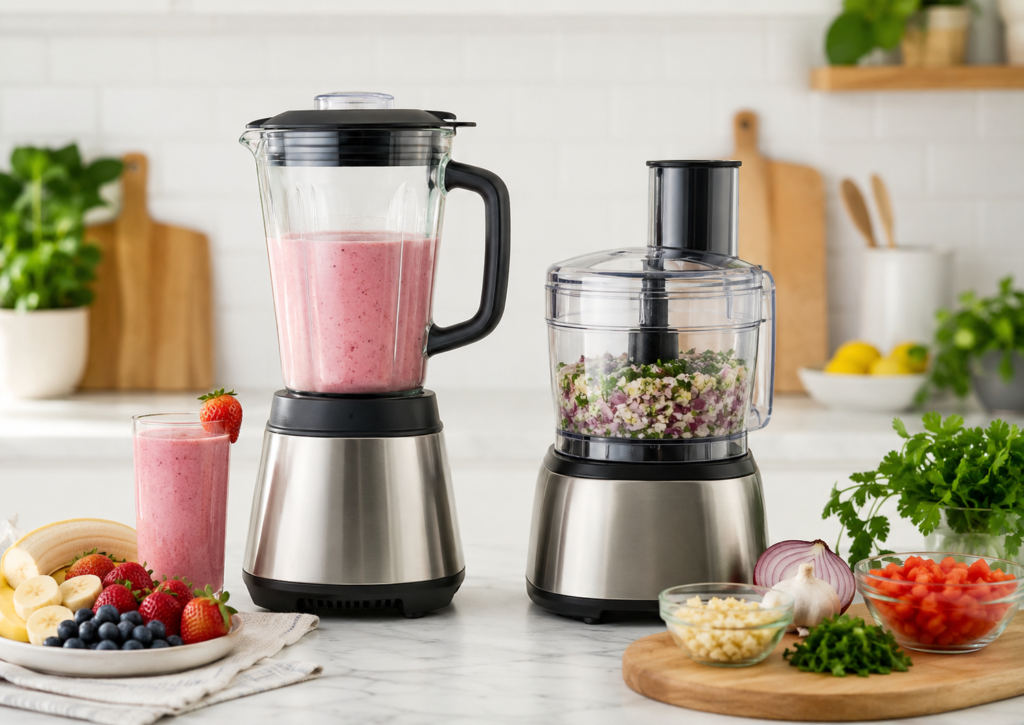
A blender is what I reach for when I want ingredients to become smooth and well blended, especially for drinks, smoothies, protein shakes, and creamy foods.
A food processor is more useful when I want to chop, slice, shred, or process food while still keeping some texture. That is why I prefer it for ingredients such as garlic and vegetables for stir-fries.
For me, the choice is usually simple: smooth and drinkable means blender; chopped with texture means food processor.
Here is a simple comparison:
| Kitchen Task | Blender | Food Processor |
|---|---|---|
| Protein shakes | Excellent | Not ideal |
| Smoothies | Excellent | Possible, but less convenient |
| Banana milk | Excellent | Not ideal |
| Creamy soups | Excellent | Possible |
| Sauces | Excellent | Excellent |
| Chopping garlic | Possible, but easy to over-process | Excellent |
| Chopping onions | Not ideal | Excellent |
| Chopping vegetables | Not ideal | Excellent |
| Chopping nuts | Possible | Excellent |
| Keeping a chunky texture | Difficult | Excellent |
| Mixing liquids | Excellent | Limited |
What Is a Blender Best For?
In our kitchen, the blender is mainly the appliance we reach for when we want something smooth, quick, and easy to drink.
My children often use it for protein shakes. Protein powder does not always mix smoothly when it is simply stirred into milk or water, but a blender can combine everything quickly and give the drink a much smoother texture.
We also use it for simple fruit drinks. Banana milk is one of the easiest examples: add milk and a banana, blend for a short time, and it is ready. Yogurt, berries, frozen fruit, or other ingredients can easily be added depending on what we have at home.
That everyday convenience is one reason I think a blender earns its place in our kitchen. It is especially useful when the goal is a smooth texture rather than chopped ingredients with some texture left.
Blenders are especially useful for:
- Protein shakes
- Smoothies
- Banana milk and fruit drinks
- Milkshakes
- Creamy soups
- Smooth sauces
- Purees
- Frozen drinks, if your blender is designed to handle ice and frozen ingredients
For families, a blender can also be a convenient appliance because many simple drinks require only a few ingredients and very little preparation.
What Is a Food Processor Best For?
In my kitchen, I use a food processor when I want ingredients chopped without turning them completely smooth.
For example, when I prepare garlic, onions, or vegetables for a stir-fry, I want the pieces to stay visible and keep some texture. That is one reason I prefer a food processor instead of a blender for this kind of prep.
I have found that a blender can sometimes process these foods too aggressively. A few extra seconds can quickly turn chopped vegetables into something much closer to a puree.
With a food processor, I can use short pulses and stop when the ingredients reach the size I want. That gives me much more control over the final texture.
Food processors are particularly useful for:
- Chopping garlic
- Chopping onions
- Preparing vegetables for stir-fries
- Chopping herbs
- Chopping nuts
- Making breadcrumbs
- Shredding or slicing vegetables with the appropriate attachment
- Making thicker dips and spreads
- Mixing certain doughs, depending on the model
Do You Really Need Both a Blender and a Food Processor?
Not everyone needs both appliances. But in my kitchen, I have found that having both makes sense because I use them for completely different jobs.
My family reaches for the blender when we want something quick and smooth, such as protein shakes, banana milk, or fruit drinks. I use the food processor when I am preparing garlic, onions, or vegetables and want to keep some texture.
Because of that, I do not feel that one appliance replaces the other.
I also used to think that owning both might take up too much space. But today, compact blenders and smaller food processors make it much easier to keep both without giving up a large amount of counter or cabinet space.
That became especially clear to me when my son was preparing to move into his college dorm. A small blender was one of the appliances he wanted to bring because it could help him make something simple and quick without needing a full kitchen. Personal blenders that let you blend in the same cup and then switch to a drinking lid can be especially convenient for that kind of lifestyle.
For our family, the question is not “Which one is better?” It is “Which one fits the job I am doing right now?”
Frequently Asked Questions
Can I use a blender instead of a food processor?
Sometimes. A blender can handle many sauces, purees, and liquid-heavy recipes. But from my experience, it is harder to control the texture when I want ingredients chopped rather than completely blended. For garlic, onions, and vegetables, I usually prefer my food processor.
Can I chop vegetables in a blender?
You can, but it is very easy to over-process them. When I want vegetables for a stir-fry to keep some texture, I prefer using a food processor and short pulses.
Is a food processor good for smoothies?
It may be able to make some smoothies, but I would still choose a blender for smoothies, protein shakes, banana milk, and other drinks. In our home, that is the appliance my family naturally reaches for when we want something smooth and drinkable.
Which is better for a college dorm?
For a student with limited space, I would choose a compact personal blender rather than a food processor if the main goal is quick drinks and simple snacks. My son actually wanted to take a small blender with him when he moved into his college dorm. A model that lets you blend in the cup, replace the blade lid with a drinking lid, and take it with you can be especially convenient.
Students should still check their dorm’s appliance rules first, since allowed appliances vary by school and residence.
Conclusion
After using both a blender and a food processor in my own kitchen, I would not want to replace one with the other.
In our family, the blender earns its place because it makes quick drinks like protein shakes and banana milk easy. The food processor earns its place for a completely different reason: it gives me more control when I am preparing garlic, onions, and vegetables and want to keep some texture.
I have also seen how useful a compact blender can be outside a full-size kitchen. When my son prepared for college, a small blender was one of the appliances he wanted to take to his dorm because it could help him make something simple and quick on his own.
For me, that experience changed the question from “Which appliance is better?” to “Which one fits the way you actually cook and eat?”
If you mainly make drinks, a blender may be all you need. If you do a lot of chopping and food prep, a food processor may be more useful. But if you regularly do both, owning both can be practical without being excessive—especially now that compact versions are available.
More in Our Blender & Food Processor Series
- What Can You Make With a Blender? Easy Everyday Uses
- What Can You Make With a Food Processor? Chopping, Slicing and More
- Best Small Kitchen Appliances for College Dorms