Introduction
For a long time, I didn’t think very much about the difference between a food processor, a small chopper, and a blender.
They all have blades, they all chop or blend food, and at first glance, they can seem like they do almost the same thing.
But after using them in my own kitchen, I realized there is an important difference.
A blender is usually what I reach for when I want something smooth. A food processor is what I prefer when I want more control over the texture.
That difference may sound small, but it matters in everyday cooking.
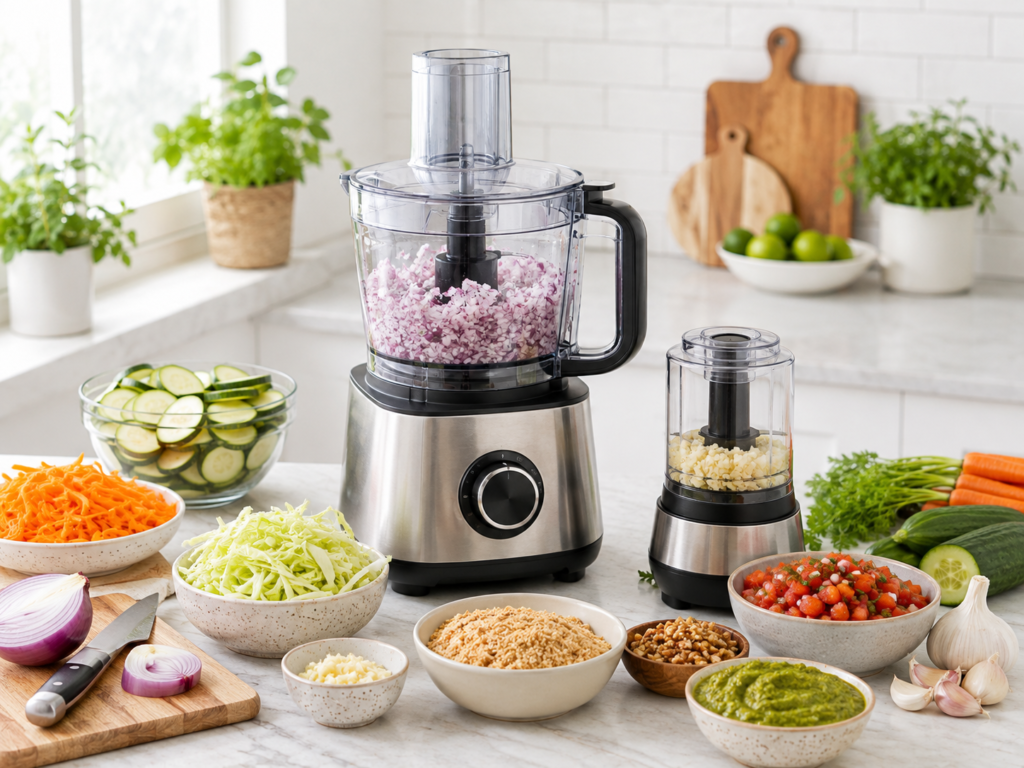
I can chop garlic or vegetables into small pieces without turning them into a completely smooth mixture. And by using the pulse button a little at a time, I can stop when the food reaches the size I want.
That is one of the things I have come to appreciate most about a food processor.
Chopping Vegetables
This is one of the most useful everyday jobs for a food processor.
Onions, carrots, celery, peppers, and other vegetables can be chopped much more quickly than doing everything by hand.
But I don’t always want my vegetables chopped extremely fine.
When I want to keep a little more texture, I use short pulses and check the size as I go.
If I keep processing longer, the pieces usually become smaller and finer. If I stop earlier, they remain a little more coarse.
I would rather stop and check a few times than accidentally process the vegetables too finely.
Chopping Garlic
Garlic is another ingredient I like using a food processor or small chopper for, especially when I need more than just one or two cloves.
I don’t necessarily want the garlic turned into a completely smooth paste.
A few short pulses can chop it while still leaving some texture.
This is one of the places where I notice the difference between my blender and food processor most clearly.
For something I want smooth, I think blender. For something I want chopped, I usually think food processor.
Making Salsa and Dips
A food processor can also be useful for salsa, dips, spreads, and similar foods.
The nice thing is that you can decide how smooth or chunky you want the finished result.
For a chunky salsa, for example, you can pulse the ingredients briefly instead of letting the machine run continuously.
For a smoother dip, you can process it longer.
Again, that ability to stop and check the texture is something I find very practical.
Shredding and Slicing
Larger food processors often come with discs for slicing or shredding.
These can be helpful when preparing larger amounts of vegetables, cheese, or other ingredients.
Not every small food processor or chopper has these attachments, though, so this is one area where the size and type of machine make a difference.
A compact chopper can be wonderful for small everyday jobs, while a larger food processor may be more useful when you want slicing, shredding, or a bigger capacity.
Making Crumbs and Chopping Nuts
A food processor can also make breadcrumbs, cookie crumbs, and chopped nuts.
This is another job where the pulse function comes in handy.
If you want coarse crumbs or larger nut pieces, use short pulses.
If you want something finer, continue processing a little longer.
The exact result will depend on the ingredient and the machine, but I find that working in short bursts gives me more control.
Dough and Other Jobs
Some full-size food processors can also mix or knead certain types of dough.
This is not something every small chopper is designed to do, so it is important to check the instructions for your particular model.
This is something I have learned as I look at newer kitchen appliances: two machines may both be called food processors, but their capacity and features can be quite different.
Food Processor vs. Blender: Similar, but Not the Same
A food processor and blender may look like close relatives, but I don’t think of them as interchangeable anymore.
In our home, the blender is often used for things like protein shakes, banana milk, and other drinks where we want a smooth result.
For garlic or vegetables that I plan to cook, however, I often want some texture left.
That is where I prefer the food processor.
The blender is better for smoothness. The food processor gives me more control over chopping and texture.
That is also why, even though the two appliances overlap in some ways, I personally find it useful to have both.
Do You Need a New Food Processor?
Not necessarily.
I’m not an early adopter, and I usually don’t replace a kitchen appliance simply because a newer version appears.
If the one I already have still works well and does what I need, I am happy to keep using it.
That is especially true for simple appliances like a food processor or small chopper.
Some compact models do not take up much storage space, and once you have one that works for the way you cook, there may be very little reason to replace it just because something newer is available.
Of course, larger food processors can take up more room, so size is something worth considering before buying.
For me, the important question is not, “What is the newest model?”
It is:
Does the one I have still do the job I need it to do?
If the answer is yes, I would rather keep using it for years.
Why I Find a Food Processor Useful
What I like about a food processor is that it does not have to be complicated.
I don’t need dozens of settings for most everyday jobs.
Sometimes I just need to put in some vegetables or garlic, press the pulse button a few times, look at the texture, and stop.
That simplicity is useful.
And because compact food processors and choppers can be relatively easy to store, they can be the kind of appliance that stays in the kitchen for a long time rather than being replaced every time a new trend appears.
For me, a useful kitchen tool does not have to be new. It just has to keep doing its job well.
FAQ
Can a food processor chop vegetables without making them mushy?
Yes, but it helps to use short pulses rather than running the machine continuously. Check the vegetables frequently and stop when they reach the size you want.
What is the pulse button on a food processor for?
The pulse function runs the blades in short bursts. It can give you more control when chopping and help prevent ingredients from becoming finer than you want.
Can a food processor replace a blender?
Sometimes the two appliances can do similar jobs, but they are not exactly the same. A blender is generally better for smooth liquids, while a food processor is often better for chopping and maintaining some texture.
Is a small food processor worth having?
For someone who frequently chops garlic, onions, vegetables, nuts, or other small amounts of food, a compact food processor or chopper can be very convenient. It may also be easier to store than a large model.
Do I need to replace an old food processor with a newer model?
Not if it still works safely and does what you need. New models may offer additional features, but newer does not automatically mean more useful for your kitchen.
Conclusion
For years, I thought a food processor and blender were almost the same kind of appliance.
Using them more carefully has changed the way I think about them.
The biggest difference for me is control over texture.
If I want something completely smooth, I usually reach for the blender. If I want garlic or vegetables chopped while keeping some texture, I prefer the food processor and use the pulse button until the pieces look right to me.
I also like that this is not necessarily an appliance that needs constant upgrading.
If a food processor works well, fits your kitchen, and does the jobs you need, it can remain useful for many years.
Sometimes understanding how to use the tool you already own is more valuable than buying the newest one.
More in Our Blender & Food Processor Series
- Blender vs Food Processor: What’s the Difference and Do You Need Both?
- What Can You Make With a Blender? Easy Everyday Uses
- What Can You Make With a Food Processor? Chopping, Slicing and More
- Best Small Kitchen Appliances for College Dorms