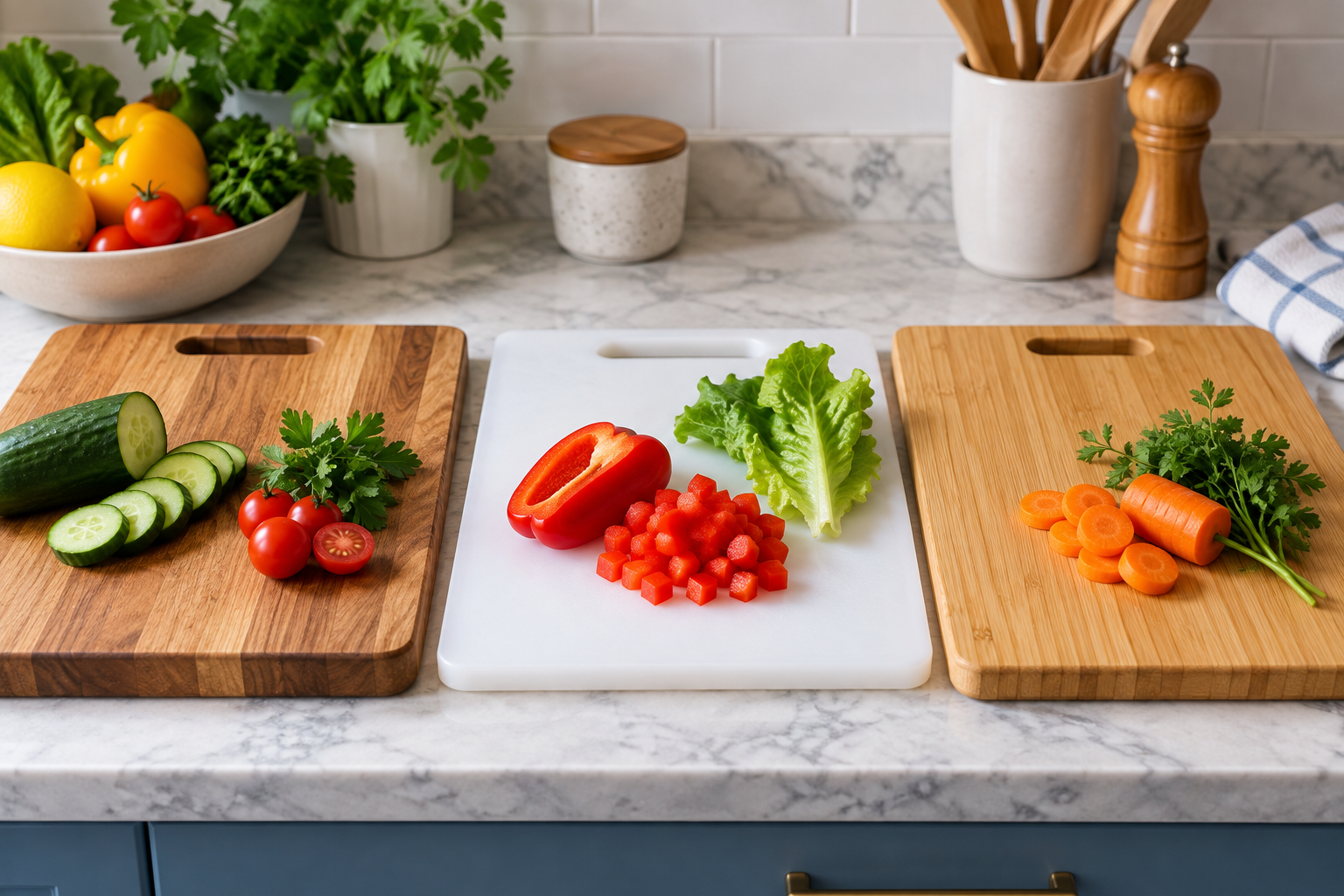
Introduction
I have used several types of cutting boards over the years, including wood, plastic, titanium, and silicone.
At first, I thought choosing a cutting board was mostly about the material. But after actually using different boards in my kitchen, I realized that how easy a board is to wash, dry, store, and maintain matters just as much as the material itself.
Wood made me think more about drying and maintenance. Plastic was convenient, but over time I noticed stains and knife marks. I also bought a fairly expensive titanium cutting board because I expected it to be extremely durable, but it showed more marks than I expected after the first use.
These days, the cutting board I reach for most often is silicone because it is lightweight, easy to wash, and simple for me to maintain. I even chose a silicone cutting board for my son when he moved into college housing because I wanted something practical and easy for him to care for.
After trying different materials myself, I have learned that the best cutting board is not necessarily the newest, most expensive, or most popular one. It is the one that fits the way you actually cook, clean, and maintain your kitchen tools.
What Are the Differences Between Wood, Plastic, and Bamboo Cutting Boards?
Wood, plastic, and bamboo cutting boards each have their own advantages and disadvantages.
Wood cutting boards are popular because they are durable and generally gentle on knife edges. Plastic boards are lightweight, inexpensive, and often easy to sanitize. Bamboo has a natural appearance and is relatively lightweight, but it can feel harder than some wood boards.
Here is a simple comparison:
| Material | Hygiene & Cleaning | Knife Friendly | Maintenance |
|---|---|---|---|
| Wood | Good when cleaned and dried properly | Excellent | Moderate |
| Plastic | Very easy to clean | Fair | Easy |
| Bamboo | Good | Good | Moderate |
The right choice depends less on which material is “best” overall and more on what you prepare and how much maintenance you are willing to do.
Wood Cutting Boards
Wood cutting boards have been used in kitchens for generations, and there are good reasons for that.
Pros
-
- Gentle on knife edges
-
- Durable when properly cared for
-
- Stable for chopping and slicing
-
- Attractive enough to leave on the counter
Cons
-
- Should not stay wet for long periods
-
- Usually should not be soaked in water
-
- May require occasional oiling
-
- Can warp or crack if not dried properly
For someone who does not mind a little maintenance, wood can be an excellent everyday cutting surface.
For me, however, the need to think about drying and maintenance is one reason I do not automatically reach for wood every time.
Plastic Cutting Boards
Plastic cutting boards are practical and easy to find. They are also useful when you want a board that is simple to wash after messy food preparation.
Pros
-
- Lightweight
-
- Affordable
-
- Easy to wash
-
- Many are dishwasher-safe if the manufacturer allows it
-
- Easy to keep separate boards for different foods
Cons
-
- Knife cuts can become visible over time
-
- Some foods may leave stains
-
- Deep grooves can make an older board harder to keep clean
-
- Boards may eventually need to be replaced
I have used plastic boards because they are convenient, but over time I noticed stains and visible knife marks, which made me less interested in keeping them for long-term everyday use.
Bamboo Cutting Boards
Bamboo cutting boards are popular with people who like the appearance of natural materials but want something lighter than many thick wooden boards.
Pros
-
- Attractive natural appearance
-
- Lightweight
-
- Relatively durable
-
- Easy to store
Cons
-
- The surface can be harder than some traditional wood boards
-
- May dull knives faster depending on the board
-
- Can crack if it is repeatedly exposed to moisture and not dried properly
-
- Quality varies between manufacturers
Bamboo can be a good middle ground, especially if you want a natural-looking board without the weight of a thick wooden one.
What About Silicone Cutting Boards?
Silicone was not the material I originally expected to prefer, but after using different cutting boards, it has become the one I reach for most often.
What I like most is the convenience.
My silicone cutting board is lightweight, simple to wash, and does not require the same type of maintenance that makes me hesitate with some wood boards. Some silicone cutting boards are also designed to tolerate fairly high temperatures, although heat limits vary by product, so I always think it is best to follow the manufacturer’s care instructions.
For everyday cooking, the easy cleaning gives me peace of mind.
I liked the practicality enough that when my son moved into college housing, I chose a silicone cutting board for him too. I wanted him to have something light, easy to wash, and easy to store in a small kitchen.
That experience reminded me that the most practical kitchen tool is often the one you are actually willing to use and clean every day.
Titanium Cutting Boards: My Experience Was Different Than I Expected
I became interested in titanium cutting boards because they sounded extremely durable.
I eventually bought a fairly expensive one, expecting it to be a long-lasting upgrade.
But after the first use, I noticed a lot more marks on the surface than I expected.
That disappointed me enough that I eventually stopped using it and put it away.
This does not mean every titanium cutting board will behave exactly the same way. Materials, finishes, thicknesses, and manufacturing quality can all vary.
But my experience taught me something important: a material that sounds impressive when I research it does not always work the way I expect once I actually use it in my own kitchen.
That is one reason I now pay more attention to real everyday usability than to price or marketing claims.
Which Cutting Board Is Best for Different Needs?
There is no single board that is perfect for every kitchen.
If keeping your knives sharp is your highest priority, a good wooden board may be the best choice.
If you frequently prepare raw meat and want something that is easy to sanitize, a plastic board that can be thoroughly washed—or placed in the dishwasher when the manufacturer permits—can be very practical.
If you want a lighter natural-material option, bamboo may suit you.
And if you value light weight, easy washing, and low maintenance, silicone may be worth considering.
My own kitchen has taught me that having one “perfect” cutting board is less important than having a board that matches the task and your cleaning habits.
Do You Need More Than One Cutting Board?
For many households, having more than one board is useful.
I especially like the idea of keeping food preparation simple by using different boards for different jobs. For example, a board used for raw meat can be kept separate from the board you use for fruit, bread, or ready-to-eat foods.
You do not need a large collection.
In a smaller kitchen, two practical boards can often be more useful than five boards that are difficult to store.
That is another reason I tend to prefer kitchen tools that are easy to clean and easy to put away.
When Should You Replace a Cutting Board?
A cutting board does not need to look brand-new forever, but it should still be easy to clean and comfortable to use.
Consider replacing a board when it develops:
-
- Very deep grooves that are difficult to clean
-
- Cracks or splits
-
- Warping that makes the board unstable
-
- Damage that makes cleaning difficult
-
- A surface you no longer feel comfortable using
I tend to keep kitchen tools for a long time, so I do not replace something simply because it looks old. But once a tool becomes difficult to clean or inconvenient to use, that is when I start thinking about replacing it.
Conclusion
After trying wood, plastic, titanium, and silicone cutting boards, I have learned that there is no single material that is perfect for everyone.
Wood can be excellent for knife friendliness and long-term use, but it requires more care. Plastic is convenient and easy to clean, but stains and knife marks can become noticeable over time. Bamboo offers a natural look and lighter weight, although it can be harder than some wood boards.
For me, silicone has become the cutting board I reach for most often because it is lightweight, easy to clean, and simple to maintain. Those practical advantages matter more to me in everyday cooking than having the newest or most expensive material.
My experience with titanium especially reminded me that what looks ideal when I research a product does not always work the way I expect once I actually use it.
The best cutting board is ultimately the one that fits your own cooking habits, cleaning routine, storage space, and comfort level.