Introduction
I’m not someone who bakes often, and I wouldn’t consider myself an expert baker. My interest in baking sheets actually started with my kids. They learned about baking at school and became interested in trying things at home, so I naturally started paying more attention to the baking tools we were using.
That’s when I realized that baking sheets are not all the same. There are aluminum, stainless steel, nonstick, and even silicone options, and each one has its own advantages and disadvantages.
I’m still learning which type is best for different baking situations, but I’ve found that understanding the basic differences makes it much easier to choose the right one. In this article, I’ll compare aluminum, stainless steel, and nonstick baking sheets and share what I think is worth considering before you buy
Aluminum Baking Sheets
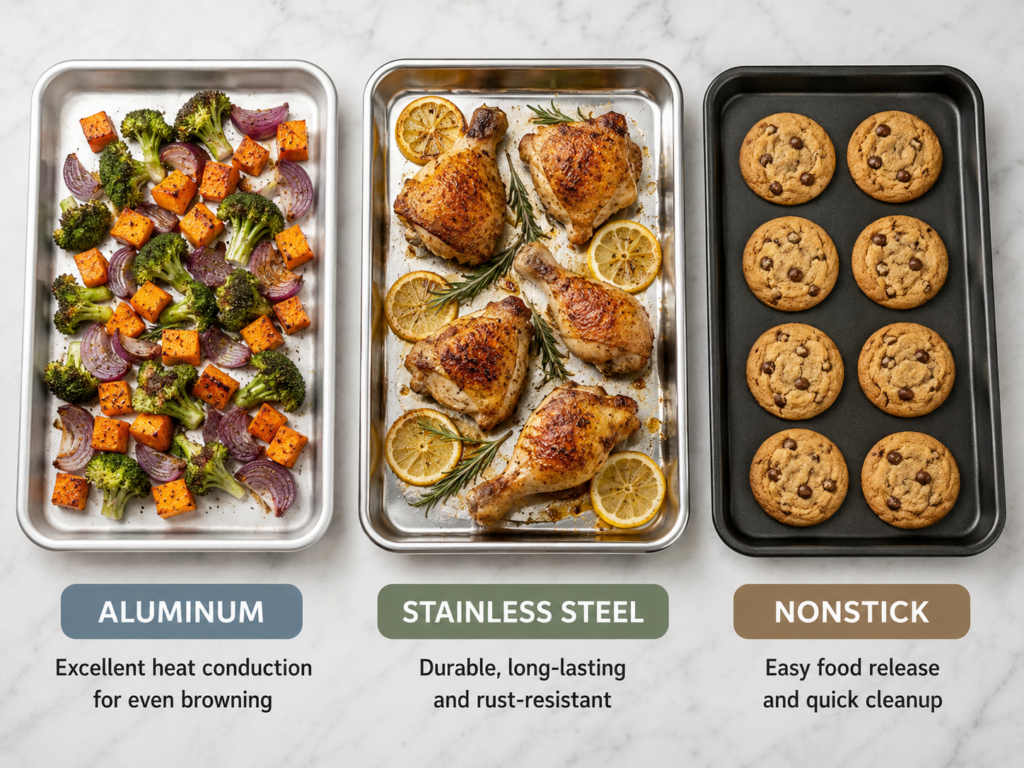
Aluminum is one of the most common materials used for baking sheets.
One reason is that aluminum heats up quickly and distributes heat fairly evenly. This can be helpful when baking cookies, pastries, and other foods that need consistent heat.
Aluminum baking sheets are also usually lightweight and easy to handle. However, they can scratch or bend more easily than some heavier materials.
Another thing to consider is that aluminum can react with some acidic foods. For everyday baking, this usually isn’t a major concern, but it is still something worth knowing when choosing cookware.
Pros:
- Heats up quickly
- Lightweight
- Good heat distribution
- Usually affordable
Cons:
- Can scratch or bend more easily
- May react with some acidic foods
- Usually needs parchment paper or another liner when sticking is a concern
Stainless Steel Baking Sheets
Stainless steel baking sheets are another option, especially for people who want something sturdy and long-lasting.
Compared with aluminum, stainless steel generally feels heavier and more durable. It also doesn’t have the same concern about reacting with acidic foods.
The downside is that stainless steel does not conduct heat as quickly as aluminum. Depending on what you are baking, this can affect how food browns and cooks.
For someone like me who doesn’t bake all the time, durability can be an important reason to consider stainless steel. I don’t necessarily need the newest baking sheet. I would rather have something that I can use for years.
Pros:
- Durable and sturdy
- Resistant to rust and corrosion
- Doesn’t easily react with acidic foods
- Good choice for long-term use
Cons:
- Heavier than aluminum
- May not heat as quickly as aluminum
- Food can stick without proper preparation
Nonstick Baking Sheets
Nonstick baking sheets have a coating designed to help food release more easily.
For someone who doesn’t bake very often, this can be appealing because less sticking can make both baking and cleanup easier.
However, the coating needs to be treated carefully. Metal utensils, rough cleaning tools, and excessive heat can damage some nonstick surfaces.
If you choose a nonstick baking sheet, following the manufacturer’s care instructions is important.
Pros:
- Food releases more easily
- Convenient for baking
- Can make cleanup easier
Cons:
- Coating can wear or scratch
- Requires more careful cleaning and use
- Lifespan may depend on how well the coating is maintained
What About Glass Baking Dishes?
Glass is actually one of the materials I personally like and use in my kitchen.
I like glass because it feels simple and familiar, and I can easily see the food while it is cooking. Since I don’t bake very often, I appreciate kitchen tools that are easy to use and useful for different types of dishes.
But I learned an important lesson about glass the hard way.
Once, I took a very hot glass baking dish out of the oven and wanted to cool it down quickly. Without really thinking about it, I put the hot dish into cold water. The glass completely shattered.
It was a good reminder that glass can be sensitive to sudden temperature changes. A hot glass dish and cold water can create thermal shock, which may cause the glass to crack or break.
This is the kind of mistake that is easy to make because the idea seems harmless: “It’s hot, so I’ll cool it down quickly.” But with glass cookware, it’s better to let it cool gradually and follow the manufacturer’s instructions.
Glass baking dishes are also different from flat metal baking sheets. They can be useful for casseroles, baked dishes, and recipes that work better in a deeper dish, but they don’t behave exactly like aluminum or stainless steel.
For me, glass is still a material I like and use. I just learned that liking a material also means understanding its limitations and treating it properly.
What About Silicone Baking Sheets?
Silicone is another material I have become interested in, even though it isn’t exactly the same type of baking sheet as a traditional metal sheet pan.
I personally like the idea of silicone because it is flexible and food tends to release easily. It can also be convenient for baking and cleanup.
However, silicone doesn’t feel the same as a rigid metal baking sheet. Depending on the recipe, a flexible silicone surface may not provide the same support or browning as a metal pan.
For that reason, I wouldn’t say silicone is automatically better than aluminum, stainless steel, or nonstick. It simply has different characteristics that may work better for certain baking situations.
If you are new to baking, it can be useful to think of silicone as another option rather than trying to find one material that is best for everything.
Which Baking Sheet Is Best?
There isn’t one baking sheet that is best for everyone.
Aluminum is a good choice if you want quick and even heating. Stainless steel may appeal to you if durability and long-term use are priorities. Nonstick can be convenient when easy food release and cleanup matter most.
And if you like flexible cookware and easy food release, silicone may be worth considering for certain types of baking.
For me, the biggest lesson is that I don’t need to buy every type. Since I don’t bake frequently, I would rather choose something practical, easy to use, and durable enough to keep for a long time.
What Should You Consider Before Buying a Baking Sheet?
Before buying a baking sheet, I think it helps to ask a few simple questions.
How often will you use it?
If you bake frequently, you may want to pay more attention to heat distribution, durability, and the type of baking you do.
If you only bake occasionally, easy cleanup and simple everyday use may matter more.
What will you usually bake?
Cookies, roasted vegetables, pastries, and other foods can have different requirements.
Think about the foods you actually make instead of choosing a pan simply because it is popular.
Is easy cleanup important to you?
For me, this is one of the practical things that matters.
A baking sheet that is difficult to clean can make you less likely to use it. Nonstick surfaces, parchment paper, or silicone products may make cleanup easier depending on the situation.
Do you want something for long-term use?
I tend to keep kitchen tools for a long time rather than replacing them just because a newer version comes out.
Durability is therefore more important to me than having the newest features.
Frequently Asked Questions
Is aluminum better than stainless steel for baking?
It depends on what you are baking and what you value. Aluminum generally heats quickly and evenly, while stainless steel is known for durability.
Are nonstick baking sheets worth it?
They can be useful if you want easy food release and easier cleanup. Just remember that the coating needs proper care to help it last.
Are silicone baking sheets good for baking?
Silicone can be convenient because it is flexible and usually provides easy food release. However, it doesn’t perform exactly like a rigid metal baking sheet, so it may not be the best choice for every recipe.
Which baking sheet is easiest to clean?
Nonstick and silicone options can make cleanup easier, but the actual experience depends on the food and the specific product. Parchment paper can also make cleanup much easier when appropriate.
Do I need more than one type of baking sheet?
Probably not if you only bake occasionally. One good-quality baking sheet that fits the way you cook may be enough.
Conclusion
I started paying attention to baking sheets because my kids became interested in baking, not because I was an experienced baker. The more I learned, the more I realized that the material of a baking sheet can affect how it heats, how food releases, how easy it is to clean, and how long the pan may last.
Aluminum, stainless steel, nonstick, silicone, and glass all have their own strengths. There isn’t one perfect choice for every kitchen.
Personally, I like glass because I already use it and feel comfortable with it. I also find silicone interesting because of its flexibility and easy food release. Since I don’t bake frequently, I care more about using something practical and familiar than having the most specialized baking product.
Next in the series: What Size Baking Sheet Do You Need?
More in Our Baking Sheets & Sheet Pans Series
Choosing a Baking Sheet & Sheet Pan
- Baking Sheet vs Sheet Pan: What’s the Difference?
- Aluminum vs Stainless Steel vs Nonstick Baking Sheets ← You are here
- What Size Baking Sheet Do You Need?
Using a Baking Sheet Safely
- Can You Put a Baking Sheet in an Air Fryer?
- Can You Use a Baking Sheet on the Stovetop?
- Are Baking Sheets Safe? Aluminum, Stainless Steel & Nonstick Explained