Introduction
A countertop composter or food recycler can sound like the perfect solution to one of the messiest kitchen problems: food scraps.
Instead of keeping wet leftovers and vegetable peels in the trash until garbage day, these appliances process food waste indoors and can dramatically reduce its volume.
But they are not inexpensive, and most require electricity, cleaning, and some ongoing maintenance.
So, are countertop composters actually worth it?
For the right household, they can be extremely convenient. But before buying one, it is important to understand what they do well—and what they do not.
Quick Answer
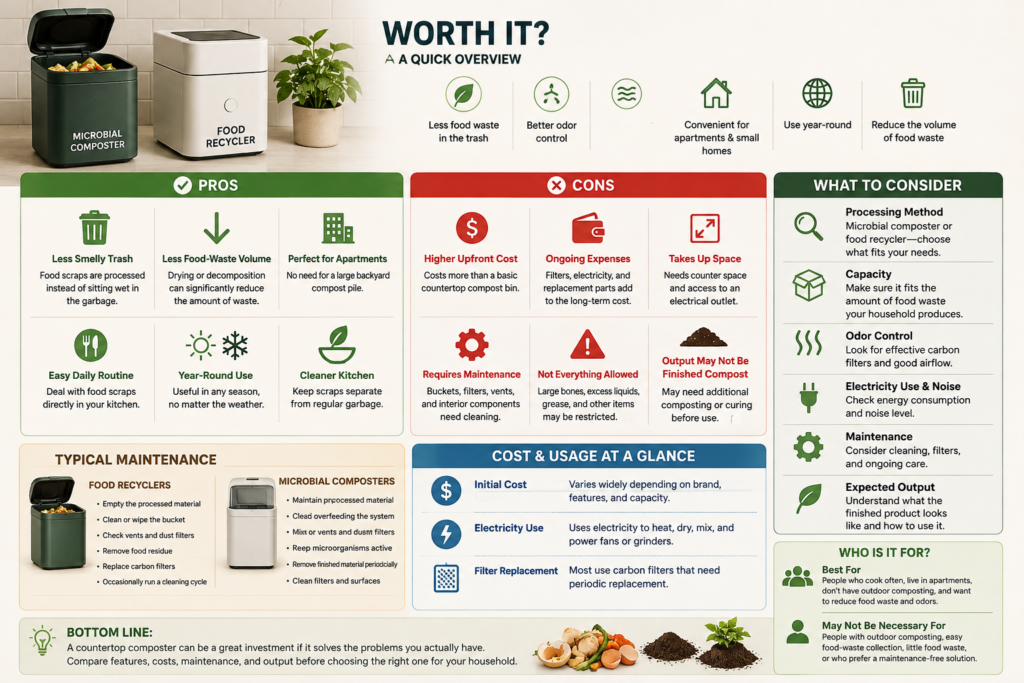
A countertop composter may be worth it if you:
- Produce food scraps regularly
- Dislike keeping food waste in the trash
- Want better odor control
- Do not have convenient outdoor composting
- Live in an apartment or small home
- Want to reduce the volume of food waste
It may be less worthwhile if you:
- Produce very little food waste
- Already have an easy outdoor composting system
- Do not want another appliance running in the kitchen
- Want to avoid replacement filters and maintenance
- Expect the machine to produce finished garden compost immediately
The Biggest Advantage: Less Food Waste Sitting in the Trash
For many households, the biggest benefit is not actually compost.
It is simply having less wet, smelly food waste sitting in the kitchen garbage.
Food recyclers remove moisture and reduce food scraps into much smaller dry material.
Microbial composters continuously break down food scraps with microorganisms.
Either approach can make dealing with everyday kitchen waste more convenient.
This can be especially useful for:
- Apartments
- Condos
- Homes without backyard composting
- Households that cook frequently
- Areas with infrequent garbage collection
- Kitchens where food-waste odor is a problem
Do Countertop Composters Smell?
A properly operating machine should generally control odors quite well.
Many countertop systems use activated carbon filters to capture odors before air leaves the appliance.
However, that does not mean every machine will remain completely odor-free forever.
Odors can develop when:
- A carbon filter needs replacing
- Food inside remains too wet
- A filter or vent becomes clogged
- The microbial balance is disturbed
- Too much food is added
- The appliance needs cleaning
You may also notice a brief smell when opening the lid.
If Your Machine Starts to Smell
Check:
- Is the carbon filter due for replacement?
- Are the vents or filters clean?
- Is there too much moisture inside?
- Have you added a large amount of strongly scented food?
- Does the machine need cleaning?
Persistent odor can often be a sign that some part of the system needs attention.
How Much Maintenance Do They Require?
Maintenance varies considerably between machines.
Food Recyclers
Typical maintenance may include:
- Emptying the processed material
- Cleaning or wiping the bucket
- Checking vents and dust filters
- Removing food residue
- Replacing carbon filters
- Occasionally running a cleaning cycle
Microbial Composters
A microbial system may also require you to:
- Maintain the proper moisture level
- Avoid overfeeding the system
- Mix or stir the contents when recommended
- Keep the microorganisms active and healthy
- Remove finished material periodically
- Clean filters and exterior surfaces
- Follow the manufacturer’s instructions for restarting the microbial culture if needed
Microbial composters can be convenient because food can often be added continuously, but they do require some attention to keep the biological system balanced.
Do You Have to Replace Filters?
Many countertop composters and food recyclers use activated carbon filters to control odors.
These filters do not last forever.
How often they need replacement depends on:
- The appliance
- How frequently you use it
- The types of food you process
- How much food waste you add
- The manufacturer’s recommended schedule
Replacement filters are an ongoing expense, so it is worth checking their price and availability before buying the appliance.
Some models may also have washable filters or other parts that require periodic cleaning.
How Much Do Countertop Composters Cost?
Countertop composters and food recyclers are generally more expensive than an ordinary kitchen compost bin.
The initial price varies widely depending on:
- Capacity
- Processing technology
- Brand
- Automatic features
- Odor-control system
- Smart functions
- Included accessories
But the purchase price is only part of the cost.
Before buying, also consider:
- Replacement filters
- Electricity
- Microbial starter material, if required
- Replacement parts
- Cleaning supplies
A less expensive appliance is not always the least expensive to own if it requires frequent replacement filters or other consumables.
Do They Use a Lot of Electricity?
Countertop composters and food recyclers are electrical appliances, so they will add some energy use to your household.
Food recyclers use electricity to heat, dry, mix, and sometimes grind food scraps.
Microbial composters may run continuously to maintain suitable temperature, airflow, and mixing conditions.
Actual electricity use varies considerably from one model to another.
If energy consumption is important to you, check the manufacturer’s specifications before purchasing rather than assuming all countertop composters use the same amount of power.
Are They Noisy?
Most countertop food-waste appliances make some noise while operating.
You may hear:
- A fan
- Grinding
- Mixing
- Motor sounds
- Occasional movement inside the container
Noise levels vary by model and by the stage of the processing cycle.
If you have an open-concept kitchen or plan to run the appliance overnight, noise may be an important feature to check before buying.
Pros of a Countertop Composter
For the right household, there are several practical advantages.
Less Smelly Kitchen Trash
Food scraps can be processed instead of sitting wet in the garbage for days.
Less Food-Waste Volume
Drying or decomposition can significantly reduce the amount of food waste you need to store or dispose of.
Convenient for Apartments
You do not need a large backyard compost pile.
Easy Daily Food-Waste Management
Instead of collecting scraps somewhere else, you can deal with them directly in the kitchen.
Useful Year-Round
Outdoor composting can be inconvenient in very cold or very hot weather. An indoor appliance can be used throughout the year.
Cleaner Kitchen Routine
A dedicated food-waste appliance can help keep scraps separate from regular household garbage.
Cons of a Countertop Composter
There are also disadvantages to consider.
Higher Upfront Cost
These appliances cost much more than a basic countertop compost bucket.
Ongoing Expenses
Filters, electricity, and other replacement materials can add to the long-term cost.
Takes Up Space
Even a countertop model needs space and access to an electrical outlet.
Requires Maintenance
Buckets, filters, vents, and interior components still need cleaning or attention.
Not Everything Can Go Inside
Large bones, excess liquids, grease, and other materials may be restricted depending on the model.
The Output May Not Be Finished Compost
This is especially important with food recyclers.
Dry food grounds or pre-compost may need additional composting or curing before being used around plants.
Who Would Benefit Most From One?
A countertop composter may make the most sense for someone who:
- Cooks frequently
- Produces a significant amount of food scraps
- Lives in an apartment or condo
- Does not have easy access to outdoor composting
- Dislikes food smells in the garbage
- Wants to reduce the volume of kitchen waste
- Is willing to perform basic maintenance
It can also be useful for households that must keep food waste indoors for several days before garbage or organics collection.
Who Might Not Need One?
You may not need a countertop composter if:
- You already have a convenient outdoor compost pile
- Your community offers easy food-waste collection
- You produce very little food waste
- You do not have room for another appliance
- You want a completely maintenance-free solution
- You are mainly buying it because you expect instant finished garden compost
In those situations, a simple compost container or municipal organics program may be enough.
So, Are Countertop Composters Worth It?
For some households, absolutely.
But the biggest value may not be producing compost.
For many people, the real benefit is convenient food-waste management—less odor, less wet garbage, and less food waste taking up space in the trash.
A countertop composter is more likely to feel worth the cost if you regularly cook at home and struggle with food scraps.
If you produce very little food waste or already have an easy composting system, the appliance may be unnecessary.
The important thing is to choose one based on the problem you actually want to solve.
Conclusion
Countertop composters and food recyclers can make dealing with kitchen scraps cleaner and more convenient, especially for people who do not have access to traditional outdoor composting.
They can reduce food-waste volume, help control odors, and keep wet scraps out of the regular trash.
However, they also require counter or floor space, electricity, cleaning, and—in many cases—replacement filters or other ongoing maintenance.
And remember that not every machine produces finished compost.
Before buying, compare the processing method, capacity, accepted foods, maintenance requirements, filter costs, energy use, and finished output.
If those features fit the way your household handles food waste, a countertop composter can be a very useful addition to the kitchen.
More in Our Countertop Composter Series
- Types of Countertop Food Composters: Microbial Composter vs Food Recycler
- What Can You Put in a Countertop Composter?
- Are Countertop Composters Worth It? Pros, Cons, Odor, Cost & Maintenance ← You are here