Introduction
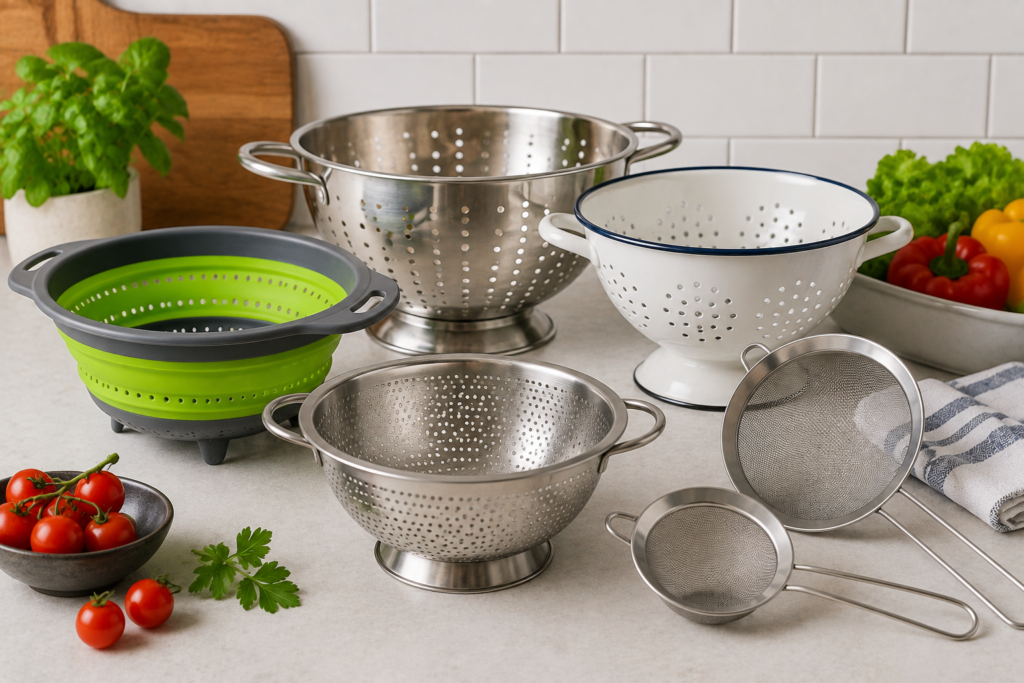
I use more than one type of strainer in my kitchen because I’ve learned that the size of the holes really matters depending on what I’m washing or draining.
For rice, I use a very fine stainless steel strainer. I like being able to rinse the rice directly under running tap water while the water drains away, and because the mesh is so fine, the rice grains don’t slip through.
For pasta, I use a more standard stainless steel strainer because the larger openings work perfectly well for draining noodles.
And when I wash leafy vegetables, I often use a salad spinner afterward to remove as much water as possible.
Over time, I’ve realized that there isn’t one strainer that is best for every job. A fine mesh, a regular strainer, and a salad spinner all solve slightly different problems.
In this article, I’ll explain the main types of colanders and strainers, what they are best used for, and how I decide which one to reach for in everyday cooking.
Colander vs Strainer: Is There Really a Difference?
The words colander and strainer are sometimes used interchangeably, and in everyday cooking, the difference may not seem very important.
Generally, a colander has larger holes and is designed for quickly draining larger amounts of food, such as pasta or washed vegetables.
A strainer usually has smaller openings or mesh and can handle foods that might slip through a colander.
In my kitchen, however, I don’t worry too much about the name. I choose the one that works best for the food I am preparing.
That has turned out to be much more practical for me.
Fine-Mesh Strainer: My Choice for Washing Rice
One of the most useful strainers in my kitchen is a very fine stainless steel strainer, especially for washing rice.
I used to rinse rice in a regular bowl. The problem came when it was time to pour out the cloudy water. If I wasn’t careful, some rice grains could escape with the water.
I didn’t like wasting rice that way.
Now I put the rice directly into my fine-mesh stainless steel strainer and rinse it under running water. The water can drain through while the small rice grains stay inside.
For me, the fine mesh isn’t just convenient. It helps me rinse rice easily without watching grains disappear down the drain.
One thing to remember is that extremely fine mesh may drain more slowly, so it isn’t necessarily the best choice for every kitchen job.
Regular Stainless Steel Strainer: What I Use for Pasta
For pasta, I don’t need such a fine mesh.
I normally use my regular stainless steel strainer. Pasta is large enough that it isn’t going to slip through the openings, and the water can drain quickly.
This is a good example of why I don’t think one strainer has to do everything.
For rice, I want very small openings. For pasta, I want fast drainage.
Choosing based on the food makes more sense to me than trying to use the same strainer for every job.
When draining very hot pasta water, I also make sure the strainer is stable and suitable for handling hot foods.
What About a Colander?
A traditional colander is especially useful when you need to drain a relatively large amount of food quickly.
It can work well for:
- pasta
- potatoes and other boiled vegetables
- washing fruits and vegetables
- draining larger foods that won’t fall through the holes
The larger holes allow water to escape quickly, but that also means a colander isn’t ideal for very small foods.
The size of the food should be one of the first things you consider when choosing between a colander and a fine strainer.
Why I Usually Prefer Stainless Steel
I own both stainless steel and plastic strainers, but I find myself reaching for stainless steel more often.
For everyday jobs such as rinsing rice and draining pasta, stainless steel works well for the way I cook.
That doesn’t mean plastic strainers are automatically a bad choice. A good plastic colander can be lightweight and easy to handle.
For me, it simply comes down to what I have become comfortable using in my own kitchen, and stainless steel is usually the one I reach for first.
Whatever the material, I think it is important to use the strainer according to the manufacturer’s instructions, particularly when dealing with very hot food or water.
Fine Mesh vs Larger Holes
If I were choosing a new strainer, hole or mesh size would be one of the first things I would look at.
Fine mesh is useful for small ingredients that could escape through larger openings.
Larger holes are better when fast drainage is more important and the food is large enough to stay inside.
A simple way to think about it is:
Small food → finer mesh
Larger food and lots of water → larger openings
That’s why having more than one type can actually be useful rather than redundant.
Where a Salad Spinner Fits In
A salad spinner does something slightly different.
When I wash leafy vegetables, simply draining them in a strainer doesn’t always remove as much water as I want.
That’s when I use my salad spinner.
After washing the vegetables, I spin them to remove more of the water clinging to the leaves.
So I don’t really think of a salad spinner as a replacement for every strainer. For me, it’s another tool for a particular job—getting excess water off leafy vegetables.
This can be especially helpful when preparing salad because excessively wet leaves can dilute dressing and make everything watery.
Do You Really Need Several Strainers?
Not necessarily.
If you cook fairly simple meals and mostly drain pasta or wash larger vegetables, one good colander or strainer may be enough.
But I have found that a couple of different types make certain jobs much easier.
My fine-mesh strainer has a clear purpose because I use it for rice. My regular stainless steel strainer works well for pasta and other everyday draining. And my salad spinner is useful when I want washed leafy vegetables to be less wet.
I don’t think the goal should be to own as many kitchen tools as possible.
The better question is whether each tool solves a problem you actually have.
How to Choose the Right Colander or Strainer
Before buying one, I would think about what you cook most often.
If you frequently rinse rice, quinoa, or other small ingredients, look for fine mesh that won’t allow the food to slip through.
If you mostly drain pasta or larger vegetables, a colander or strainer with larger openings may be more convenient because water drains quickly.
Also consider the size.
A strainer should be large enough that you aren’t trying to balance too much food inside it, but it doesn’t need to be unnecessarily large if you usually cook small portions.
Finally, think about storage. Kitchen tools are only convenient if you have somewhere practical to keep them.
FAQ
Is a colander the same as a strainer?
Not exactly. Colanders generally have larger holes and are commonly used for draining foods such as pasta, while strainers can have finer openings or mesh. In everyday cooking, however, the terms are sometimes used loosely.
What type of strainer is best for washing rice?
I prefer a fine-mesh strainer because the openings are small enough to keep the rice grains inside while the rinse water drains away.
Can I wash rice directly in a strainer?
A fine strainer designed for food preparation can make rinsing rice convenient. I rinse mine under running water and allow the water to drain through the mesh.
What is best for draining pasta?
A sturdy colander or strainer with openings small enough to hold the pasta but large enough to drain water quickly works well. Make sure it is suitable for contact with hot food and water.
Is stainless steel better than plastic?
Both can work. I personally use stainless steel more often, but the best choice depends on the quality of the product, what you are draining, how you prefer to handle it, and the manufacturer’s intended use.
Is a salad spinner the same as a strainer?
No. A strainer allows water to drain away, while a salad spinner uses spinning action to remove additional water from washed leafy vegetables.
Conclusion
I used to think of strainers as fairly simple kitchen tools, but the more I use them, the more I appreciate having the right type for the job.
For rice, my fine-mesh stainless steel strainer has become especially useful. Instead of rinsing rice in a bowl and worrying about losing grains when I pour the water away, I can rinse the rice directly in the strainer and let the water drain through.
For pasta, my regular stainless steel strainer is all I need. And for leafy vegetables, I often reach for my salad spinner when I want to remove more water after washing.
I own plastic strainers too, but stainless steel is what I personally use most often.
That doesn’t mean everyone needs several different strainers. If one works for everything you normally cook, there is no reason to fill your cabinets with more.
But if you regularly prepare foods of very different sizes, choosing the right mesh or hole size can make a surprisingly big difference.
For me, the best strainer isn’t necessarily the fanciest one. It’s the one that keeps the food where I want it while letting the water go where it should.