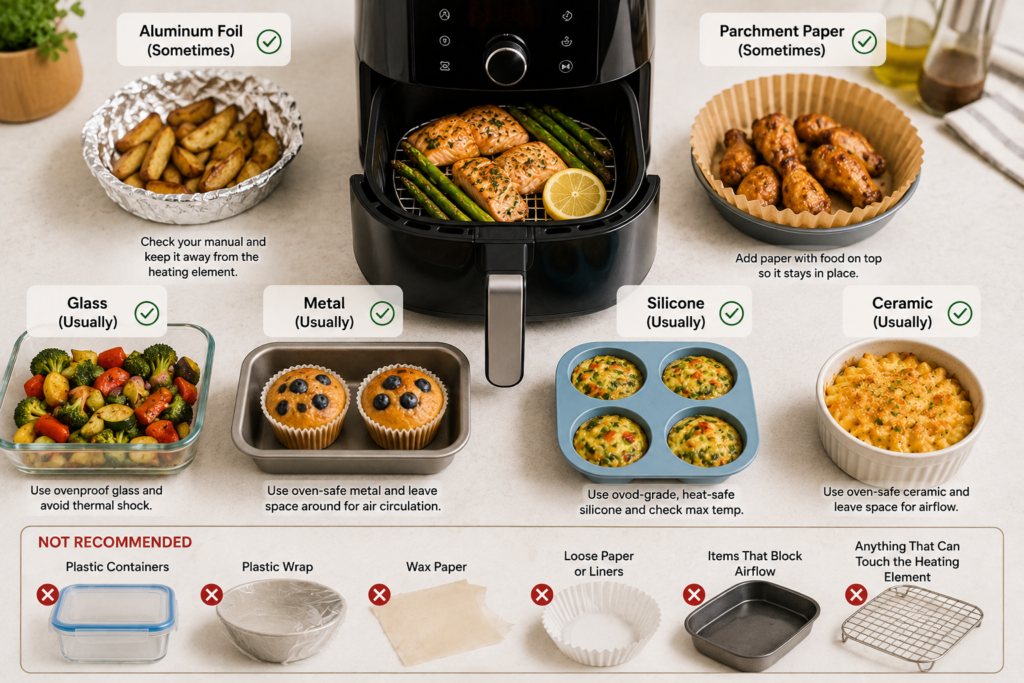
Introduction
Air fryers are convenient, but one question comes up again and again:
What can you safely put inside an air fryer?
Can you use aluminum foil? What about parchment paper, glass dishes, metal pans, silicone molds, or ceramic bowls?
The answer is often yes—but not always.
Air fryers rely on rapidly circulating hot air, so anything you place inside must be able to handle the heat without blocking airflow or touching the heating element.
And because air fryer designs differ, always check the instructions for your specific model first.
Quick Answer
| Material | Can You Use It? | Main Caution |
|---|---|---|
| Aluminum Foil | Sometimes | Check your manual and do not block airflow |
| Parchment Paper | Sometimes | Keep it weighted down with food |
| Glass | Usually, if approved for the appliance | Avoid thermal shock |
| Metal | Usually | Must be oven-safe and fit properly |
| Silicone | Usually | Use food-grade, heat-safe silicone |
| Ceramic | Usually, if oven-safe | Avoid damaged or decorative pieces |
1. Can You Put Aluminum Foil in an Air Fryer?
In many air fryers, yes—but check your model first.
Some manufacturers allow aluminum foil in the air fryer basket or drawer, while others advise against it.
If your manufacturer allows foil:
- Use only as much as necessary.
- Keep it securely underneath food.
- Do not allow loose foil to blow around.
- Do not cover vents or completely block the basket’s airflow.
- Keep foil away from the heating element.
Blocking airflow can reduce cooking performance and may cause uneven cooking.
What About Food Contact With Aluminum?
Aluminum can transfer small amounts into food during cooking. The amount depends partly on the food and cooking conditions.
Acidic or salty foods can increase transfer from aluminum cookware, so if you prefer to minimize direct contact between food and aluminum, parchment paper or an appropriate oven-safe dish may be another option.
2. Can You Put Parchment Paper in an Air Fryer?
Often yes, if your air fryer manufacturer allows it.
Parchment paper can make cleanup easier and help prevent delicate foods from sticking.
However, there is one very important rule:
Never place loose parchment paper in an air fryer during preheating unless the manufacturer specifically says it is safe.
The air fryer’s powerful fan can lift lightweight paper toward the heating element.
Instead:
- Add parchment when you add the food.
- Make sure enough food is sitting on top to hold it down.
- Do not cover more of the basket than necessary.
- Use parchment designed to tolerate the cooking temperature.
Perforated air-fryer parchment liners can help maintain airflow.
Parchment Paper Is Not the Same as Wax Paper
Do not substitute wax paper for parchment paper.
Wax paper is not designed for the high heat used in air fryers.
3. Can You Put Glass in an Air Fryer?
Sometimes—but this one requires extra care.
Some air fryer manufacturers allow ovenproof glass dishes. But not every glass container is designed for every type of high-heat appliance.
Check both:
- Your air fryer’s instructions
- The glassware manufacturer’s instructions
Do not assume that a glass food-storage container is safe simply because it looks like bakeware.
Avoid Thermal Shock
Glass can break when exposed to sudden temperature changes.
Avoid:
- Putting very cold glass directly into a hot air fryer
- Adding cold liquid to very hot glass
- Putting hot glass onto a cold or wet surface
- Using chipped, cracked, or heavily scratched glassware
Use only intact glassware that the manufacturer approves for the type of cooking you are doing.
4. Can You Put Metal in an Air Fryer?
Usually, yes.
Because an air fryer cooks with hot air rather than microwaves, many oven-safe metal pans and baking tins can be used.
Examples may include:
- Stainless steel
- Aluminum baking pans
- Small cake pans
- Loaf pans
- Metal ramekins
The pan must fit comfortably inside the air fryer without blocking circulation.
Leave space around the sides so hot air can move around the pan.
And remember: metal becomes extremely hot, so always use oven mitts when removing it.
5. Can You Put Silicone in an Air Fryer?
Food-grade, heat-safe silicone bakeware can generally be used if your air fryer manufacturer allows it.
Silicone molds are useful for foods such as:
- Muffins
- Egg bites
- Small cakes
- Baked oatmeal
- Individual desserts
Check the silicone manufacturer’s maximum temperature before using it.
Do not assume every silicone product is designed for cooking.
Use only food-grade silicone bakeware intended for high-temperature use.
Because silicone is flexible, remove hot molds carefully so food does not spill.
6. Can You Put Ceramic in an Air Fryer?
Oven-safe ceramic dishes can often be used.
Small ceramic ramekins and baking dishes are especially useful for eggs, desserts, dips, and individual portions.
As with glass, make sure the item is actually designed for cooking—not simply serving or decoration.
Avoid ceramic pieces that are:
- Cracked or chipped
- Marked “not for food use”
- Intended only for decoration
- Not rated for oven temperatures
Also make sure the dish leaves enough room around it for air to circulate.
What Should You Never Put in an Air Fryer?
Unless your specific appliance instructions say otherwise, avoid putting these items inside:
- Regular plastic containers
- Plastic lids
- Plastic wrap
- Wax paper
- Ordinary paper
- Loose lightweight liners
- Containers that are not heat-safe
- Cookware that completely blocks airflow
Also avoid using anything that can rise or shift into the heating element.
The Most Important Rule: Don’t Block the Airflow
Whether you are using foil, parchment, glass, metal, silicone, or ceramic, the same basic principle applies:
An air fryer needs moving hot air to cook properly.
A dish or liner that covers too much of the basket can interfere with circulation.
When using a baking dish or mold:
- Choose one smaller than the basket.
- Leave space around the sides.
- Keep vents unobstructed.
- Follow your air fryer’s instructions for accessories.
A Simple Safety Rule to Remember
Before putting something in your air fryer, ask three questions:
1. Does my air fryer manufacturer allow it?
2. Is the material designed to tolerate the cooking temperature?
3. Will it leave enough space for air to circulate?
If the answer to all three is yes, the item is much more likely to be appropriate for use.
Conclusion
Many common kitchen materials—including glass, metal, silicone, and ceramic—can be used in an air fryer when they are heat-safe, fit properly, and are permitted by the appliance manufacturer.
Aluminum foil and parchment paper can also be useful, but instructions vary between air fryer models. Never allow lightweight liners to move toward the heating element, and never cover the basket in a way that prevents hot air from circulating.
When in doubt, check both the air fryer manual and the cookware or liner manufacturer’s instructions before using a new material.
A few seconds of checking can help protect your appliance, your cookware, and your food.
More in Our Air Fryer Series
- Types of Air Fryers: Which One Is Right for You?
- Air Fryer Basics: How It Works, What to Cook, What to Avoid & Do You Need to Preheat?
- What Can You Put in an Air Fryer? Foil, Parchment, Glass, Metal, Silicone & Ceramic ← You are here