Introduction
Choosing the right frying pan size can make everyday cooking much easier. A pan that is too small can crowd your food and make browning difficult, while a pan that is larger than you need may be heavier and less convenient to handle.
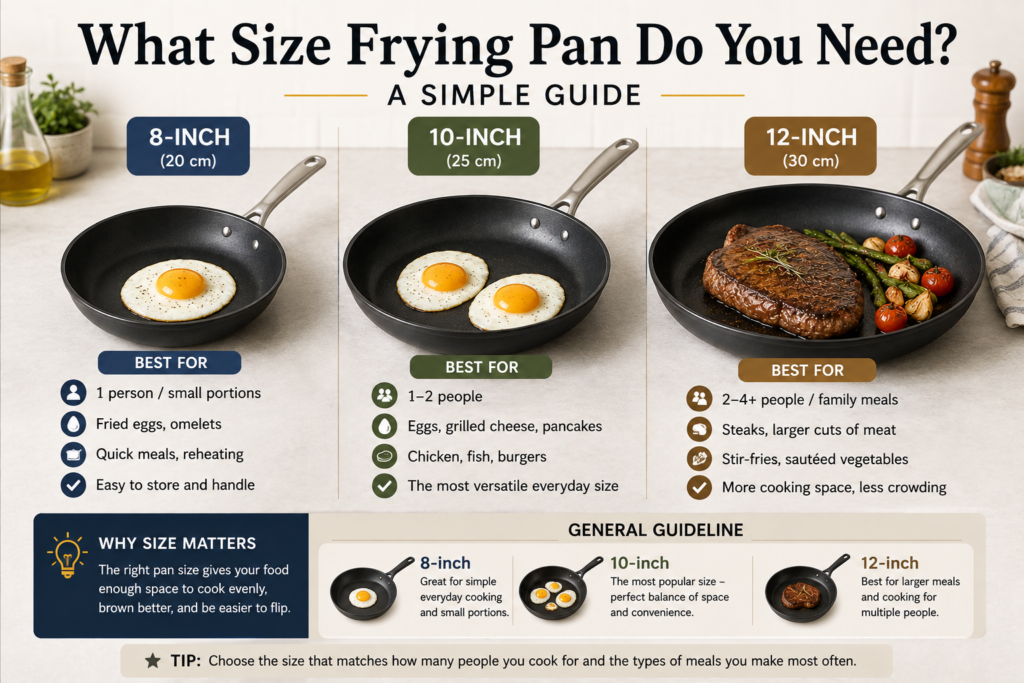
The most common frying pan sizes are around 8, 10, and 12 inches. Each size has advantages depending on how many people you cook for and the types of meals you prepare.
In this guide, we’ll compare 8-inch, 10-inch, and 12-inch frying pans to help you choose the most practical size for your kitchen.
Frying Pan Sizes: Quick Comparison
| Pan Size | Best For | Typical Use |
|---|---|---|
| 8-inch | Small portions | 1–2 eggs, small omelets, reheating |
| 10-inch | Everyday cooking | Eggs, pancakes, chicken, fish |
| 12-inch | Larger meals | Steaks, vegetables, family meals |
8-Inch Frying Pan
An 8-inch frying pan is compact, lightweight, and convenient for small portions.
It works particularly well when cooking one or two eggs, a small omelet, or other individual portions. Because of its smaller size, it is also relatively easy to store and handle.
However, the limited cooking surface can become crowded quickly. If you regularly cook larger portions or meals for several people, you may find an 8-inch pan too small.
10-Inch Frying Pan
A 10-inch frying pan offers a useful balance between cooking space and easy handling.
It provides enough room for many everyday foods without being excessively large or heavy. Eggs, pancakes, fish fillets, burgers, vegetables, and smaller cuts of meat can all fit comfortably depending on portion size.
For one or two people, a 10-inch frying pan is often a versatile everyday option.
12-Inch Frying Pan
A 12-inch frying pan provides considerably more cooking surface and is useful for larger portions.
The extra space can help when cooking steaks, several pieces of chicken, larger quantities of vegetables, or meals for multiple people. More surface area also makes it easier to avoid overcrowding when browning or sautéing food.
The trade-off is that a 12-inch pan is generally heavier and requires more storage space. The weight becomes even more noticeable with materials such as cast iron.
Why Frying Pan Size Matters
Pan size affects more than how much food fits inside.
When ingredients are packed too closely together, moisture released during cooking may have less opportunity to evaporate. This can make it more difficult to achieve good browning.
A pan with sufficient cooking space allows ingredients to spread out and make better contact with the cooking surface.
On the other hand, using a very large pan for a tiny portion may be unnecessary and can make the cookware less convenient to handle.
What Size Frying Pan Is Best for Eggs?
For one or two eggs, an 8-inch frying pan can be very convenient.
If you regularly cook several eggs, larger omelets, or breakfast for more than one person, a 10-inch pan provides additional room.
A 12-inch pan can be useful when preparing a larger breakfast or cooking several portions at once.
What Size Frying Pan Is Best for Steak?
The most important consideration when cooking steak is having enough room around the meat so the pan is not overcrowded.
A 10-inch pan may be sufficient for a single moderate-sized steak, while a 12-inch pan offers more room for a larger steak or multiple portions.
The exact size you need depends on the dimensions of the steak and the usable cooking surface of the pan.
What Size Frying Pan Is Best for a Family?
For households that frequently prepare several portions at once, a 12-inch frying pan is often the most practical of these three sizes.
Its larger cooking surface provides more room for chicken, vegetables, burgers, steaks, and other family-style meals.
Some households may still prefer a 10-inch pan for smaller meals and keep a 12-inch pan available when additional cooking space is needed.
Should You Own More Than One Frying Pan Size?
You do not necessarily need several frying pans, but having two different sizes can be convenient.
A smaller pan is useful for quick breakfasts and individual portions, while a larger pan provides the space needed for bigger meals.
For example, a 10-inch pan can serve as an everyday pan while a 12-inch pan can be used when you need additional cooking space.
How Frying Pan Size Is Measured
Frying pan sizes are generally described by the diameter across the top of the pan rather than the diameter of the flat cooking surface.
This is important because two pans labeled as the same size may have different amounts of usable cooking space depending on the shape and slope of their sides.
When comparing pans, consider both the stated diameter and the actual cooking surface.
Which Frying Pan Size Should You Choose?
Choose an 8-inch frying pan if you mainly cook small portions, one or two eggs, or individual meals.
Choose a 10-inch frying pan if you want a versatile everyday size for one or two people and a variety of foods.
Choose a 12-inch frying pan if you regularly prepare larger portions, cook for several people, or want more room for browning and sautéing.
If you are buying only one frying pan, a 10-inch or 12-inch model will generally provide more versatility than a very small pan. Your best choice ultimately depends on your household size, cooking habits, stove, and how much weight you are comfortable handling.
Frequently Asked Questions
1. What is the most useful frying pan size?
There is no single ideal size for everyone. A 10-inch pan offers a convenient balance of cooking space and handling for many everyday meals, while a 12-inch pan is more practical for larger portions and households.
2. Is an 8-inch frying pan too small?
Not necessarily. An 8-inch pan can be very useful for one or two eggs, small omelets, individual portions, and reheating small amounts of food. It may be limiting for larger meals.
3. Is a 12-inch frying pan too big for one person?
It can be larger than necessary for small meals, but it may still be useful if you frequently cook large steaks, vegetables, meal-prep portions, or dishes that benefit from extra cooking space.
4. Is a 10-inch or 12-inch frying pan better?
A 10-inch pan is generally easier to handle and works well for smaller meals. A 12-inch pan provides more cooking space and is usually more convenient when preparing several portions. The better size depends on how much food you normally cook.
5. Does frying pan size affect cooking?
Yes. A pan that is overcrowded can make browning more difficult, while sufficient cooking space allows ingredients to spread out and make better contact with the hot surface.
6. Does the material of the frying pan affect which size I should buy?
Yes. Larger pans made from heavy materials such as cast iron can become quite heavy, especially when filled with food. Weight, handle design, and ease of lifting should be considered along with diameter.
Conclusion
Choosing the right frying pan size comes down to how much food you normally cook and how you use your cookware.
An 8-inch pan is convenient for small portions and simple breakfasts. A 10-inch pan provides a versatile balance of cooking space and easy handling, while a 12-inch pan offers additional room for larger meals and multiple portions.
Rather than choosing the largest pan automatically, consider your household size, typical recipes, storage space, stove size, and the weight of the cookware.
The right frying pan should give your food enough room to cook properly while still being comfortable for you to use.
Related Frying Pan Guides
Best Frying Pan for Eggs: Which Type Should You Choose?