Introduction
Colanders and strainers are both used to separate food from liquid, so it is easy to assume they are basically the same kitchen tool.
However, they are designed for different jobs.
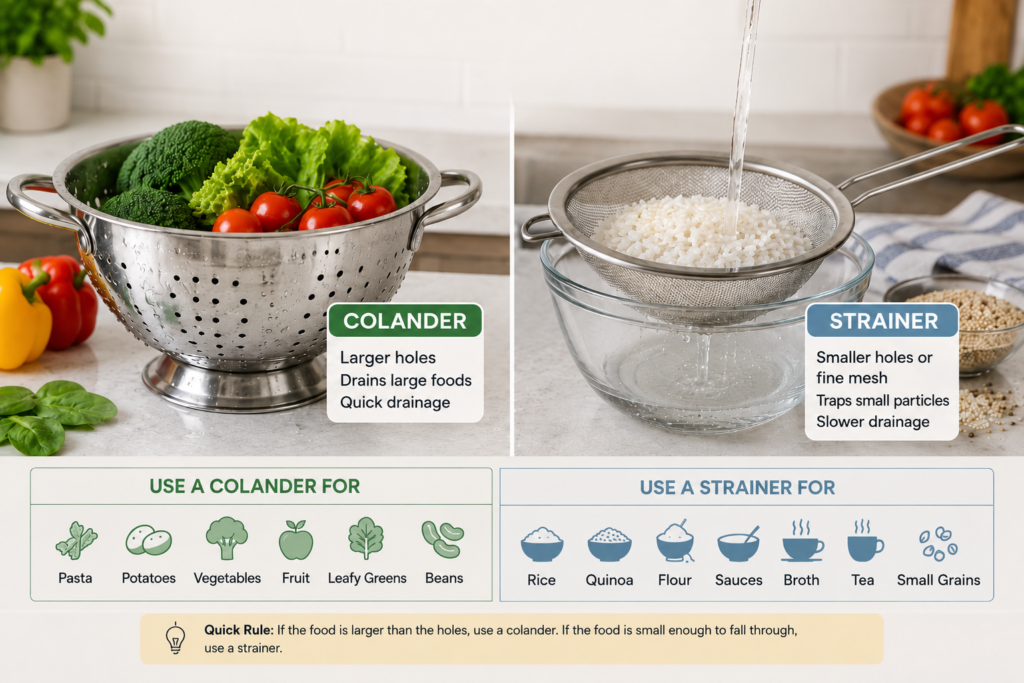
A colander usually has larger holes and is best for quickly draining foods such as pasta, potatoes, fruits, and vegetables. A strainer usually has smaller holes or fine mesh, making it better for rice, quinoa, sauces, broth, flour, and other small ingredients.
Understanding the difference can help you choose the right tool for each kitchen task.
In this guide, we’ll compare colanders and strainers, explain when to use each one, and help you decide whether you really need both.
I used the words colander and strainer almost interchangeably for years. It wasn’t until I started paying more attention to mesh size and different kitchen jobs that I realized they can be useful in different ways.
What Is a Colander?
A colander is usually a bowl-shaped kitchen tool with holes around the bottom and sides.
It is designed to drain large amounts of liquid quickly.
Common uses include:
- Draining pasta
- Washing vegetables
- Rinsing fruit
- Draining potatoes
- Rinsing beans
- Washing leafy greens
Colanders are usually larger than strainers and often have handles or a raised base.
What Is a Strainer?
A strainer usually has a mesh surface or much smaller holes.
It is designed to catch smaller particles while allowing liquid to pass through.
Common uses include:
- Rinsing rice
- Washing quinoa
- Straining broth
- Straining sauces
- Sifting flour
- Removing seeds
- Straining tea
- Draining small pasta
A fine mesh strainer is one of the most versatile types.
Colander vs Strainer: Main Differences
The biggest differences are hole size, shape, and purpose.
| Feature | Colander | Strainer |
|---|---|---|
| Hole Size | Larger | Smaller or fine mesh |
| Typical Shape | Deep bowl | Bowl or basket with handle |
| Best For | Pasta, vegetables, fruit | Rice, quinoa, sauces, flour |
| Drainage Speed | Very fast | Slower |
| Small Ingredients | May fall through | Excellent |
| Large Quantities | Excellent | Depends on size |
Which Is Better for Pasta?
For most pasta, a colander is the better choice.
Large drainage holes allow boiling water to escape quickly.
A medium or large colander also gives you enough room for a full pot of pasta.
For very small pasta shapes, a fine or medium mesh strainer may work better.
Best choice: Colander
Which Is Better for Rice?
A fine mesh strainer is usually better for rice.
Some colanders have holes large enough for grains to slip through.
Fine mesh keeps the rice inside while allowing water to drain.
Best choice: Strainer
Which Is Better for Quinoa?
Quinoa grains are very small, so a fine mesh strainer is the safest choice.
A regular colander will often have holes that are too large.
Best choice: Fine mesh strainer
Which Is Better for Vegetables?
For most vegetables, a colander works very well.
It is especially useful for washing:
- Broccoli
- Lettuce
- Spinach
- Tomatoes
- Peppers
- Potatoes
For very small herbs or chopped vegetables, a strainer may be easier.
Best choice: Colander
Which Is Better for Fruit?
A colander works well for larger fruits such as:
- Grapes
- Strawberries
- Apples
- Peaches
A fine mesh strainer may be more convenient for very small berries.
Best choice: Usually colander
Which Is Better for Flour?
A fine mesh strainer is much better for flour.
You can use it to sift flour directly into a mixing bowl.
It can also be used for:
- Cocoa powder
- Powdered sugar
- Baking soda mixtures
Best choice: Fine mesh strainer
Which Is Better for Sauces?
A fine mesh strainer is ideal for sauces.
It can remove:
- Seeds
- Pulp
- Herbs
- Small solids
This can help produce a smoother sauce.
Best choice: Fine mesh strainer
Which Is Better for Broth and Stock?
A strainer is usually better for broth or stock when you want to remove small pieces of food.
A medium or fine mesh strainer can catch:
- Herbs
- Small vegetable pieces
- Spices
- Small pieces of meat
For very large ingredients, a colander can be used first, followed by a finer strainer if necessary.
Best choice: Strainer
Which Is Better for Beans?
Both can work.
A colander is usually more convenient for larger quantities of beans because it drains quickly.
If you are rinsing very small beans or lentils, a strainer may prevent them from falling through.
Which Is Better for Washing Leafy Greens?
A large colander is usually easier.
It provides plenty of space for washing and draining lettuce, spinach, kale, and other greens.
However, if you frequently prepare salads, a salad spinner may remove water more effectively after rinsing.
Hole Size Makes the Biggest Difference
The size of the openings is one of the easiest ways to decide which tool to use.
Use a colander when the food is much larger than the holes.
Use a fine mesh strainer when ingredients are small enough that they could fall through a regular colander.
This simple rule works for most kitchen tasks.
What About Fine Mesh Strainers?
Fine mesh strainers have very small openings and are particularly useful for:
- Rice
- Quinoa
- Flour
- Powdered sugar
- Sauces
- Broth
- Tea
- Seeds
- Small grains
If you only buy one strainer, a medium-sized fine mesh version is usually the most versatile.
What Materials Are Best?
Both colanders and strainers are available in several materials.
Stainless Steel
Stainless steel is durable, heat-resistant, and easy to clean.
It is a good choice for frequent use.
Plastic
Plastic is lightweight and affordable.
It works well for washing fruits and vegetables, but check the manufacturer’s heat recommendations before draining very hot food.
Silicone
Silicone is flexible and often collapsible.
It can be useful for kitchens with limited storage space.
Does Size Matter?
Yes.
For a colander, a medium or large size is usually most useful because it can handle pasta, vegetables, and family-size meals.
For a strainer, a medium size is very versatile.
A small strainer can also be helpful for tea, citrus juice, or garnishing desserts.
Do You Really Need Both?
For most home kitchens, yes.
They perform different enough jobs that having one of each is useful.
A simple setup is enough:
- One medium or large colander
- One medium fine mesh strainer
With these two tools, you can handle most everyday draining, rinsing, and straining tasks.
What If You Only Want to Buy One?
If you cook mostly pasta and vegetables, choose a colander.
If you frequently cook rice, quinoa, sauces, or bake, a fine mesh strainer may be more useful.
However, because they serve different purposes, many people eventually find it convenient to own both.
Which One Takes Up Less Storage Space?
Strainers generally take up less room, especially small handheld versions.
Traditional colanders can be bulky.
If cabinet space is limited, consider:
- A collapsible colander
- A nesting colander set
- A strainer with a hanging loop
Which One Is Easier to Clean?
Colanders are generally easy to rinse because their holes are larger.
Fine mesh strainers can require a little more care because food particles can become trapped in the mesh.
Rinse strainers soon after use and clean both sides of the mesh.
A soft brush can help remove stuck food.
Quick Guide: Which One Should You Use?
Use a colander for:
- Pasta
- Potatoes
- Vegetables
- Large fruit
- Leafy greens
- Beans
Use a fine mesh strainer for:
- Rice
- Quinoa
- Flour
- Sauces
- Broth
- Tea
- Small grains
- Powdered sugar
FAQ
Is a colander the same as a strainer?
No. They both drain liquids, but colanders usually have larger holes, while strainers generally have smaller holes or fine mesh.
Can I use a strainer for pasta?
Yes, especially for small amounts or small pasta shapes. For a large pot of pasta, a colander is usually more convenient.
Can I use a colander for rice?
Only if the holes are small enough. A fine mesh strainer is generally safer because grains are less likely to fall through.
Which is better for washing vegetables?
A colander is usually better because it provides more space and drains water quickly.
Which is better for baking?
A fine mesh strainer is more useful for baking because it can sift flour, cocoa powder, and powdered sugar.
What type of strainer should I buy?
A medium fine mesh strainer is one of the most versatile choices for most kitchens.
Do I need more than one colander?
Usually not. One sturdy medium or large colander is enough for most everyday cooking tasks.
Conclusion
Colanders and strainers may look similar, but each is designed for a different kind of kitchen job.
Colanders are best for quickly draining larger foods such as pasta, potatoes, vegetables, and fruit.
Strainers, especially fine mesh strainers, are better for smaller ingredients such as rice and quinoa and for tasks such as sifting flour or straining sauces and broth.
For most kitchens, the simplest solution is to own one medium or large colander and one medium fine mesh strainer.
Those two tools can handle nearly every everyday draining, rinsing, and straining task without taking up too much storage space.