Introduction
Baking sheets are used in millions of kitchens every day, but you may have wondered what happens when metal or nonstick coatings are repeatedly exposed to high oven temperatures.
Can aluminum get into food?
Can stainless steel release metals?
And what happens to a nonstick coating when it gets very hot?
The short answer is that baking sheets made for food use are generally designed to be used safely when they are used according to the manufacturer’s instructions.
However, the material of the baking sheet, the temperature, the type of food, and the condition of the pan can all make a difference.
In this guide, we’ll look at aluminum, stainless steel, and nonstick baking sheets and explain how to use each one safely.
Can Baking Sheet Materials Get Into Food?
Small amounts of substances from cookware and bakeware can sometimes transfer into food.
How much transfer occurs depends on several factors, including:
- The material of the pan
- The type of food
- Cooking temperature
- Cooking time
- Whether the surface is scratched or damaged
- How long food remains in contact with the pan
This does not automatically mean that using a baking sheet is unsafe.
The important thing is to understand how each material behaves and use the pan for its intended purpose.
Are Aluminum Baking Sheets Safe?
Aluminum is one of the most popular materials for baking sheets because it is lightweight, inexpensive, and an excellent conductor of heat.
It is especially useful for cookies, roasted vegetables, and foods where even browning is important.
Small amounts of aluminum can transfer from cookware into food, particularly under certain conditions.
When Can More Aluminum Transfer Into Food?
Transfer may increase when:
- The pan is heavily worn or pitted
- Food is highly acidic
- Food is very salty
- Food remains in contact with bare aluminum for a long time
Acidic foods can include:
- Tomatoes
- Citrus fruits
- Vinegar-based foods
- Some fruit dishes
For this reason, it is a good idea not to store acidic or salty foods on a bare aluminum baking sheet for long periods.
Does Aluminum Cookware Cause Alzheimer’s Disease?
Concerns about aluminum and Alzheimer’s disease have existed for many years.
However, current evidence has not established ordinary aluminum cookware use as a cause of Alzheimer’s disease.
Rather than avoiding aluminum cookware completely, a practical approach is to use good-quality pans properly and replace pans that become severely damaged or pitted.
How to Use Aluminum Baking Sheets Safely
For everyday use:
- Follow the manufacturer’s temperature recommendations
- Avoid storing acidic or salty foods on bare aluminum
- Avoid aggressively scratching the surface
- Replace badly pitted or damaged pans
- Wash according to the manufacturer’s instructions
Discoloration alone does not necessarily mean that an aluminum baking sheet is unsafe.
Baking sheets often darken or develop marks after repeated use.
Are Stainless Steel Baking Sheets Safe?
Stainless steel is another popular option because it is strong, corrosion-resistant, and does not rely on a nonstick coating.
Stainless steel is usually made primarily from iron with chromium and, in many products, nickel.
The chromium helps create the corrosion-resistant surface that makes stainless steel durable.
Small amounts of metals can potentially transfer from stainless steel cookware into food, but normal use of good-quality stainless steel cookware is generally considered appropriate for food preparation.
What About Nickel in Stainless Steel?
Some stainless steel contains nickel.
For most people this is not a concern, but someone with a known nickel allergy or sensitivity may want to consider cookware that contains little or no nickel.
You may see stainless steel cookware labeled with numbers such as:
- 18/10
- 18/8
- 18/0
These numbers generally refer to the approximate chromium and nickel content.
For example, 18/0 stainless steel contains little or no nickel.
How to Use Stainless Steel Baking Sheets Safely
Stainless steel baking sheets are relatively low-maintenance.
For best results:
- Follow the manufacturer’s instructions
- Avoid severe scratching or damage
- Clean baked-on food rather than letting residue accumulate
- Replace severely damaged or corroded pans
- Consider nickel content if you have a known nickel allergy
Stainless steel is particularly useful when cooking acidic foods because it is less reactive than bare aluminum.
Are Nonstick Baking Sheets Safe?
Nonstick baking sheets are convenient because cookies and other foods release easily and cleanup is usually simple.
Many traditional nonstick coatings use PTFE, a fluoropolymer that provides the slippery surface.
Modern nonstick cookware intended for food contact is designed to keep the coating attached to the cookware surface during normal use.
The biggest concern with nonstick cookware is generally not routine baking but excessive heat and damage to the coating.
Why High Heat Matters With Nonstick Bakeware
Nonstick coatings should not be overheated.
Extremely high temperatures can damage the coating and may produce irritating fumes.
This is why you should:
- Never exceed the manufacturer’s recommended temperature
- Avoid heating empty nonstick cookware unnecessarily
- Avoid using damaged nonstick pans
- Keep nonstick bakeware away from broilers unless specifically approved
- Do not use nonstick bakeware during an oven self-cleaning cycle
Many nonstick products have specific maximum temperature ratings, so check the instructions that came with your pan.
What About PFAS and Nonstick Baking Sheets?
This is one of the most confusing topics for shoppers.
PFAS refers to a very large family of chemicals. PTFE, commonly used in traditional nonstick cookware, belongs to the broader PFAS family.
PFOA is another PFAS that was historically used during some nonstick manufacturing processes but has been phased out of many uses.
The presence of the word “PFAS” does not mean that every PFAS behaves in the same way.
For consumers, the practical approach is to buy cookware from reputable manufacturers, follow the temperature limits, and replace nonstick bakeware when its coating becomes badly damaged.
When Should You Replace a Nonstick Baking Sheet?
Consider replacing a nonstick pan if the coating is:
- Peeling
- Flaking
- Chipping
- Deeply scratched
- Separating from the pan
Minor cosmetic marks are different from a coating that is visibly breaking apart.
Avoid metal utensils and abrasive scrubbers if the manufacturer recommends using softer tools.
What About Silicone Baking Mats?
Silicone baking mats are usually placed on top of a metal baking sheet rather than used as the baking sheet itself.
Food-grade silicone bakeware is designed to tolerate oven temperatures within its specified temperature range.
However, silicone products also have maximum temperature limits.
Always check the manufacturer’s instructions rather than assuming that every silicone mat can tolerate the same temperature.
A silicone baking mat can be especially useful for:
- Cookies
- Pastries
- Sticky foods
- Candy
- Repeated baking where reusable liners are convenient
Keep in mind that using a silicone mat can also change how quickly the bottom of some foods browns compared with baking directly on metal.
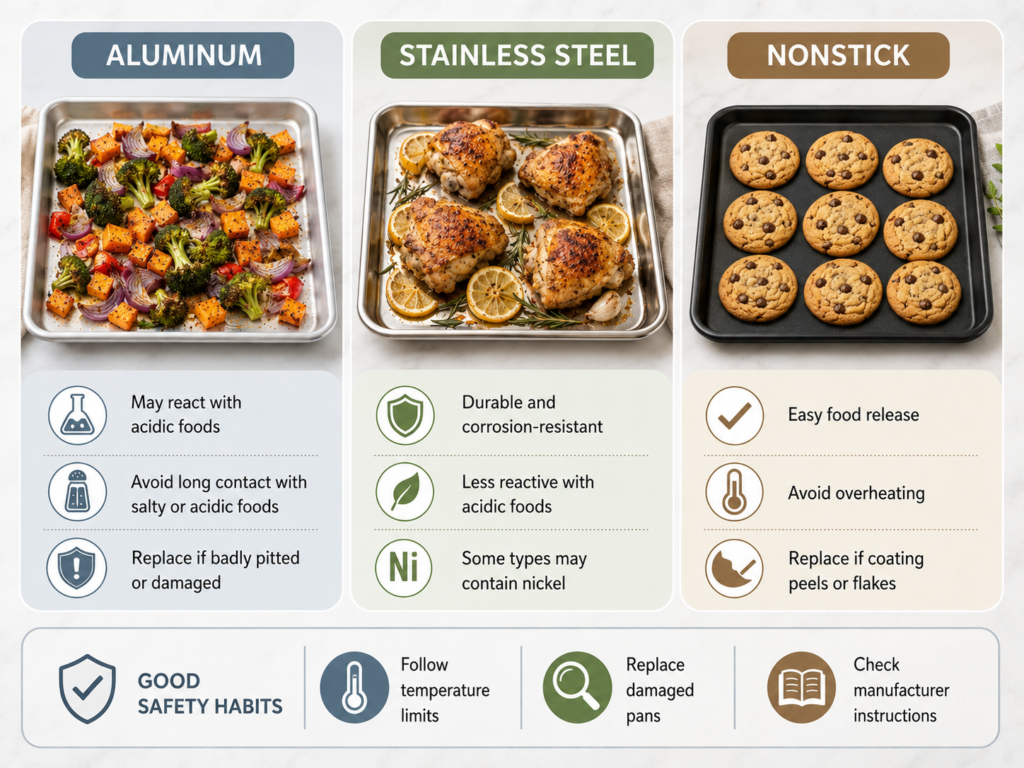
Aluminum vs Stainless Steel vs Nonstick: Which Is Safest?
There is no single material that is automatically the safest choice for every person and every recipe.
| Material | Main Safety Consideration | Good Practice |
|---|---|---|
| Aluminum | More transfer may occur with acidic or salty foods and damaged surfaces | Avoid long contact with acidic foods |
| Stainless Steel | May contain nickel | Consider nickel-free options if you have an allergy |
| Nonstick | Coating can be damaged by excessive heat or scratching | Stay within temperature limits and replace damaged pans |
For most people, all three can be useful choices when good-quality bakeware is used as intended.
Does Parchment Paper Make a Baking Sheet Safer?
Parchment paper creates a barrier between food and the surface of the baking sheet.
It can be particularly useful when:
- Baking sticky foods
- Cooking acidic ingredients on bare aluminum
- Trying to simplify cleanup
However, parchment paper also has a maximum recommended temperature.
Always check the package instructions, and never allow loose parchment paper to contact an exposed heating element.
Is a Scratched Baking Sheet Dangerous?
It depends on the material.
A few scratches on bare aluminum or stainless steel do not necessarily mean the pan must immediately be discarded.
A damaged nonstick coating deserves more attention.
If the coating is peeling, flaking, or badly damaged, replacing the baking sheet is usually the better choice.
Frequently Asked Questions
Is it safe to bake directly on aluminum?
Aluminum baking sheets are commonly used for baking. For bare aluminum, avoid prolonged contact with highly acidic or salty foods, particularly if the pan is worn or pitted.
Does aluminum leach into food while baking?
Small amounts can transfer into food. The amount can increase with acidic or salty foods and damaged aluminum surfaces.
Is stainless steel safer than aluminum for baking?
Both can be appropriate baking materials. Stainless steel is less reactive with acidic foods, while aluminum generally conducts heat more efficiently.
Are scratched nonstick baking sheets safe?
Light surface wear is different from a coating that is peeling or flaking. If a nonstick coating is badly scratched, peeling, or separating from the pan, replacing the baking sheet is a sensible choice.
Is PTFE the same as PFOA?
No. PTFE is a fluoropolymer commonly used as a nonstick coating. PFOA is a different PFAS that was historically used in some manufacturing processes.
Are silicone baking mats safe?
Food-grade silicone baking mats are intended for baking within their specified temperature range. Always follow the manufacturer’s maximum temperature recommendation.
What is the safest baking sheet for acidic foods?
Stainless steel is a useful choice for acidic foods because it is less reactive than bare aluminum. Parchment paper can also provide a barrier between food and a baking sheet when appropriate.
Conclusion
Aluminum, stainless steel, and nonstick baking sheets can all have a place in a home kitchen.
The key is using each material the way it was designed to be used.
For bare aluminum, be cautious with prolonged contact with acidic or salty foods.
For stainless steel, people with a nickel allergy may want to pay attention to the type of stainless steel they choose.
For nonstick bakeware, avoid excessive heat and replace pans with badly damaged coatings.
Most importantly, follow the manufacturer’s instructions for temperature, cleaning, and intended use.
A good baking sheet does not need to stay perfectly shiny forever—but understanding its material and caring for it properly can help you use it safely for many years.
More in Our Baking Sheets & Sheet Pans Series
Choosing a Baking Sheet & Sheet Pan
- Baking Sheet vs Sheet Pan: What’s the Difference?
- Aluminum vs Stainless Steel vs Nonstick Baking Sheets
- What Size Baking Sheet Do You Need? Half Sheet vs Quarter Sheet
Using a Baking Sheet Safely
- Can You Put a Baking Sheet in an Air Fryer?
- Can You Use a Baking Sheet on the Stovetop?
- Are Baking Sheets Safe? Aluminum, Stainless Steel & Nonstick Explained ← You are here