Introduction
A baking sheet is designed to handle high temperatures in the oven, so it may seem reasonable to assume that you can also place it directly on a stovetop.
But oven-safe does not automatically mean stovetop-safe.
Most standard baking sheets and sheet pans are designed to be heated evenly inside an oven—not directly over a gas flame, electric coil, or stovetop burner.
Using the wrong baking sheet on a stovetop can cause warping, discoloration, damage to coatings, or dangerously uneven heating.
In this guide, we’ll explain when a baking sheet can—and cannot—be used on a stovetop, how different materials react to direct heat, and what to use instead.
Can You Put a Baking Sheet Directly on a Stove Burner?
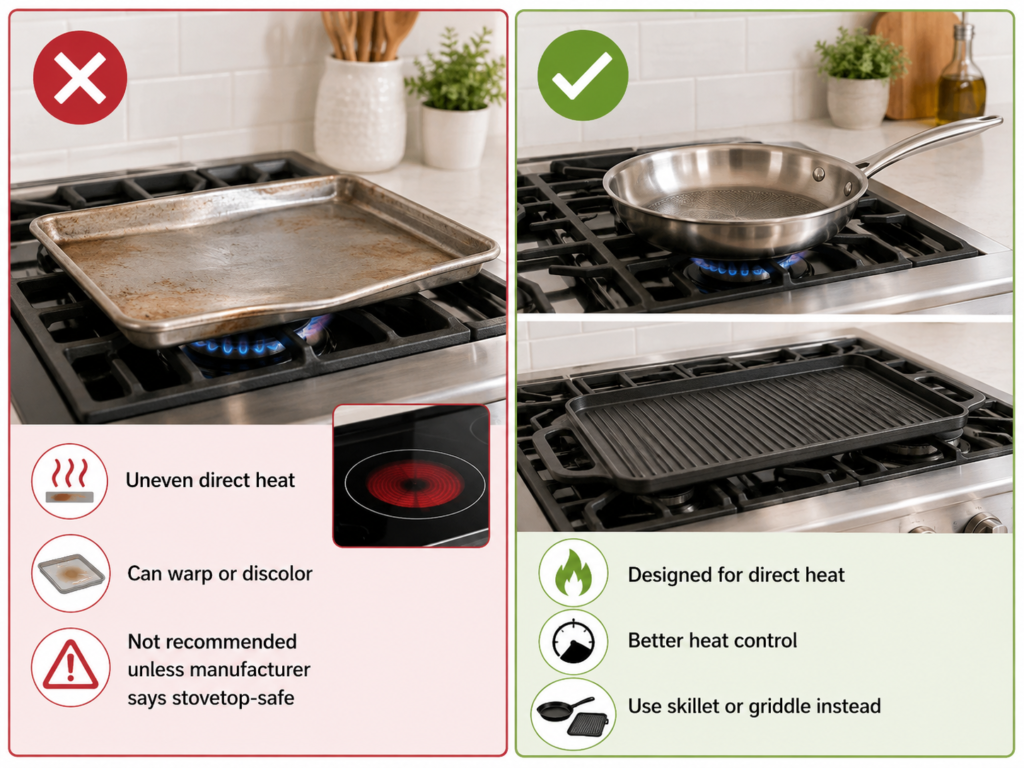
For most ordinary baking sheets, it is best not to place them directly on a stovetop burner unless the manufacturer specifically says the pan is stovetop-safe.
A stovetop concentrates heat in a relatively small area.
An oven, on the other hand, surrounds the baking sheet with hot air and heats the pan much more gradually and evenly.
That difference matters.
Direct burner heat can create extremely hot spots on one part of the baking sheet while the rest of the pan remains much cooler.
This can cause the metal to expand unevenly and potentially warp.
Why Baking Sheets Can Warp on the Stovetop
Metal expands as it heats.
Inside an oven, the entire baking sheet generally heats at a relatively similar rate.
On a stovetop, however, only the area directly above the burner may become extremely hot.
The center of the pan may expand before the surrounding metal does.
This uneven expansion can cause:
- Warping
- Twisting
- Popping or bending sounds
- Permanent changes in the shape of the pan
Thin baking sheets are particularly vulnerable.
Even a heavy-duty sheet pan can be damaged if it was not designed for direct stovetop heat.
Can You Use an Aluminum Baking Sheet on the Stovetop?
Bare aluminum conducts heat very efficiently, but that does not mean a standard aluminum baking sheet should automatically be used on a stovetop.
A burner can create concentrated hot spots that may cause a thin aluminum pan to warp.
With a gas stove, direct flame may also heat certain areas of the pan much more aggressively than others.
Unless the manufacturer specifically approves stovetop use, use an aluminum baking sheet in the oven rather than directly on a burner.
Can You Use a Stainless Steel Baking Sheet on the Stovetop?
Stainless steel is durable and resistant to high temperatures, but a stainless steel baking sheet is still not necessarily designed for stovetop cooking.
The construction of the pan matters.
A stainless steel frying pan or skillet is designed with a base that can handle direct burner heat.
A thin stainless steel baking sheet may not have that same construction.
For this reason, do not assume that a stainless steel baking sheet is stovetop-safe simply because stainless steel cookware can be used on a stove.
What About Nonstick Baking Sheets?
Nonstick baking sheets require even more caution.
Nonstick coatings are designed to be used within specific temperature limits.
A stovetop burner can create concentrated areas of very high heat that may exceed the coating manufacturer’s recommended temperature.
This is especially concerning if the pan is:
- Empty
- Heated over high heat
- Directly exposed to flame
- Scratched or damaged
Unless the manufacturer explicitly says the nonstick baking sheet can be used on a stovetop, avoid direct burner use.
Can You Put a Baking Sheet Over Two Burners?
Some people use large flat pans or griddles over two stovetop burners.
However, a regular baking sheet is not the same as a stovetop griddle.
Heating a baking sheet across two burners can create multiple hot spots while leaving cooler areas between them.
That increases the risk of uneven heating and warping.
If you want to cook over two burners, use a griddle specifically designed for stovetop use.
Can You Use a Baking Sheet on a Gas Stove?
A standard baking sheet should generally not be placed directly over a gas flame unless the manufacturer approves it for that use.
Gas flames can concentrate intense heat on a small section of the pan.
The flame may also extend around the bottom or sides of a shallow sheet pan.
For stovetop cooking, a skillet, griddle, or roasting pan specifically rated for direct heat is a safer and more reliable choice.
Can You Use a Baking Sheet on an Electric Stove?
Electric coil and smooth-top electric stoves also produce concentrated heat.
Placing a large baking sheet across an electric burner can result in uneven heating and warping.
On glass or ceramic cooktops, there is another concern: cookware should generally have a stable, appropriate base that makes proper contact with the cooking surface.
A baking sheet is not designed for this purpose.
What About Induction Cooktops?
Induction cooking requires compatible magnetic cookware.
Most aluminum baking sheets will not work on an induction cooktop unless they contain a magnetic layer.
Some stainless steel pans may be magnetic, but that still does not mean a baking sheet is suitable for induction cooking.
The pan must be specifically designed and approved for stovetop or induction use.
Is Oven-Safe the Same as Stovetop-Safe?
No.
This is one of the most important points to remember.
Oven-safe means the cookware can tolerate the temperatures and heating conditions found inside an oven.
Stovetop-safe means the cookware is designed to handle concentrated direct heat from a burner.
A pan can be perfectly safe in a 450°F oven while still being unsuitable for direct stovetop heating.
Always check the cookware manufacturer’s instructions.
What Should You Use Instead?
If you need a large cooking surface on your stovetop, use cookware designed for direct heat.
Better options include:
- A cast iron griddle
- A stovetop griddle
- A large skillet
- A sauté pan
- A stovetop-safe roasting pan
- Cookware specifically designed to span two burners
These products are built to handle concentrated burner heat.
What If a Recipe Tells You to Put a Sheet Pan on the Stove?
Occasionally, a recipe may instruct you to briefly place a roasting pan or similar cookware over a burner to make a sauce or deglaze drippings.
This does not mean every baking sheet can safely be used the same way.
Follow the cookware manufacturer’s instructions first.
If your baking sheet is not specifically rated for stovetop use, transfer the drippings or ingredients to a skillet or saucepan instead.
Frequently Asked Questions
Can you fry food on a baking sheet on the stove?
Generally, no. A standard baking sheet is not designed to function like a frying pan. Use a skillet or griddle designed for direct stovetop heat.
Can an aluminum sheet pan go on a gas stove?
Do not assume that it can. Although aluminum conducts heat well, standard aluminum sheet pans may warp under concentrated burner heat. Use it only if the manufacturer specifically approves stovetop use.
Can stainless steel baking sheets go on the stove?
Some stainless steel cookware is stovetop-safe, but a stainless steel baking sheet may not be. Check the manufacturer’s instructions rather than relying on the material alone.
Can a baking sheet go over two burners?
A regular baking sheet is not designed to function as a two-burner griddle. Use a griddle specifically designed for that purpose.
Why can a baking sheet go in a hot oven but not on a burner?
An oven heats the pan relatively evenly from the surrounding hot air. A burner concentrates intense heat in a small area, which can create hot spots and cause the pan to warp or become damaged.
Conclusion
Although baking sheets are designed to withstand high oven temperatures, most should not be used directly on a stovetop unless the manufacturer specifically says they are stovetop-safe.
Direct burner heat is very different from oven heat and can cause uneven heating, warping, discoloration, or damage to nonstick coatings.
The safest rule is simple:
Use baking sheets for the oven and cookware designed for direct heat on the stovetop.
If you need a large cooking surface over one or two burners, choose a stovetop-safe griddle, skillet, or roasting pan instead.
More in Our Baking Sheets & Sheet Pans Series
Choosing a Baking Sheet & Sheet Pan
- Baking Sheet vs Sheet Pan: What’s the Difference?
- Aluminum vs Stainless Steel vs Nonstick Baking Sheets
- What Size Baking Sheet Do You Need? Half Sheet vs Quarter Sheet
Using a Baking Sheet Safely
- Can You Put a Baking Sheet in an Air Fryer?
- Can You Use a Baking Sheet on the Stovetop? ← You are here
- Are Baking Sheets Safe? Aluminum, Stainless Steel & Nonstick Explained
Next in the series: Are Baking Sheets Safe? Aluminum, Stainless Steel & Nonstick Explained