Introduction
A stockpot is one of the most useful pieces of cookware for preparing large quantities of food.
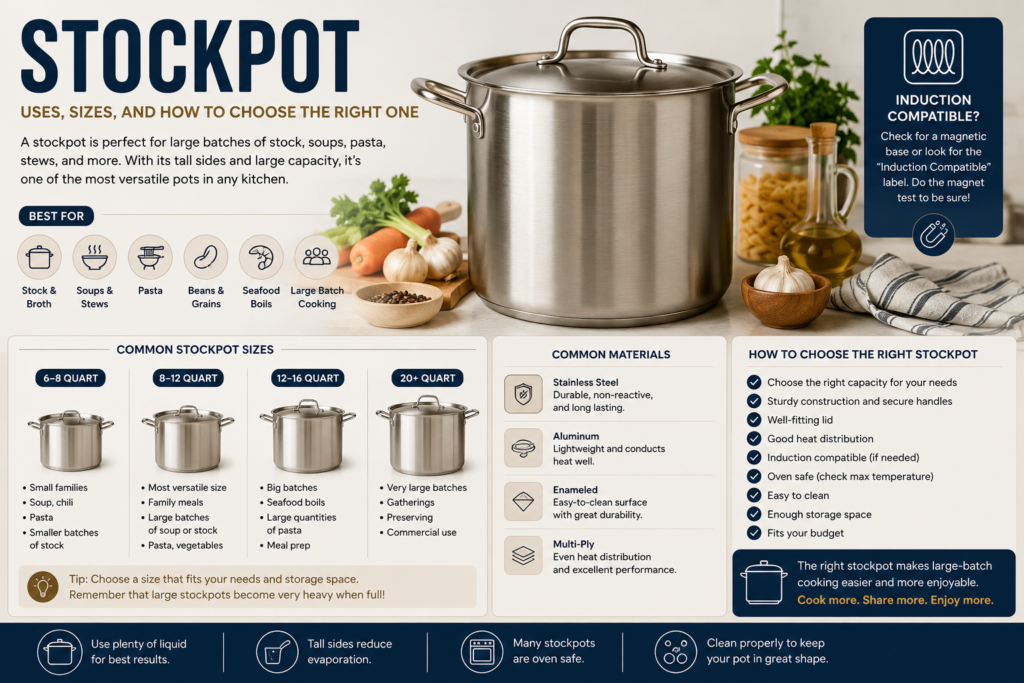
With its tall sides, large capacity, and two sturdy handles, a stockpot is designed for cooking foods that require plenty of liquid or extra space. It is commonly used for homemade stock, soups, stews, pasta, seafood, and large family meals.
Stockpots come in many sizes and materials, so choosing the right one depends on how much you cook, the foods you prepare, and the type of cooktop you use.
In this guide, we’ll look at common stockpot sizes, materials, best uses, induction compatibility, and what to consider before buying one.
What Is a Stockpot?
A stockpot is a large, deep cooking pot with tall straight sides and two handles.
Most stockpots also include a lid.
The tall shape allows the pot to hold a large amount of liquid while limiting evaporation during long cooking periods.
Traditionally, stockpots are associated with making stocks and broths, but they are useful for many other cooking tasks.
What Is a Stockpot Used For?
A stockpot can be used for:
- Chicken, beef, and vegetable stock
- Soups
- Stews
- Chili
- Pasta
- Corn on the cob
- Potatoes
- Beans
- Seafood boils
- Large quantities of vegetables
- Batch cooking
Its large capacity makes it especially useful when cooking for a family, entertaining guests, or preparing food to freeze for later.
Common Stockpot Sizes
Stockpots range from relatively compact household sizes to extremely large commercial pots.
6–8 Quart Stockpot
A 6–8 quart stockpot can be a practical choice for smaller households.
It works well for:
- Soup
- Chili
- Pasta
- Smaller batches of stock
- Boiling vegetables
This size is easier to store and handle than a very large stockpot.
8–12 Quart Stockpot
For many home kitchens, this is a versatile range.
It provides enough room for:
- Family-sized soup
- Homemade stock
- Large pasta portions
- Meal preparation
- Corn
- Beans
If you want one general-purpose stockpot, this size range is often worth considering.
12–16 Quart Stockpot
A larger stockpot is useful for people who regularly cook in large quantities.
It can handle:
- Large batches of stock
- Soup for gatherings
- Seafood boils
- Large quantities of pasta
- Batch cooking
Remember that a large stockpot becomes very heavy when filled with water or food.
20 Quarts and Larger
Very large stockpots are generally more appropriate for large gatherings, specialized cooking, preserving foods, or commercial-style quantities.
Most households do not need a pot this large for everyday cooking.
Stainless Steel Stockpot
Stainless steel is one of the most popular stockpot materials.
It is durable, corrosion resistant, and relatively easy to maintain.
Quality stainless-steel stockpots often incorporate aluminum into the base or layered construction to improve heat distribution.
Best For
- Stock
- Soup
- Pasta
- Stews
- Beans
- Boiling
- General-purpose cooking
For many households, stainless steel offers a good balance of durability and versatility.
Aluminum Stockpot
Aluminum conducts heat well and is lighter than many comparable stainless-steel pots.
This can be particularly helpful with a large stockpot because the pot will already become heavy when filled.
However, plain aluminum can react with some acidic foods. Aluminum stockpots may therefore be anodized, coated, or otherwise constructed to address this issue.
Induction compatibility also varies.
Enameled Stockpot
Some stockpots use an enamel-coated metal body.
The enamel provides a smooth cooking surface and can make the cookware attractive enough for serving as well as cooking.
However, enamel can chip if the pot is dropped or handled roughly.
Always follow the manufacturer’s care instructions.
Stockpot Material Comparison
| Material | Main Advantage | Consideration |
|---|---|---|
| Stainless Steel | Durable and versatile | Can be heavier |
| Aluminum | Lightweight and conducts heat well | Plain aluminum is not induction compatible |
| Hard-Anodized Aluminum | Durable and good heat conduction | Compatibility varies |
| Enameled Metal | Easy-care cooking surface | Enamel can chip |
| Multilayer Stainless Steel | Improved heat distribution | Usually more expensive |
Does a Stockpot Need to Be Expensive?
Not necessarily.
Stockpots are commonly used for liquid-heavy cooking, so you may not need the same sophisticated construction you might want in a frying pan used for precise browning.
However, the bottom of the pot should still distribute heat reasonably well.
Very thin cookware can develop hot spots or scorch foods during longer cooking.
Look for sturdy construction, secure handles, a reasonably substantial base, and a lid that fits properly.
Why Are Stockpots Tall?
The tall, narrow shape serves several purposes.
It provides plenty of capacity while limiting the amount of surface area exposed at the top.
This can help reduce evaporation during long cooking periods.
The tall sides are particularly useful when simmering bones, meat, vegetables, and aromatics for homemade stock.
Are Stockpots Good for Cooking Pasta?
Yes.
A stockpot is one of the best general-purpose pots for cooking larger quantities of pasta.
The large capacity provides plenty of room for water and pasta.
However, you do not necessarily need a specialized pasta pot if you already own an appropriately sized stockpot.
A pasta insert can make draining easier, but a conventional colander works perfectly well too.
Can You Make Soup in a Stockpot?
Absolutely.
Stockpots are excellent for large batches of soup.
For smaller everyday quantities, however, a medium soup pot or Dutch oven may be easier to handle.
This is why the best choice depends partly on how many people you normally cook for.
Stockpot vs Soup Pot
These two types of cookware overlap considerably.
A stockpot is generally taller and often larger. It is particularly useful for stock, large batches of soup, pasta, and high-volume cooking.
A soup pot is often somewhat shorter and more manageable for everyday quantities of soup and stew.
Neither is automatically better.
If you regularly cook large quantities, choose a stockpot. If you usually make moderate batches, a smaller soup pot may be more convenient.
Stockpot vs Dutch Oven
A stockpot and Dutch oven serve different purposes.
A stockpot is generally taller and lighter and is particularly useful when cooking with large amounts of liquid.
A Dutch oven is typically much heavier and retains heat extremely well.
Choose a stockpot for:
- Large batches of stock
- Pasta
- Soup
- Boiling
Choose a Dutch oven for:
- Braising
- Slow cooking
- Stews
- Bread
- Oven cooking
Many kitchens can benefit from having both.
Are Stockpots Induction Compatible?
Some are and some are not.
As with the saucepans and frying pans we’ve discussed, induction compatibility depends on the bottom construction, not simply the name of the cookware.
Magnetic stainless steel and cast iron generally work with induction.
Plain aluminum does not work by itself on a standard induction cooktop, although manufacturers can add a magnetic base to make an aluminum stockpot compatible.
When buying, look for Induction Compatible in the manufacturer’s specifications.
For a pot you already own, place a magnet against the bottom. If it sticks firmly, the cookware will generally work with induction.
Handles Are Especially Important
Handles matter on any cookware, but they are particularly important on a stockpot.
A large pot filled with several quarts of hot liquid can be extremely heavy.
Look for:
- Two sturdy handles
- Secure attachment
- Enough space for a comfortable grip
- A design that allows safe lifting
Always be particularly careful when moving a stockpot filled with hot liquid.
What About the Lid?
A good stockpot should normally have a well-fitting lid.
The lid helps control evaporation and retain heat during longer cooking.
Glass lids allow you to see inside the pot, while metal lids can be lighter or more durable depending on construction.
As with saucepans, the quality and fit of the lid matter more than whether it is glass or metal.
How to Choose the Right Stockpot
Before buying, consider:
- Capacity
- Diameter and height
- Material
- Weight when empty
- Handle construction
- Lid quality
- Base thickness
- Induction compatibility
- Oven-safe temperature
- Ease of cleaning
- Storage space
- Warranty
- Price
Also remember to consider the filled weight, not just how light the empty pot feels in the store.
What Size Stockpot Should You Buy?
For many home cooks, an 8–12 quart stockpot provides a useful balance between capacity and manageability.
If you cook for only one or two people, a 6–8 quart model may be sufficient.
If you frequently prepare large batches, entertain guests, or make large quantities of stock, a 12–16 quart model may be more useful.
Buying the largest pot available is not necessarily better. A very large stockpot takes more space to store and becomes difficult to handle when full.
Frequently Asked Questions
1. What size stockpot is best for home use?
For many households, approximately 8–12 quarts is a versatile range. Smaller households may prefer 6–8 quarts, while frequent batch cooking may justify a larger pot.
2. Can I use a stockpot for soup?
Yes. Stockpots are excellent for soup, particularly when preparing large quantities.
3. Can I cook pasta in a stockpot?
Yes. A stockpot is an excellent choice for larger quantities of pasta and eliminates the need for a dedicated pasta pot for many households.
4. What is the best material for a stockpot?
Stainless steel is a popular general-purpose choice because it is durable and corrosion resistant. Aluminum is lighter and conducts heat efficiently, while other constructions offer different advantages.
5. Can a stockpot be used on induction?
Yes, if it has a magnetically compatible base. Check the manufacturer’s specifications or test the bottom with a magnet.
6. Is a stockpot the same as a Dutch oven?
No. A stockpot is generally taller and lighter and is particularly suited to large amounts of liquid. A Dutch oven is heavier and better suited to braising, slow cooking, and excellent heat retention.
7. Do I need both a stockpot and a soup pot?
Not necessarily. There is considerable overlap. Choose based on the quantities you normally cook and the amount of storage space available.
Conclusion
A stockpot is a simple but extremely useful piece of cookware.
Its tall sides and generous capacity make it ideal for homemade stock, soup, pasta, beans, vegetables, seafood boils, and batch cooking.
For many households, an 8–12 quart stainless-steel stockpot is a practical starting point, but smaller or larger sizes may make more sense depending on how many people you cook for.
Pay particular attention to the handles, lid, weight, base construction, and induction compatibility.
The best stockpot isn’t necessarily the largest or most expensive one. It’s the pot that provides enough capacity for the foods you actually cook while remaining comfortable to use, clean, and store.
Related Cooking Pot Guides
Types of Cooking Pots: A Complete Guide to Choosing the Right Pot
Saucepan: Types, Uses, and How to Choose the Right One
Dutch Oven: Pros, Cons, and Best Uses
Soup Pot vs Stockpot: What’s the Difference?