Introduction
I have a set of stainless steel pots that I’ve been using for more than 20 years.
There are four pots in the set, and honestly, they still don’t feel like “old cookware” to me. I still enjoy using them, and they are some of the kitchen tools I trust most.
One reason is the weight and thickness of the stainless steel. The pots feel sturdy, hold heat well, and in my experience, food does not scorch as easily as it can in thinner cookware.
I also find them especially useful for cooking vegetables. I often don’t need to use a large amount of water, and the pots seem to hold enough steady heat to cook the food gently and evenly.
Another reason I still enjoy using them is the design.
They are very simple, and even after more than 20 years, I don’t feel tired of how they look. The pot handles, lid handles, and the rest of the cookware are all stainless steel, so the whole set has a clean, consistent design.
Simple design has aged better in my kitchen than trendy design would have.
I also like that there are fewer different materials and joints to worry about. For me, that makes the pots feel easier to clean and maintain over the long term.
That experience has shaped the way I think about cookware.
A good pot is not something I feel I need to replace just because a newer version comes out. If it still cooks well, feels good to use, and holds up over time, I would rather keep using it.
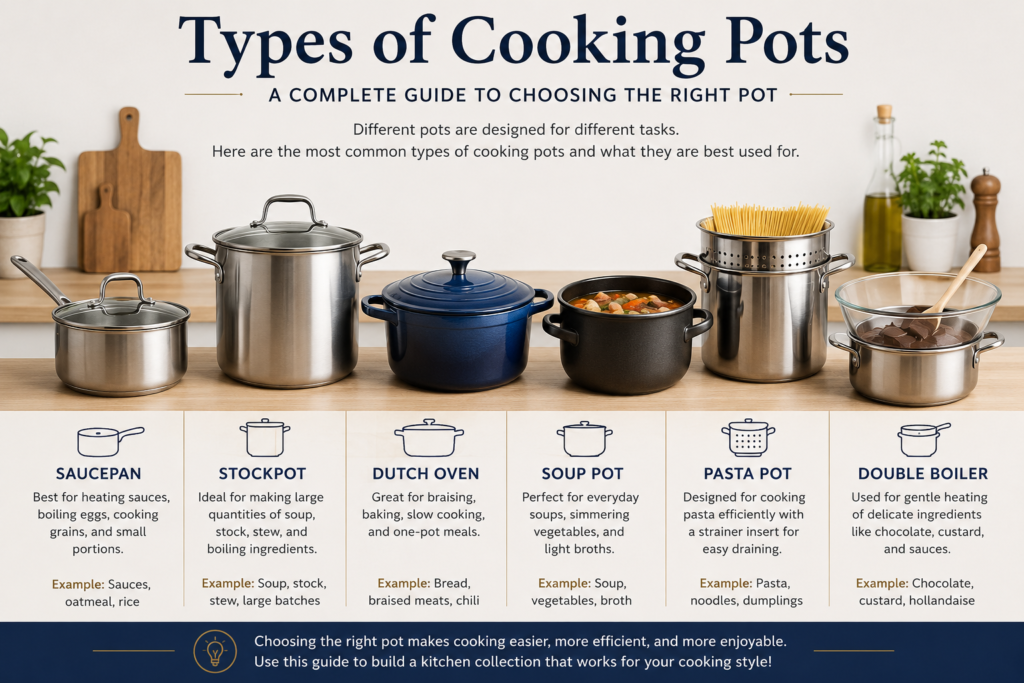
In this guide, I’ll look at the main types of cooking pots, what each one is best for, and what matters most when choosing a pot you may use for many years.
1. Saucepan
A saucepan is one of the most useful everyday pots in many kitchens.
It usually has tall sides, a long handle, and comes in smaller to medium sizes.
A saucepan is useful for:
- heating soup
- making sauces
- boiling eggs
- cooking oatmeal
- reheating small portions
- cooking grains or vegetables
For me, a smaller pot is often the one I reach for when I do not need to cook a large amount.
A pot does not need to be large to be useful. It needs to match the amount of food you normally prepare.
2. Stockpot
A stockpot is much larger and deeper than a saucepan.
It is commonly used for:
- stock and broth
- large batches of soup
- boiling pasta
- cooking for several people
- preparing foods that need plenty of liquid
A stockpot can be very useful, but it also takes up more storage space.
If you rarely cook large quantities, I would think carefully before choosing the biggest size available.
Large cookware makes sense when you actually use the extra capacity.
3. Dutch Oven
A Dutch oven is a heavy pot with thick walls and a tight-fitting lid.
It is useful for:
- braising
- stews
- soups
- slow cooking
- baking certain breads
- oven-to-table cooking
Dutch ovens can be made from cast iron, enameled cast iron, or other materials.
They hold heat well, but they can also be quite heavy.
For someone who enjoys slow cooking or one-pot meals, a Dutch oven can be extremely useful.
For someone who prefers lighter cookware, the weight may be something to consider.
4. Soup Pot
A soup pot usually falls somewhere between a saucepan and a stockpot.
It can be useful for everyday soups, stews, noodles, and other medium-size meals.
This type of pot can be a practical option for people who want more capacity than a saucepan but do not need a very large stockpot.
I think this is a good example of why size matters just as much as the name of the pot.
5. Stainless Steel Pots
Stainless steel is the material I have used most consistently over the years.
My own set has lasted more than 20 years, and I still enjoy using it.
What I like most is the combination of:
- durability
- simple design
- ease of cleaning
- sturdy construction
- long-term usefulness
My pots are also fairly thick, which I believe contributes to the way they hold and distribute heat.
In my own cooking, that steady heat makes them feel forgiving and reliable.
Of course, not every stainless steel pot is built the same way. Thickness, construction, base design, and overall quality can vary quite a bit.
6. Aluminum Pots
Aluminum cookware is usually lighter and heats quickly.
It can be useful for people who want cookware that is easy to lift and responsive to temperature changes.
Some aluminum cookware is coated or anodized, which changes how it behaves and how it should be maintained.
Compared with my stainless steel pots, aluminum generally feels lighter, but durability and cooking performance depend on the specific product.
7. Nonstick Pots
Nonstick pots can be convenient for foods that tend to stick.
They may also make cleanup easier.
However, the coating requires more careful treatment than plain stainless steel.
Metal utensils, abrasive cleaning tools, and very high heat can damage some nonstick surfaces.
For someone who values easy food release, nonstick can be useful.
For someone like me who wants cookware to last for many years, the lifespan and care requirements of the coating are things I would think about carefully.
8. Cast Iron and Enameled Cast Iron
Cast iron is excellent at holding heat, but it is much heavier than stainless steel or aluminum.
Enameled cast iron adds a protective coating and is common in Dutch ovens.
These materials can be wonderful for slow cooking and braising, but the weight is something to consider.
I have learned that a pot can cook beautifully and still not be the best fit if it feels too heavy or inconvenient for everyday use.
Why Thickness Matters to Me
One of the things I appreciate most about my old stainless steel set is the thickness of the pots.
They do not feel flimsy.
In my experience, the thicker construction helps the pot hold steady heat and makes cooking feel more predictable.
I also notice this when cooking vegetables.
I do not always need to add a large amount of water, and the vegetables still cook gently.
I would not say that every thick pot automatically performs the same way, but for the cookware I own, thickness has been one of the qualities I value most.
Why I Still Use the Same Pots After 20 Years
It comes down to a few simple things.
They still work.
They still look good to me.
They are easy to clean.
They feel sturdy in my hands.
And I know how they behave when I cook.
Familiarity matters more than I used to think.
When you have used the same pot for years, you get a sense of how quickly it heats, how it responds to lower heat, and how much water or liquid you usually need.
That kind of familiarity is one reason I do not feel much desire to replace cookware that still performs well.
Simple Design Has Lasted Well for Me
My pots have a very simple all-stainless-steel design.
The handles and lid handles are also stainless steel.
That has worked well for me because the design does not feel dated, even after many years.
I also prefer the simplicity of having fewer different materials in the construction.
For me, simple cookware is often easier to live with long term.
I do not need decorative details or trendy colors if the pot is comfortable, durable, and easy to maintain.
How Many Pots Do You Really Need?
This depends on how you cook.
Some people may only need:
- one small saucepan
- one medium pot
- one larger pot
Others may cook often enough to benefit from several sizes.
I have a set of four, and I like having different sizes available because I can choose the one that best matches the amount of food I am preparing.
I would rather have a few useful sizes that I actually use than many specialized pots that sit in storage.
What Should You Look for When Buying a Pot?
Size
Choose a size based on how much food you normally make.
Do not automatically choose the biggest pot.
Weight
A pot should feel comfortable enough to lift and move when it is full.
Construction
Look at how sturdy the pot feels, including the base and handles.
Heat Performance
A well-constructed pot should heat in a way that feels predictable and manageable for your cooking style.
Handles
Make sure the handles feel secure and comfortable.
Lid Fit
A lid that fits well can help retain heat and moisture.
Cleaning
If you plan to keep a pot for years, easy cleaning matters.
Long-Term Use
Ask yourself whether the design and construction feel like something you will still enjoy using years from now.
Is a Cookware Set Worth It?
A cookware set can be useful if the sizes included actually match the way you cook.
My own four-pot set has worked well for me because I use the different sizes.
But I would not buy a large set simply because it includes more pieces.
A smaller set of useful pots can be more practical than a large collection with pieces you rarely touch.
If you already know which sizes you use most, buying individual pots can also make sense.
Do You Need to Replace Old Pots?
Not necessarily.
Age alone is not a reason to replace cookware.
If a pot is still structurally sound, safe to use, easy to clean, and performing well, I do not see a reason to replace it just because it is old.
My own stainless steel set is more than 20 years old, and I still use it regularly.
That has taught me that good cookware can become more valuable over time because you know it so well.
FAQ
What type of pot is most useful for everyday cooking?
A medium saucepan or soup pot is very useful for many everyday tasks, but the best choice depends on how much food you normally prepare.
Is stainless steel good for long-term use?
Good-quality stainless steel cookware can be very durable. My own set has lasted more than 20 years and is still in regular use.
Are thicker pots better?
Not always, but thicker construction can help with heat retention and more even cooking. Quality depends on the overall design, not thickness alone.
Do I need a stockpot if I already have a saucepan?
Only if you regularly cook larger quantities. A stockpot is useful for big batches, while a saucepan handles smaller everyday jobs.
Is a cookware set better than buying individual pots?
It depends on whether you will actually use the included sizes. A smaller set can be very practical if every piece has a purpose.
Conclusion
After more than 20 years of using the same stainless steel pot set, I have learned that good cookware does not have to be new to feel valuable.
After using different types of cooking pots over the years, I’ve learned that durability and everyday comfort matter more to me than having the newest cookware.
My pots still work well, still look good to me, and still feel pleasant to use.
I like their thickness, their simple all-stainless-steel design, and the way they hold steady heat during everyday cooking.
I also appreciate that the design has never really felt dated.
Simple, sturdy cookware has aged very well in my kitchen.
For me, choosing a pot is not about buying the newest material or the most fashionable design.
It is about finding something that fits the way I cook, feels comfortable to use, and is built well enough that I may still enjoy using it many years from now.
If a pot works well, lasts well, and still makes cooking feel good after 20 years, that is a pretty strong sign that it was the right choice.
Our Next Cooking Pot Guides
Saucepan: Types, Uses, and How to Choose the Right One
Stockpot: Uses, Sizes, and How to Choose the Right One