Introduction
Saucepans and stockpots are two common pieces of cookware, and at first glance they can look quite similar. Both are deep cooking vessels that can be used for liquids, soups, and many everyday recipes.
However, their size, shape, handles, capacity, and best uses are quite different. A saucepan is generally designed for smaller everyday cooking tasks, while a stockpot is made for larger quantities of food and liquid.
In this guide, we’ll compare a saucepan and a stockpot, explain their main differences, and help you decide which one is better for different cooking tasks.
What Is a Saucepan?
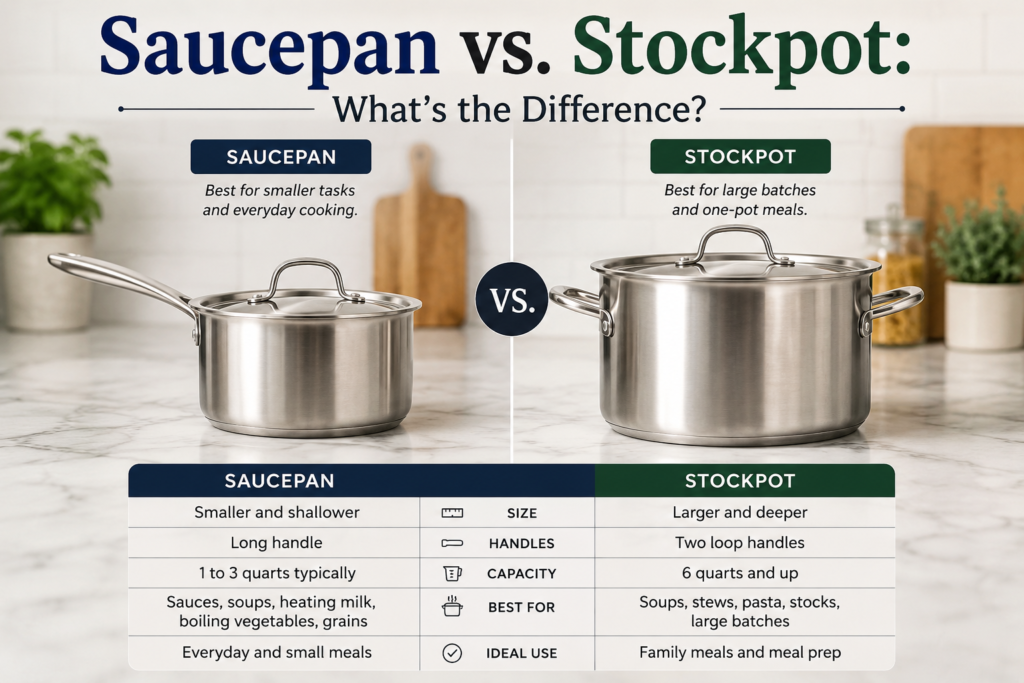
A saucepan is a relatively small, deep pan with straight or slightly rounded sides and one long handle. Most saucepans also come with a lid.
Common saucepan sizes range from about 1 to 4 quarts, although larger sizes are available.
Saucepans are useful for everyday cooking tasks such as:
- Making sauces
- Heating soup
- Cooking oatmeal
- Heating milk
- Cooking rice and other grains
- Boiling vegetables
- Making small portions of pasta
- Reheating leftovers
Because of its smaller size and long handle, a saucepan is easy to move and control while cooking.
What Is a Stockpot?
A stockpot is a large, deep pot designed to hold significantly more food and liquid than a saucepan.
Instead of one long handle, stockpots usually have two loop handles on opposite sides. This makes a large, heavy pot easier to lift with both hands.
Stockpots are commonly used for:
- Making stock or broth
- Cooking large batches of soup
- Making stews
- Boiling pasta
- Cooking corn or other large vegetables
- Preparing food for a family or group
- Batch cooking and meal preparation
Their tall sides and large capacity make stockpots particularly useful when you need to cook a large quantity of liquid.
Saucepan vs. Stockpot: Quick Comparison
| Feature | Saucepan | Stockpot |
|---|---|---|
| Size | Small to medium | Large |
| Capacity | Usually about 1–4 quarts | Often 6 quarts or larger |
| Handles | One long handle | Two loop handles |
| Best for | Small everyday cooking tasks | Large batches |
| Sauces | Excellent | Possible, but usually too large |
| Soup | Small portions | Large portions |
| Pasta | Small amounts | Large amounts |
| Stock and broth | Small batches | Excellent |
| Storage | Easier to store | Requires more space |
What Is the Main Difference Between a Saucepan and a Stockpot?
The biggest difference is capacity and intended use.
A saucepan is designed for smaller cooking jobs. Its long handle makes it convenient when stirring, pouring, or moving the pan around the stovetop.
A stockpot is designed to hold much larger quantities. Its tall sides provide plenty of room for water, broth, vegetables, pasta, or large batches of soup.
The two side handles also make more sense on a stockpot because a large pot filled with liquid can become very heavy.
Which Is Better for Making Soup?
Both can be used for soup.
A saucepan is a good choice when making one or two servings or reheating a small amount of soup.
A stockpot is more practical when making a large batch for a family, meal preparation, or freezing portions for later.
So the better choice depends mainly on how much soup you plan to make.
Which Is Better for Cooking Pasta?
For small portions, a sufficiently large saucepan can work.
However, a stockpot is generally more convenient for cooking larger quantities of pasta because it provides more room for water and allows the pasta to move while boiling.
If pasta is something you prepare regularly for several people, a stockpot can be particularly useful.
Which Is Better for Making Sauces?
A saucepan is the clear winner for most sauces.
Its smaller size makes it easier to control the temperature, stir ingredients, and reduce liquids.
A stockpot can technically be used to make sauce, but its large size is unnecessary for most recipes.
Which Is Better for Making Stock or Broth?
This is where the stockpot has the advantage.
Homemade stock often requires plenty of water along with bones, vegetables, herbs, and other ingredients. A tall stockpot provides the capacity needed to hold everything comfortably.
For a very small batch of broth, however, a saucepan can still work.
Saucepan Pros and Cons
Pros
- Convenient for everyday cooking
- Easy to handle
- Great for sauces and small portions
- Heats relatively quickly
- Easier to store
- Useful for reheating food
Cons
- Limited capacity
- Not ideal for large batches
- Can be too small for large quantities of pasta, soup, or stock
Stockpot Pros and Cons
Pros
- Large capacity
- Excellent for stocks and broths
- Great for soups and large batches
- Useful for cooking pasta
- Good for family meals and meal preparation
Cons
- Takes up more storage space
- Can become very heavy when full
- Usually unnecessary for small cooking tasks
- May take longer to heat because of its size
Do You Need Both a Saucepan and a Stockpot?
For many kitchens, having both is useful because they serve different purposes.
A saucepan handles the smaller jobs you encounter frequently, such as heating soup, cooking grains, making sauces, and reheating food.
A stockpot handles jobs that require much more capacity, including large batches of soup, pasta, homemade stock, and meals for several people.
If you have limited kitchen space and usually cook for only one or two people, a saucepan may be used more frequently.
If you regularly cook for a family, entertain guests, make homemade stock, or prepare large batches of food, adding a stockpot can be worthwhile.
How to Choose Between a Saucepan and a Stockpot
Think about what you cook most often.
Choose a saucepan if you primarily:
- Cook small meals
- Make sauces
- Heat soup or milk
- Cook rice or grains
- Reheat leftovers
- Have limited storage space
Choose a stockpot if you primarily:
- Cook for several people
- Make large batches of soup
- Prepare homemade stock or broth
- Boil large quantities of pasta
- Batch cook or meal prep
For a well-equipped kitchen, the most practical solution may be to own both in sizes appropriate for your household.
FAQ
Can I use a saucepan instead of a stockpot?
Yes, for smaller quantities. If the ingredients and liquid comfortably fit inside the saucepan without overcrowding or boiling over, it can often substitute for a stockpot.
Can I use a stockpot instead of a saucepan?
Yes, but it may not be convenient. A stockpot is much larger, so small quantities of sauces or other foods may be more difficult to cook and handle efficiently.
What size saucepan is good for everyday cooking?
A saucepan around 2 to 3 quarts is a versatile choice for many everyday tasks, although the ideal size depends on household size and cooking habits.
What size stockpot should I buy?
For many households, a stockpot in the 6- to 8-quart range can handle pasta, soups, and many larger meals. People who regularly cook large batches may prefer an even larger size.
Is a stockpot the same as a Dutch oven?
No. A stockpot is generally taller and lighter and is designed primarily for cooking larger quantities of liquid. A Dutch oven is typically heavier with thick walls and excellent heat retention, making it especially useful for braising, slow cooking, roasting, and baking.
Conclusion
A saucepan and a stockpot may look similar, but they are designed for different cooking jobs.
A saucepan is smaller, easier to handle, and ideal for everyday tasks such as sauces, grains, small portions of soup, and reheating food. A stockpot offers much greater capacity and is better suited to large batches of soup, pasta, stock, broth, and family-sized meals.
Rather than thinking of one as better than the other, consider them complementary pieces of cookware. Choosing the right one depends primarily on how much food you are preparing and the type of cooking you do most often.