Introduction
Titanium frying pans are attracting attention from home cooks looking for durable, high-performance alternatives to traditional cookware.
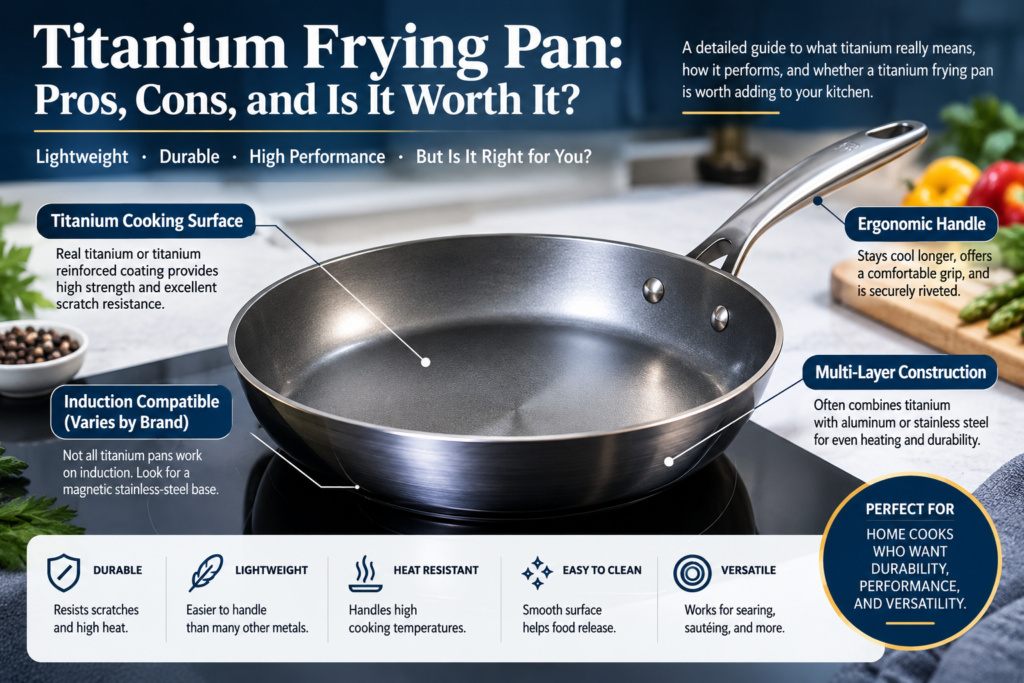
However, the term “titanium frying pan” can be confusing. It does not always mean that the entire pan is made from solid titanium. Depending on the manufacturer, titanium may be used as the cooking surface, as part of a multilayer construction, or as a material used to reinforce a nonstick coating.
Understanding these differences is important before buying.
In this guide, we’ll explain what a titanium frying pan really is, its advantages and disadvantages, induction compatibility, and whether it may be worth adding to your kitchen.
What Is a Titanium Frying Pan?
There is no single construction used for every frying pan marketed as titanium cookware.
Depending on the product, titanium may refer to:
- A titanium cooking surface
- Titanium incorporated into a multilayer pan
- A titanium-reinforced nonstick surface
- A specialized surface treatment involving titanium
This distinction matters because the cooking performance, weight, durability, maintenance requirements, and price can vary significantly.
For example, Viking’s current PureGlide Pro uses a titanium cooking surface over a three-ply construction with an aluminum core and stainless-steel exterior.
So when shopping, look beyond the word “Titanium” and check exactly how the pan is constructed.
Pros of Titanium Frying Pans
Durability
Titanium is valued for its strength and corrosion resistance.
When used as part of a properly designed cooking surface, it can provide a durable surface capable of handling regular use.
However, the durability of a particular frying pan depends on its entire construction—not simply the presence of titanium.
Corrosion Resistance
Titanium itself has excellent resistance to corrosion.
This can be an advantage in cookware, although other metals in a multilayer pan can also affect the pan’s overall care requirements.
Potential for a Lighter Pan
Titanium is known for its high strength-to-weight ratio.
Some cookware designs take advantage of this property to create durable cookware without excessive weight. However, a titanium-branded pan is not automatically lightweight because it may also contain substantial layers of aluminum or stainless steel.
High-Temperature Capability
Some titanium cooking surfaces can tolerate relatively high cooking temperatures.
For example, Viking currently rates its PureGlide Pro titanium-surface cookware as oven-safe to 600°F (315°C). That specification applies to this particular product and should not be assumed for every titanium pan.
Nonreactive Cooking Surface
Titanium itself is highly resistant to chemical reaction, which can make it useful as a cooking surface.
Again, the actual behavior of the pan depends on what material is directly contacting the food.
Cons of Titanium Frying Pans
Higher Price
Premium titanium cookware can be expensive compared with basic stainless-steel or conventional nonstick cookware.
The cost varies substantially depending on how much titanium is used and how the pan is constructed.
The Name Can Be Confusing
One of the biggest disadvantages for shoppers is that “titanium” does not describe one standardized type of frying pan.
A titanium-reinforced nonstick pan and a pan with an actual titanium cooking surface are very different products.
Not Automatically Nonstick
Titanium itself should not automatically be interpreted as a conventional nonstick coating.
Food-release performance depends on the particular surface technology and construction.
Some manufacturers design titanium surfaces specifically to provide easier food release, while others use titanium mainly for durability.
Induction Compatibility Varies
A titanium frying pan is not automatically induction compatible.
The pan needs suitable magnetic material in its construction to work with an induction cooktop.
That means induction compatibility should always be checked for the individual model.
Titanium Frying Pan vs Stainless Steel
| Feature | Titanium-Based Pan | Stainless Steel |
|---|---|---|
| Durability | Excellent depending on construction | Excellent |
| Corrosion Resistance | Excellent | Excellent |
| Weight | Can be lightweight | Usually moderate |
| Food Release | Depends on surface | Requires technique |
| High-Heat Cooking | Model dependent | Excellent |
| Induction | Model dependent | Model dependent |
| Maintenance | Depends on construction | Relatively simple |
| Price | Often premium | Wide price range |
The key point is that stainless steel is a relatively well-defined cookware category, while titanium cookware varies considerably between manufacturers.
Are Titanium Frying Pans Good for Induction?
Some are excellent for induction, while others will not work at all.
Induction cooking requires a pan with a magnetically responsive base. Titanium itself does not guarantee this.
For example, Viking’s PureGlide Pro combines its titanium cooking surface with stainless-steel construction and is specifically listed as compatible with induction, gas, electric, halogen, and ceramic cooktops.
Other titanium cookware manufacturers even sell induction compatibility as a specific version or option.
So our rule for future product recommendations will be simple:
Always check “Induction Compatible” in the manufacturer’s specifications rather than assuming that a titanium pan will work.
For a complete comparison of which frying pan materials work with induction, see our Best Frying Pans for Induction Cooktops: What You Need to Know guide.
What Can You Cook in a Titanium Frying Pan?
The answer depends on the particular surface, but suitable models can be versatile enough for:
- Eggs
- Fish
- Vegetables
- Chicken
- Steak
- Sautéing
- Browning
- Everyday frying
Always follow the manufacturer’s recommended heat range, especially when the pan incorporates a nonstick component.
A Current Titanium Frying Pan to Know
One interesting current example is Viking PureGlide Pro 3-Ply Fry Pan.
Unlike a conventional coated nonstick pan, Viking describes this cookware as using a hardened titanium cooking surface combined with an aluminum core and stainless-steel exterior.
The 10-inch model is designed for frying, searing, browning, eggs, vegetables and other everyday cooking. Viking also lists it as induction compatible and oven-safe to 600°F.
This is useful as an example of where the titanium cookware category is going, but it should not be interpreted as saying that every titanium frying pan has these same properties.
Another Type of Titanium Cookware
There are also products marketed as titanium cookware with very different construction and pricing.
For example, Titanium Cookware Inc. currently offers a German-made 10.2-inch frying pan with induction available as an option. The manufacturer positions it for foods including steaks, eggs, omelets and fried potatoes.
This illustrates why we should evaluate titanium cookware product by product instead of treating “titanium” as one uniform category.
What to Look for When Buying a Titanium Frying Pan
Before buying, check:
- What exactly is made from titanium?
- What material actually touches the food?
- Is there a nonstick coating?
- Is it PFAS-free if that matters to you?
- Is it induction compatible?
- What is the oven-safe temperature?
- How heavy is the pan?
- Can metal utensils be used?
- Is it dishwasher safe or hand-wash only?
- What warranty does the manufacturer provide?
- How does the price compare with stainless steel, carbon steel, and hybrid cookware?
These questions tell you much more than the word Titanium printed on the package.
Is a Titanium Frying Pan Worth It?
A titanium frying pan may be worth considering if you value durability, corrosion resistance, relatively light construction, or newer cooking-surface technologies.
It may be particularly interesting for someone looking for an alternative to conventional nonstick cookware.
However, titanium cookware can be expensive, and the category is not standardized. Two pans labeled “titanium” can have completely different cooking surfaces and performance characteristics.
For that reason, titanium is a category where reading the construction specifications is especially important.
If budget is your main concern, conventional stainless steel, carbon steel, cast iron, ceramic, or nonstick cookware may provide better value depending on how you cook.
Frequently Asked Questions
1. Are titanium frying pans really made of titanium?
Sometimes, but not always entirely. Titanium may be used as the cooking surface, as part of a multilayer structure, or to reinforce another type of cooking surface. Check the manufacturer’s material specifications.
2. Are titanium frying pans nonstick?
Not automatically. Some titanium cookware is engineered for easy food release, while other products use titanium primarily for durability. A titanium-reinforced nonstick coating is also different from an uncoated titanium cooking surface.
3. Can titanium frying pans be used on induction?
Some can. Induction compatibility depends on whether the pan contains an appropriate magnetic layer or base. Check the individual product specifications.
4. Is titanium better than stainless steel?
Neither material is universally better. Stainless steel is durable, versatile, and widely available. Titanium can offer excellent corrosion resistance and strength with relatively low weight, but titanium cookware varies considerably in construction and can be more expensive.
5. Can titanium frying pans handle high heat?
Some can, but the safe temperature depends on the entire pan construction. Always follow the manufacturer’s temperature limits, particularly when the pan includes a nonstick component.
6. Is a titanium frying pan worth the higher price?
It can be for cooks who specifically value its construction, durability, weight, or cooking surface. For many home cooks, however, stainless steel, carbon steel, cast iron, or conventional nonstick cookware may accomplish the same everyday cooking tasks for less money.
Conclusion
Titanium frying pans are an interesting and evolving cookware category, but the word “titanium” alone does not tell you enough about a pan.
Some products use an actual titanium cooking surface, while others incorporate titanium into multilayer construction or use it to reinforce a nonstick surface.
The best titanium pan therefore depends less on the name and more on its actual construction.
Before buying, check the cooking surface, underlying metals, induction compatibility, oven-safe temperature, care requirements, warranty, and price.
For cooks who want durable, corrosion-resistant cookware and are interested in newer cooking-surface technologies, a well-designed titanium frying pan may be worth considering.
Related Frying Pan Guides
Hybrid Frying Pan: Pros, Cons, and Is It Worth It?
Stainless Steel Frying Pan: Pros, Cons, and Best Uses