Introduction
Induction cooking is fast, responsive, and increasingly popular, but it has one important requirement: not every frying pan will work on an induction cooktop.
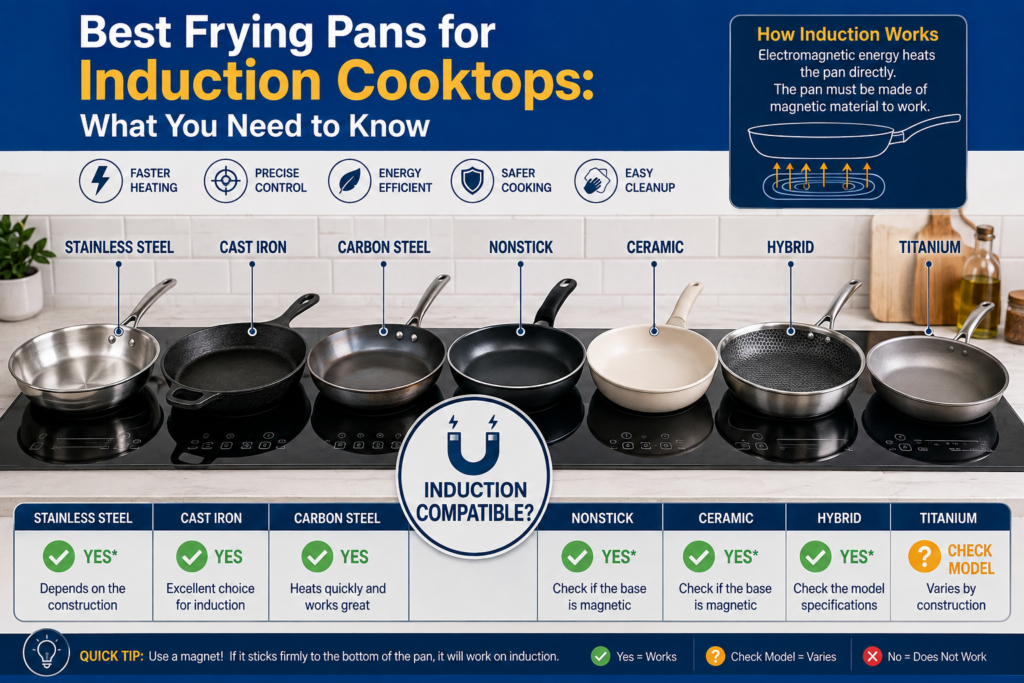
Unlike conventional gas or electric cooking, induction uses electromagnetic energy to heat compatible cookware directly. For this to work, the bottom of the frying pan must contain a magnetically responsive material.
That means the material written on the front of a frying pan—stainless steel, nonstick, ceramic, hybrid, or titanium—does not always tell you whether it will work on induction.
In this guide, we’ll explain which frying pans work with induction, how to check your existing cookware, and what to consider when choosing a new induction-compatible frying pan.
How Does an Induction Cooktop Work?
An induction cooktop creates an electromagnetic field beneath its glass surface. When compatible magnetic cookware is placed on the cooking zone, energy is transferred directly to the pan and generates heat.
Because the cookware itself is involved in generating the heat, induction requires cookware containing suitable magnetic material.
This is why a pan that works perfectly on a gas or conventional electric stove may not necessarily work on induction.
Which Frying Pans Work on Induction?
Here is a simple overview:
| Frying Pan Type | Induction Compatibility |
|---|---|
| Cast Iron | Usually Yes |
| Carbon Steel | Usually Yes |
| Stainless Steel | Depends on construction |
| Nonstick | Depends on the base |
| Ceramic-Coated | Depends on the base |
| Hybrid | Depends on the model |
| Titanium | Depends on the construction |
| Aluminum | Not by itself; needs a magnetic base |
| Copper | Not by itself; needs a magnetic base |
Cast iron, carbon steel, enameled magnetic steel, and magnetic stainless steel are commonly suitable for induction. Aluminum and copper require an added magnetic layer or compatible construction to work.
Stainless Steel Frying Pans for Induction
Stainless steel is one of the most popular choices for induction cooking, but there is an important catch:
Not every stainless steel pan is magnetic.
Some stainless-steel alloys are compatible with induction while others are not. Many modern multilayer stainless-steel pans therefore use an induction-compatible magnetic exterior or base.
Always look for an induction-compatible label or test the bottom with a magnet before buying or using the pan.
Stainless steel can be an excellent induction choice for searing, sautéing, browning, and making pan sauces.
Cast Iron Frying Pans for Induction
Cast iron is naturally well suited to induction because it contains iron and is magnetic.
It also provides excellent heat retention, making it useful for steaks, frying, and other cooking methods that benefit from steady heat.
However, cast iron is heavy. On a smooth glass induction cooktop, it is better to lift the pan rather than slide it, particularly if the bottom is rough, to reduce the risk of scratching the surface.
Carbon Steel Frying Pans for Induction
Carbon steel is another strong choice for induction cooking.
Like cast iron, it contains iron and is generally magnetic. GE specifically lists carbon steel among the cookware materials recommended for induction.
Carbon steel is usually lighter and more responsive to temperature changes than traditional cast iron, while still being capable of high-heat cooking.
It does, however, require seasoning and careful drying to help protect it from rust.
Nonstick Frying Pans for Induction
A nonstick coating by itself does not determine whether a frying pan works on induction.
What matters is the construction underneath it.
A nonstick pan with an induction-compatible magnetic stainless-steel or other ferromagnetic base can work perfectly well. A nonstick aluminum pan without a magnetic base will not.
When buying a nonstick pan for induction, check the manufacturer’s specifications rather than assuming all nonstick pans are compatible.
Ceramic Frying Pans for Induction
The same rule applies to ceramic-coated frying pans.
The ceramic coating is the cooking surface, but induction compatibility depends on the materials beneath it.
Some ceramic pans contain an induction-compatible magnetic base; others do not.
Look specifically for Induction Compatible or the induction symbol on the cookware.
Hybrid Frying Pans for Induction
Many modern hybrid frying pans are available in induction-compatible versions.
However, the word hybrid does not automatically mean induction compatible.
Different manufacturers use different constructions, so check whether the individual pan contains a suitable magnetic base.
This is especially important because hybrid cookware can combine stainless steel, aluminum, nonstick surfaces, and other materials in different ways.
Titanium Frying Pans for Induction
Titanium cookware requires the same careful checking.
The word titanium may describe a titanium cooking surface, titanium-reinforced coating, or a multilayer construction containing other metals.
Therefore, a titanium frying pan should not automatically be assumed to work on induction.
Look at the actual construction of the base and confirm that the manufacturer specifically lists the model as induction compatible.
The Easy Magnet Test
There is a very simple way to check many frying pans you already own.
Take an ordinary magnet and place it against the bottom of the pan.
If the magnet sticks firmly, the pan is generally suitable for induction.
If it does not stick, the pan will generally not work on a standard induction cooking zone. Whirlpool, GE, and Frigidaire all recommend this basic test.
You can also look on the bottom of the cookware or its packaging for an induction symbol, which often resembles a small coil or spring.
Pan Size Matters on Induction
Material isn’t the only consideration.
The size of the magnetic area on the bottom of the pan can also affect performance.
If the base is too small for a particular induction cooking zone, the cooktop may fail to detect the pan. A flat bottom with a size reasonably matched to the cooking zone generally provides better performance.
This is particularly useful to remember when buying very small frying pans.
What Should You Look for When Buying an Induction Frying Pan?
Check these features before buying:
- Induction Compatible clearly stated by the manufacturer
- A magnetic base
- A flat cooking base
- Appropriate pan size for your induction zones
- Pan material and construction
- Comfortable weight and handle
- Oven-safe temperature, if important
- Coating type, if applicable
- Cleaning and maintenance requirements
- Warranty
Don’t choose a frying pan solely because the front label says stainless steel, ceramic, hybrid, or titanium. Check the complete construction.
Which Frying Pan Is Best for Induction?
There isn’t one best choice for everyone.
Choose stainless steel if you want versatility, durability, good browning, and easy maintenance.
Choose cast iron if heat retention and powerful searing are your priorities.
Choose carbon steel if you want high-heat performance with somewhat lighter handling and quicker temperature response than cast iron.
Choose an induction-compatible nonstick or ceramic pan if eggs and delicate foods are your main priority.
Consider hybrid cookware if you want a combination of easier food release and stronger browning.
Consider titanium cookware if its particular construction and features suit your needs—but verify induction compatibility carefully.
Frequently Asked Questions
1. How do I know if my frying pan works on induction?
Check the manufacturer’s specifications or place a magnet against the bottom of the pan. If the magnet sticks firmly, the cookware is generally induction compatible.
2. Does all stainless steel work on induction?
No. Stainless steel must have suitable magnetic properties. Some stainless-steel cookware is induction compatible and some is not.
3. Can I use cast iron on an induction cooktop?
Yes. Cast iron generally works very well on induction. Because it can be heavy and rough underneath, lift rather than drag it across a glass cooking surface.
4. Can nonstick frying pans work on induction?
Yes, if the pan has a suitable magnetic base. The nonstick coating itself does not determine induction compatibility.
5. Can aluminum frying pans work on induction?
Plain aluminum is not magnetic and will not work by itself. However, an aluminum pan can be designed for induction by adding a suitable magnetic layer to its base.
6. Why won’t my induction cooktop recognize my pan?
The pan may not contain enough magnetic material, or the magnetic area of the base may be too small for the cooking zone. The structure and size of the pan base can affect whether an induction cooktop detects it properly.
Conclusion
Choosing a frying pan for an induction cooktop is easier once you understand one simple rule:
The bottom of the pan must be magnetically compatible with induction.
Cast iron and carbon steel are generally straightforward choices. Stainless steel, nonstick, ceramic, hybrid, and titanium pans require more careful checking because compatibility varies by construction.
The magnet test provides a quick way to check cookware you already own, while the manufacturer’s induction-compatible marking is the best place to start when buying a new pan.
Beyond compatibility, consider the pan’s size, weight, cooking surface, maintenance requirements, and the foods you cook most often.
The best induction frying pan isn’t simply one that works on induction—it should also fit the way you cook.
Related Frying Pan Guides
Stainless Steel Frying Pan: Pros, Cons, and Best Uses
Cast Iron Frying Pan: Pros, Cons, and Best Uses
Carbon Steel Frying Pan: Pros, Cons, and Best Uses
Nonstick Frying Pan: Pros, Cons, and Best Uses
Ceramic Frying Pan: Pros, Cons, and Best Uses
Hybrid Frying Pan: Pros, Cons, and Is It Worth It?