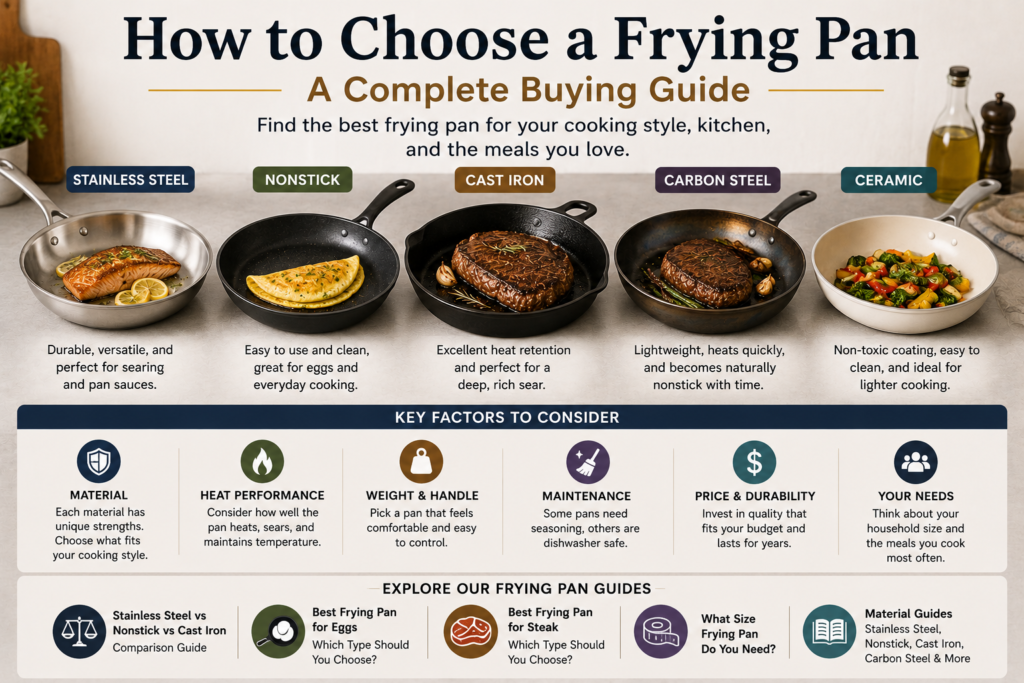
Introduction
I feel like I’ve tried almost every major type of frying pan at some point.
For many years, I mostly used nonstick pans. Then I started wondering whether there might be a better long-term choice.
I tried cast iron because I liked the idea of owning a pan without a coating that could wear out. I thought, if I take care of this properly, maybe I could use it for decades—or even pass it down someday.
I followed the care instructions and tried seasoning it, but living with cast iron was harder for me than I expected. Keeping the surface in a condition I felt comfortable with took more effort, and the weight became another issue.
Then I became interested in stainless steel and newer pans with stainless-steel or patterned cooking surfaces. I liked the idea of something durable that might reduce some of my concerns about traditional nonstick coatings.
But again, my everyday experience was different from my expectations. I struggled with food sticking to stainless steel, and eventually I stopped reaching for it.
After trying these alternatives, I recently bought another frying pan.
And what did I choose?
I went back to a regular nonstick pan.
Not because I think it is perfect, and not because cast iron or stainless steel are bad choices. I simply realized that ease of use and ease of care matter a lot in my everyday kitchen.
This guide explains the major types of frying pans, what I learned from using them, and what I now consider before choosing a pan.
1. Nonstick Frying Pans
Nonstick pans are popular for an obvious reason: food releases easily.
They can be especially convenient for foods such as:
- eggs
- pancakes
- fish
- delicate foods
- everyday sautéing
They also usually require less effort to clean than pans where food has become heavily stuck to the surface.
That convenience is ultimately what brought me back to nonstick.
After trying other materials, I realized how much I value being able to cook an everyday meal and clean the pan without turning it into another project.
But convenience does not mean the pan can be treated carelessly.
What I Learned About Caring for Nonstick
I learned this lesson from experience.
Once, I used a nonstick pan over very high heat and ended up with badly burned-on oil. I tried to clean it, but I could never get the pan back to a condition I was comfortable using.
Eventually, I stopped using it.
That experience taught me that even an easy-care pan still needs proper care.
With nonstick cookware, I now pay much more attention to avoiding unnecessary overheating. I also follow the manufacturer’s instructions for cooking temperatures, utensils, cleaning, and care.
When my son moved into college housing, I bought him two nonstick pans.
I chose them because I wanted him to have something straightforward and relatively easy to maintain for everyday cooking.
I also told him not to begin by blasting the pan over the highest heat. I showed him how I prefer to warm the pan more gently and then cook at an appropriate temperature.
A college student may not want cookware that requires a complicated maintenance routine.
For that situation, simple and manageable mattered more to me than choosing the pan that might theoretically last the longest.
2. Cast Iron: The Pan I Thought I Would Keep Forever
At one point, cast iron sounded like the perfect solution to me.
There is no traditional nonstick coating to eventually wear away, and a well-maintained cast-iron pan can potentially be used for a very long time.
That appealed to both my practical side and my desire not to keep replacing cookware.
I remember thinking:
Maybe this is the pan I could keep forever and eventually pass down.
So I bought one and tried to take care of it properly.
I seasoned it and followed the care recommendations as best I could.
But I found the maintenance more difficult than I expected.
The seasoned surface sometimes felt like it had oily residue that I wanted to clean more thoroughly, and I never became completely comfortable with the maintenance routine.
And then there was the weight.
Cast iron is heavy.
That may not bother everyone, but for everyday cooking I found myself reaching for lighter pans instead.
Interestingly, I still haven’t thrown mine away.
Part of me thinks that someday I might clean it thoroughly, season it again, and give it another chance.
Whether it actually makes it back onto my stove is another question.
3. Stainless Steel: What I Expected vs. What Happened
Stainless steel also appealed to me for a different reason.
I already have stainless steel pots that I have used successfully for many years, so the material itself was familiar to me.
I liked the durability and the idea of cooking without relying on a traditional nonstick surface.
I also became curious about newer pans with patterned or stainless-steel cooking surfaces because they looked like an interesting compromise between durability and convenience.
But when I tried cooking with stainless steel, I struggled.
Food stuck much more easily than I expected.
I know technique matters with stainless steel. Preheating, temperature control, oil, and knowing when food is ready to release can all make a difference.
But this is where I learned another important lesson about choosing cookware:
A pan can be excellent cookware and still not be the right pan for you.
I didn’t want every simple meal to become a lesson in mastering my frying pan.
Eventually, I stopped using stainless steel frying pans regularly.
4. What About Hybrid Frying Pans?
Hybrid-style frying pans have become increasingly visible and often feature a distinctive patterned cooking surface.
The idea can be appealing to someone who wants some of the convenience associated with nonstick cooking along with greater durability.
I was attracted to that idea too.
However, “hybrid” does not describe one identical construction across every brand, so it is important to check exactly what materials and coatings a particular pan uses.
I would not choose one simply because the surface looks like stainless steel.
I would look at the actual construction, manufacturer’s care instructions, heat limitations, and how the cooking surface is designed.
5. Why I Eventually Returned to Nonstick
After trying different pans, I started thinking less about which material sounded best on paper and more about which pan I actually wanted to use every day.
For me, that was nonstick.
It is lighter than my cast-iron pan.
I find it easier to cook with than stainless steel.
Cleanup is generally straightforward.
And it fits the kind of everyday meals I normally make.
That doesn’t make nonstick the universal winner.
It simply makes it the winner in my kitchen right now.
6. How Long Should a Frying Pan Last?
This depends heavily on the material and construction.
A cast-iron or good-quality stainless-steel pan can potentially last for many years when properly used and maintained.
A coated nonstick pan is different because its cooking surface can wear over time.
That is one trade-off I accept when choosing nonstick.
I pay attention to the condition of the cooking surface and follow the manufacturer’s care and replacement guidance.
I no longer expect every pan I own to last forever.
Sometimes ease of everyday use is worth more to me than maximum lifespan.
7. Does a More Expensive Pan Mean a Better Pan?
Not necessarily.
Price can reflect materials, construction, manufacturing, design, and brand, but an expensive pan is not automatically the best choice for every cook.
My cast-iron experience taught me this in a different way.
A pan can have tremendous longevity and still spend most of its life in the cabinet if you dislike lifting or maintaining it.
Value is not just how many years a pan can survive. Value is also how often you actually use it.
8. Weight Matters More Than I Expected
I used to think mostly about cooking performance when choosing pans.
Now I pay much more attention to weight.
Remember that you are not only lifting an empty pan.
Once it contains food, it becomes heavier.
If a pan already feels uncomfortable when empty, think about how it will feel when you need to move it while cooking.
My cast-iron pan taught me that durability doesn’t help much if I continually avoid using the pan because it feels too heavy.
9. Think About Maintenance Before You Buy
Different pans ask different things from their owners.
Cast iron may require seasoning and particular cleaning and drying habits.
Stainless steel may require more attention to cooking technique if you want to minimize sticking.
Nonstick is easier for me day to day, but the cooking surface needs appropriate utensils, cleaning, and temperature control.
There is no completely maintenance-free pan.
So before buying, I would ask:
What kind of maintenance am I actually willing to do?
That question might be more useful than asking which material is technically “best.”
10. How I Would Choose a Frying Pan Today
After my own trial and error, these are the things I would consider first.
What Do You Cook Most Often?
Someone who cooks eggs every morning may have different priorities from someone who frequently sears meat.
How Much Maintenance Do You Want?
Be realistic.
A pan that requires a routine you dislike may eventually stop being used.
How Heavy Is It?
Pick it up if possible.
Think about the weight after food has been added too.
What Kind of Stove Do You Have?
Not every pan works equally well on every cooktop. If you use induction, for example, make sure the specific pan is induction compatible.
How Much Storage Space Do You Have?
A pan that is difficult to store can become annoying surprisingly quickly.
How Long Do You Expect It to Last?
Durability matters, but so does actual use.
The longest-lasting pan isn’t necessarily the best value if you don’t enjoy cooking with it.
Do You Need More Than One Frying Pan?
Possibly, but I don’t think everyone needs a large collection.
Different pans can certainly be useful for different jobs.
But after trying several materials myself, I have become less interested in owning every possible type.
I would rather have a few pans that I genuinely use than several “perfect” specialty pans sitting untouched in my cabinets.
My son going to college reinforced that idea for me.
I didn’t send him off with every type of cookware.
I chose two simple nonstick pans because I thought they matched the way he was most likely to cook and care for them.
FAQ
Which frying pan is easiest to maintain?
For my cooking habits, I find nonstick the easiest for everyday use and cleanup. However, it still requires appropriate temperature control, utensils, and cleaning according to the manufacturer’s instructions.
Is cast iron worth buying?
It can be an excellent choice for someone who appreciates its heat retention, durability, and maintenance routine. I liked the idea of owning one for decades, but its weight and upkeep made it less practical for me personally.
Why does food stick to stainless steel?
Temperature, preheating, oil, moisture, and cooking technique can all affect sticking. Stainless steel can perform very well, but it may require more technique than a traditional nonstick surface.
Should I throw away a scratched nonstick pan?
Follow the manufacturer’s instructions for your specific cookware. If the cooking surface is significantly damaged, peeling, or deteriorating, I would check the manufacturer’s replacement guidance rather than continuing to use it automatically.
Are hybrid pans the same as stainless steel pans?
Not necessarily. Hybrid cookware varies by manufacturer and may combine different materials, surface patterns, and coatings. Check the construction of the specific product rather than relying on the word “hybrid.”
What is the best frying pan for a college student?
There isn’t one answer for everyone. When my son moved into college housing, I chose two nonstick pans because I wanted something straightforward and easy for him to manage. Whatever the material, safe handling and following the manufacturer’s care instructions are important.
Conclusion
After trying nonstick, cast iron, stainless steel, and other frying-pan designs, I have stopped looking for one material that is objectively best for everyone.
Cast iron appealed to me because I imagined keeping it for decades. But I found the weight and maintenance difficult enough that mine eventually ended up in storage.
Stainless steel appealed to me because of its durability, but I struggled with food sticking and didn’t enjoy having to think so much about technique during everyday cooking.
And so, after all that experimenting, I ended up back where I started: with a nonstick frying pan.
The difference is that I now understand its trade-offs much better.
I pay more attention to heat, I try not to overheat the pan, I take care of the cooking surface, and I accept that a coated pan may eventually need to be replaced.
I made a similar choice when buying frying pans for my son before he moved into college housing. I chose what I believed he would realistically use and maintain, rather than what sounded best in theory.
That may be the biggest thing all these pans have taught me.
Don’t choose a frying pan only by asking which material is supposed to be the best. Choose the one whose cooking style, weight, maintenance, and limitations fit the way you actually live and cook.
For me, right now, that means nonstick.
Related Frying Pan Guides
Stainless Steel Frying Pan: Pros, Cons, and Best Uses
Nonstick Frying Pan: Pros, Cons, and Best Uses
Cast Iron Frying Pan: Pros, Cons, and Best Uses
Carbon Steel Frying Pan: Pros, Cons, and Best Uses
Ceramic Frying Pan: Pros, Cons, and Best Uses
Stainless Steel vs Nonstick vs Cast Iron Frying Pans
Carbon Steel vs Cast Iron Frying Pan: Which Is Better?
Ceramic vs Nonstick Frying Pan: Which Is Better?
Best Frying Pan for Eggs: Which Type Should You Choose?