Introduction
A saucepan is one of the most useful pieces of cookware in almost any kitchen.
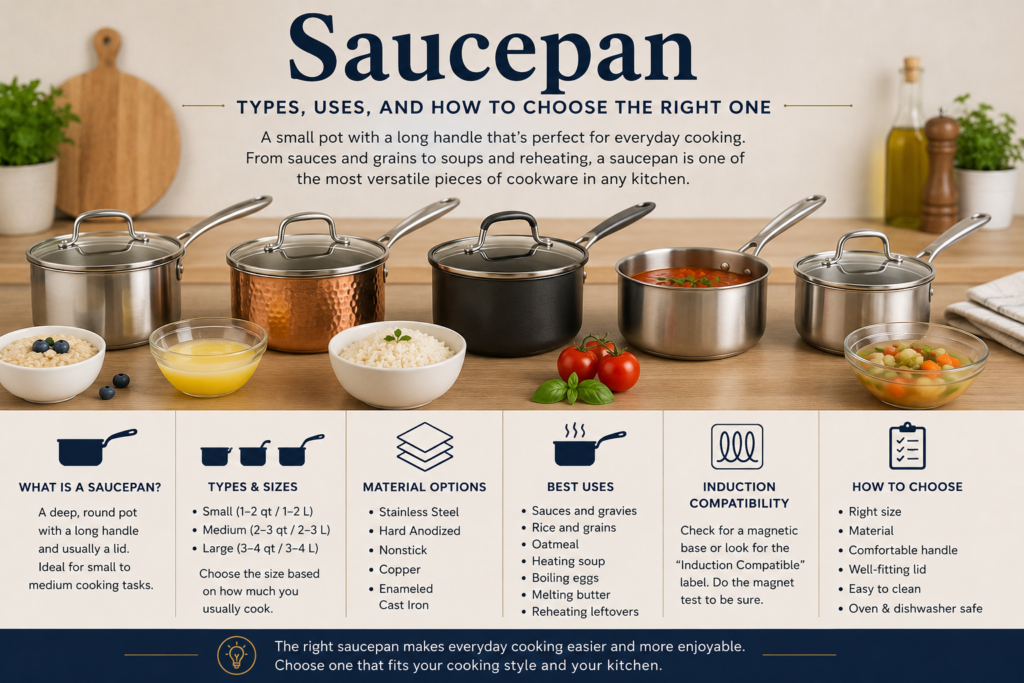
With its deep sides, relatively small cooking surface, and long handle, a saucepan is designed for everyday tasks such as making sauces, cooking rice, heating soup, boiling eggs, and reheating leftovers.
Saucepans come in different sizes and materials, and choosing the right one depends on what you cook, how many people you usually cook for, and the type of cooktop you use.
In this guide, we’ll look at the most common saucepan sizes and materials, their best uses, induction compatibility, and what to consider before buying one.
What Is a Saucepan?
A saucepan is a relatively deep, round cooking vessel that usually has one long handle and often comes with a lid.
Its tall sides help contain liquids and reduce splashing, while the long handle makes it easy to lift, pour, and move around the stovetop.
Saucepans are generally smaller than stockpots and are designed primarily for small to medium cooking tasks.
They are particularly useful for foods that require simmering, boiling, stirring, or gentle heating.
Common Saucepan Sizes
Saucepans are available in several sizes. The exact capacity varies by manufacturer, but these are common choices.
1–2 Quart Saucepan
A small saucepan is useful for:
- Heating a small amount of sauce
- Melting butter
- Boiling a few eggs
- Making oatmeal
- Heating milk
- Reheating small portions
This size can be especially convenient for one or two people.
2–3 Quart Saucepan
A medium saucepan is one of the most versatile sizes for everyday cooking.
It works well for:
- Rice and grains
- Sauces
- Soup
- Vegetables
- Small portions of pasta
- Oatmeal
- Reheating leftovers
If you plan to own only one saucepan, a medium size is often a practical place to start.
3–4 Quart Saucepan
A larger saucepan provides more room for family-sized portions.
It can be useful for:
- Larger quantities of rice
- Soup
- Pasta
- Potatoes
- Vegetables
- Sauces for several people
At this size, a saucepan begins to overlap somewhat with smaller soup pots.
Stainless Steel Saucepan
Stainless steel is one of the most common saucepan materials.
It is durable, resistant to corrosion, and suitable for many everyday cooking tasks.
Many stainless-steel saucepans use an aluminum or copper layer within the base or body to improve heat distribution.
Best For
- Sauces
- Soup
- Pasta
- Vegetables
- Rice and grains
- Boiling
- Everyday cooking
Stainless steel is a particularly good choice for someone looking for a versatile saucepan that can last for many years with proper care.
Nonstick Saucepan
A nonstick saucepan can be convenient for foods that tend to stick or leave difficult residue.
It may also require less oil and can make cleanup easier.
Best For
- Oatmeal
- Porridge
- Some sauces
- Rice
- Reheating food
- Sticky or delicate foods
However, nonstick surfaces generally require more careful handling than uncoated stainless steel.
Avoid excessive heat and follow the manufacturer’s recommendations regarding utensils and cleaning.
Hard-Anodized Aluminum Saucepan
Hard-anodized aluminum cookware is made from aluminum that has undergone an electrochemical process to create a harder surface.
These saucepans are generally relatively lightweight and provide good heat conduction.
Some models also have a nonstick cooking surface.
Best For
- Everyday cooking
- Sauces
- Rice
- Soup
- Vegetables
- Reheating
Induction compatibility varies, so check the individual product before purchasing.
Copper Saucepan
Copper is known for excellent heat conductivity and quick temperature response.
This makes copper cookware particularly useful when precise temperature control is important.
Because copper can react with certain foods, copper saucepans are commonly lined with another cooking surface such as stainless steel.
Best For
- Delicate sauces
- Temperature-sensitive cooking
- Custards
- Caramel
- Tasks requiring precise heat control
Copper cookware is generally more expensive and may require additional exterior maintenance.
Enameled Cast Iron Saucepan
Enameled cast iron saucepans combine excellent heat retention with a protective enamel surface.
They tend to be considerably heavier than stainless-steel or aluminum saucepans.
Best For
- Slow simmering
- Sauces
- Soup
- Beans
- Stews
- Foods requiring steady heat
The enamel eliminates the seasoning requirements associated with traditional bare cast iron, although care is still needed to protect the enamel surface from damage.
Saucepan Material Comparison
| Material | Main Advantage | Consideration |
|---|---|---|
| Stainless Steel | Durable and versatile | Quality of construction matters |
| Nonstick | Easy food release and cleanup | Coating requires care |
| Hard-Anodized Aluminum | Lightweight and good heat conduction | Induction varies by model |
| Copper | Excellent temperature control | Expensive and may need maintenance |
| Enameled Cast Iron | Excellent heat retention | Heavy |
There is no single best material for everyone.
The right choice depends on the foods you cook and the characteristics you value most.
What Can You Cook in a Saucepan?
A saucepan can handle an impressive range of everyday foods.
Common uses include:
- Sauces and gravies
- Rice
- Quinoa and other grains
- Oatmeal
- Soup
- Vegetables
- Boiled eggs
- Small portions of pasta
- Potatoes
- Custards
- Melting butter
- Heating milk
- Reheating leftovers
This versatility is why a saucepan is often one of the first pieces of cookware worth buying for a new kitchen.
Are Saucepans Good for Induction?
A saucepan can work very well on an induction cooktop, but induction compatibility depends on the construction of the pot.
Cast iron and magnetic stainless steel are generally compatible with induction.
Plain aluminum and copper are not magnetic, but manufacturers can make cookware containing these materials induction compatible by adding a suitable magnetic base.
The easiest quick test for cookware you already own is to place a magnet against the bottom.
If the magnet sticks firmly, the saucepan will generally work with induction.
When purchasing a new saucepan, however, check for an Induction Compatible label or the manufacturer’s specifications.
Should a Saucepan Have a Lid?
For most people, yes.
A well-fitting lid makes a saucepan considerably more versatile.
A lid helps:
- Retain heat
- Reduce evaporation
- Bring liquids to temperature efficiently
- Simmer foods
- Cook rice and grains
- Keep food warm
A glass lid allows you to see the food without lifting the lid, while a metal lid may be lighter or more durable depending on its construction.
Neither is automatically better—the quality and fit of the lid matter more.
What Kind of Handle Is Best?
Because saucepans typically have one long handle, handle design is particularly important.
Look for a handle that:
- Feels secure
- Is comfortable to grip
- Provides good balance
- Is firmly attached
- Does not become excessively hot during normal stovetop use
Some larger saucepans also include a small helper handle on the opposite side.
A helper handle can be useful when the saucepan is full of water or heavy food.
Saucepan vs Stockpot
A saucepan and a stockpot serve somewhat different purposes.
A saucepan is generally smaller and has one long handle. It is designed for everyday small and medium cooking tasks.
A stockpot is much larger and usually has two short side handles. Its tall body and large capacity make it better suited for stock, large batches of soup, pasta, and other high-volume cooking.
If you regularly cook both small and large quantities, having one of each can be useful.
Saucepan vs Sauté Pan
These two pieces of cookware can also be confused.
A saucepan is relatively deep with a smaller cooking surface.
A sauté pan is wider and shallower, providing more surface area for browning and sautéing.
Choose a saucepan when liquids, boiling, and simmering are the priority.
Choose a sauté pan when browning and a larger cooking surface are more important.
How to Choose the Right Saucepan
Before buying a saucepan, consider:
- Size
- Material
- Weight
- Handle comfort
- Lid quality
- Heat distribution
- Induction compatibility
- Oven-safe temperature
- Dishwasher compatibility
- Ease of cleaning
- Warranty
- Price
Most importantly, think about what you actually cook.
A beautiful saucepan that is too large, too heavy, or poorly suited to your cooktop may be less useful than a simpler pan that fits your everyday cooking habits.
Do You Need More Than One Saucepan?
Not necessarily.
For many households, one good 2–3 quart saucepan can handle a large percentage of everyday tasks.
If you cook frequently, however, having two sizes can be useful.
For example:
Small saucepan: sauces, oatmeal, butter, eggs, and small portions.
Medium or large saucepan: rice, vegetables, soup, pasta, and family-sized portions.
Start with the size you will use most frequently and add another only when you find that you genuinely need it.
Frequently Asked Questions
1. What size saucepan is best for everyday cooking?
For many households, a saucepan around 2–3 quarts provides a useful balance between capacity and convenience.
2. What is the best material for a saucepan?
There is no universal best material. Stainless steel is durable and versatile, nonstick can simplify cleanup, copper offers excellent temperature control, and enameled cast iron provides excellent heat retention.
3. Can I cook pasta in a saucepan?
Yes. A sufficiently large saucepan works well for smaller portions of pasta. For large quantities, a stockpot or pasta pot is usually more convenient.
4. Can I fry food in a saucepan?
Some shallow frying is possible, but a frying pan or sauté pan generally provides more surface area and easier access to the food.
5. Can a saucepan go in the oven?
Some can, but oven safety depends on the saucepan’s body, handle, lid, coating, and manufacturer specifications. Always check the maximum oven-safe temperature before use.
6. Can I use a saucepan on induction?
Yes, if the saucepan has an induction-compatible magnetic base. Check the manufacturer’s specifications or test the bottom with a magnet.
7. Is an expensive saucepan necessary?
Not necessarily. Construction quality, heat distribution, handle comfort, durability, and compatibility with your cooktop are more important than price alone.
Conclusion
A saucepan may look simple, but it is one of the most versatile pieces of cookware in the kitchen.
From sauces and grains to vegetables, soup, eggs, and reheating leftovers, the right saucepan can be used almost every day.
For many households, a medium 2–3 quart saucepan is an excellent starting point.
From there, choose the material and additional sizes based on your cooking habits, cooktop, storage space, and budget.
Rather than buying several saucepans immediately, start with one that fits your everyday needs and expand your collection only when another size or material would genuinely make cooking easier.
Related Cooking Pot Guides
Types of Cooking Pots: A Complete Guide to Choosing the Right Pot
Stockpot: Uses, Sizes, and How to Choose the Right One
Dutch Oven: Pros, Cons, and Best Uses
Soup Pot vs Stockpot: What’s the Difference?