Introduction
For a long time, I never thought I needed baking sheets in every possible size.
I don’t bake very often, and because my kitchen is small, storage space has always been an important consideration for me. I try not to keep large kitchen tools that I might use only once or twice a year.
Most of the time, I would rather have a baking sheet that fits the way we normally cook and is easy to store.
And on those rare occasions when I really need an unusually large pan for something special, I have even borrowed one from a friend instead of buying another pan that would spend most of the year taking up space in my kitchen.
That made me think about a simple question:
Do we really need a large baking sheet, or would a smaller one be enough for everyday cooking?
Half sheet and quarter sheet pans are both useful, but they make sense for different kitchens and different amounts of food.
In this article, I’ll look at the practical differences between them and which size may make more sense—especially if, like me, you have limited storage space and don’t want to own more kitchen tools than you actually use.
What Is a Half Sheet Pan?
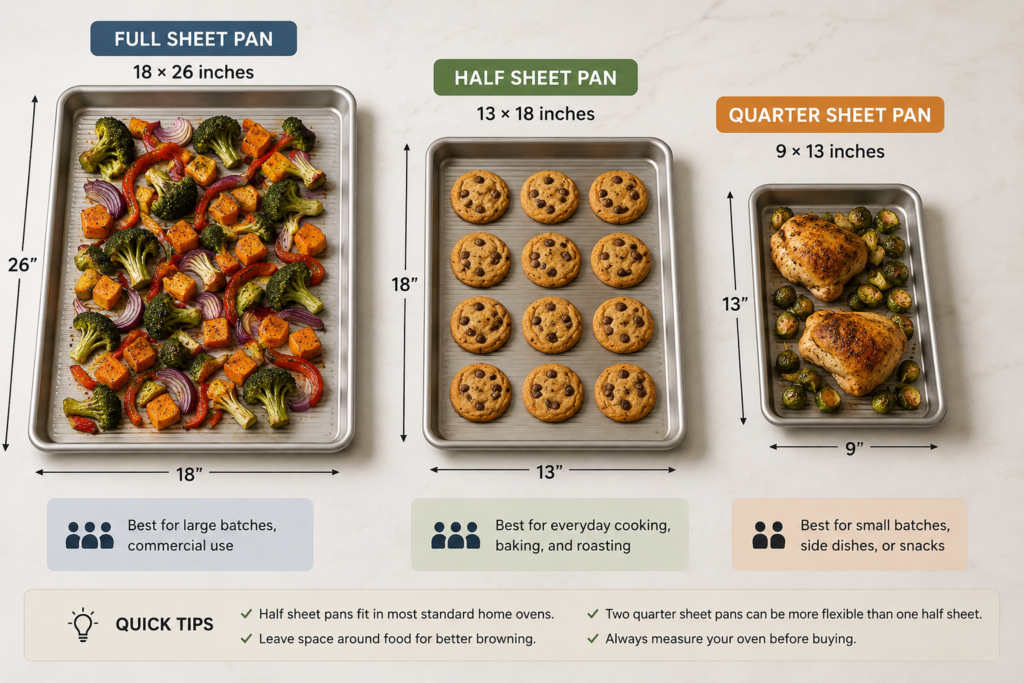
A half sheet pan is one of the most common sizes used in home kitchens.
A standard half sheet pan is usually about 18 x 13 inches, although the exact dimensions can vary slightly by manufacturer.
It provides plenty of room for cookies, roasted vegetables, chicken, and larger batches of food.
The extra space can also help when roasting because spreading food out gives hot air more room to circulate around it.
For a family or someone who regularly cooks larger portions, a half sheet pan can be a very useful all-purpose size.
The downside for me is simple: it is bigger.
In a kitchen with limited storage space, even a few inches can make a difference.
What Is a Quarter Sheet Pan?
A quarter sheet pan is roughly half the size of a half sheet pan, commonly around 13 x 9 inches, with some variation among brands.
It holds less food, but that smaller size can actually be an advantage.
It is easier to handle, easier to wash in many sinks, and usually easier to store.
For one or two people, or when cooking a small amount of food, a quarter sheet pan may be all you need for many everyday jobs.
That is something I appreciate because I don’t necessarily want the biggest kitchen tool available. I want the size that I will actually use.
Half Sheet vs Quarter Sheet: The Main Differences
The biggest difference is obviously capacity.
A half sheet gives you considerably more cooking surface, while a quarter sheet is more compact.
But I think there is more to the decision than simply asking which one holds more food.
Half Sheet Pan
A half sheet may make more sense if you:
- regularly cook for several people
- bake larger batches of cookies
- roast larger quantities of vegetables
- want more room to spread food out
- have enough oven and storage space
Quarter Sheet Pan
A quarter sheet may make more sense if you:
- usually cook for one or two people
- make smaller batches
- have limited storage space
- want something easier to wash and handle
- use a countertop oven or other smaller cooking space, if the manufacturer confirms the pan fits safely
Bigger gives you more capacity, but smaller can sometimes be more convenient.
Bigger Is Not Automatically Better
This is something I have started thinking about differently with kitchen tools in general.
It is easy to think:
If I buy the larger one, I can always use it for smaller amounts too.
And technically, that may be true.
But a large pan still has to be stored, washed, lifted, and moved around every time you use it.
If you regularly need that extra space, it makes sense.
But if you need it only once or twice a year, I think it is worth asking whether you really need to own it.
The most useful size is not necessarily the largest size. It is the size that matches the way you normally cook.
What I Do When I Need Something Bigger
Because my kitchen is small, I try not to keep large kitchen tools just because I might need them someday.
There have been special occasions when I needed something larger than what I normally keep at home.
Instead of buying a large pan that I might use once and then have to store for years, I have borrowed what I needed from a friend.
For me, that works.
Of course, borrowing is not practical for everyone. But it taught me something about the way I want to organize my kitchen.
I don’t necessarily need to own every tool I might possibly need someday.
If I use something regularly, I want to own a good one.
If I need something unusually large only for a special occasion, sometimes borrowing it makes more sense.
Think About Your Oven Before Choosing a Size
Before buying either size, measure the inside of your oven.
This is especially important with smaller ovens and countertop appliances.
Do not assume that a pan will fit simply because it is described as a standard size.
There needs to be appropriate clearance around the pan according to the appliance manufacturer’s instructions so that heat and air can circulate properly.
A baking sheet is only useful if it fits your oven safely and comfortably.
Think About Storage Too
This is probably one of the first things I consider.
Where will the pan actually go when I’m not using it?
If you have a large pantry or plenty of cabinet space, this may not matter much.
In my kitchen, it does.
A quarter sheet can be much easier to tuck into a cabinet or store with other baking pans.
A half sheet requires more room.
And if you own several sizes, they all need somewhere to go.
I think storage should be part of the buying decision, not something we figure out after bringing the pan home.
What About Cooking for Two?
For a household of one or two people, a quarter sheet can be surprisingly useful.
It can handle smaller portions of vegetables, a few pieces of chicken, small batches of cookies, and many other everyday foods.
But there are still situations where a half sheet can be useful even for two people.
For example, if you want to roast several ingredients without crowding them together, the extra surface area can help.
So I wouldn’t say that every two-person household should automatically choose a quarter sheet.
I would ask:
How much food do we actually cook at one time?
That answer is more useful than simply looking at the number of people in the house.
Do You Need Both Sizes?
Maybe—but not everyone does.
Someone who bakes or roasts frequently may genuinely use both sizes.
The quarter sheet can handle smaller jobs while the half sheet is available for larger batches.
But if you bake only occasionally and storage space is limited, I don’t think you need to buy both simply because both exist.
Start with the size that matches most of what you actually cook.
If you repeatedly find yourself wishing for more space, then a larger pan may be worth adding later.
That makes more sense to me than buying several sizes first and hoping I eventually use them.
What Should You Consider Before Buying?
Before choosing between a half sheet and quarter sheet, I would ask these questions:
How much food do I normally cook?
Think about an ordinary week, not just holidays or special occasions.
How many people am I usually cooking for?
Smaller households may find a quarter sheet convenient, while families may appreciate the additional space of a half sheet.
Will it fit my oven?
Measure first, especially if you have a smaller oven.
Where will I store it?
If cabinet space is tight, this can make a big difference.
How often will I really need the larger size?
If the answer is only once or twice a year, you may not need to own it at all.
FAQ
What size is a half sheet pan?
A typical half sheet pan is approximately 18 x 13 inches, although dimensions can vary slightly by manufacturer.
What size is a quarter sheet pan?
A typical quarter sheet pan is approximately 13 x 9 inches, although exact dimensions can vary.
Is a quarter sheet pan big enough for two people?
It can be for many smaller meals and baking jobs. The best size depends on how much food you normally prepare at one time.
Is a half sheet pan better than a quarter sheet pan?
Neither is automatically better. A half sheet offers more cooking surface, while a quarter sheet is easier to handle and store.
Do I need both a half sheet and a quarter sheet pan?
Not necessarily. If you have limited storage or bake only occasionally, start with the size you are most likely to use regularly.
Conclusion
I used to think choosing a baking sheet size was simply a matter of deciding how much food would fit on it.
Now I think about it a little differently.
How often will I use it? Where will I store it? Does it fit my oven? And do I really need the larger size often enough to own it?
Because my kitchen is small and I don’t bake frequently, I prefer to keep the tools I actually use rather than storing something large for the possibility that I might need it someday.
And when a special occasion comes along and I need something unusually large, I have borrowed it from a friend instead of buying another pan.
That approach may not work for everyone, but it works for me.
I don’t need to own every kitchen tool I might someday need. I would rather have fewer things that fit my kitchen and the way I actually cook.
For me, that is ultimately more important than whether the pan is called a half sheet or a quarter sheet.
More in Our Baking Sheets & Sheet Pans Series
Choosing a Baking Sheet & Sheet Pan
- Baking Sheet vs Sheet Pan: What’s the Difference?
- Aluminum vs Stainless Steel vs Nonstick Baking Sheets
- What Size Baking Sheet Do You Need? Half Sheet vs Quarter Sheet ← You are here
Using a Baking Sheet Safely
- Can You Put a Baking Sheet in an Air Fryer?
- Can You Use a Baking Sheet on the Stovetop?
- Are Baking Sheets Safe? Aluminum, Stainless Steel & Nonstick Explained
Next in the series: Can You Put a Baking Sheet in an Air Fryer?