Introduction
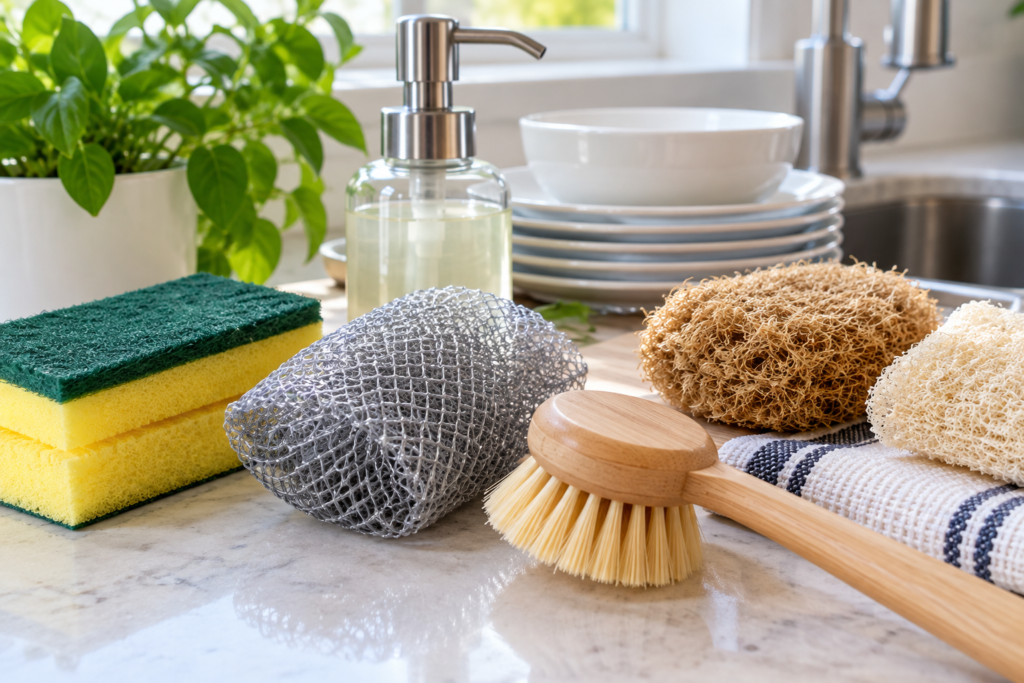
For years, I didn’t think very much about what my kitchen scrubber was made of. Like many people, I had used the familiar yellow-and-green kitchen sponges, dish brushes, and different types of scrubbers depending on what I was washing.
Recently, however, I started seeing more articles about microplastics released from everyday kitchen products. After researching plastic cutting boards for another article, I became curious about something I use even more often: the scrubber beside my kitchen sink.
I had already stopped using traditional metal scrubbers because I worried about tiny pieces breaking off and being left behind on cookware. I also moved away from the thick yellow-and-green sponges and started using a lightweight mesh scrubber because it dries quickly and feels cleaner between uses.
Then I checked the package.
The mesh scrubber I currently use is made from polypropylene (PP).
In other words, the scrubber I thought might be a better alternative was still made from plastic.
That discovery made me want to look more closely at the research. Do kitchen sponges and scrubbers release microplastics? Is a dish brush a better choice? And how long should we keep using the same scrubber before replacing it?
Here is what I learned.
Can Kitchen Sponges Release Microplastics?
Recent research suggests that the answer is yes—when a kitchen sponge contains plastic, abrasion during scrubbing can release some of that material as microplastics into wastewater.
A 2026 study published in Environmental Advances tested several commonly available kitchen sponges using both real household use and laboratory abrasion experiments. Researchers found that plastic-containing sponges lost material during normal use. Across the different products tested, estimated microplastic release ranged from about 0.68 to 4.21 grams per person per year.
One of the conventional North American sponges tested had a cellulose sponge layer and a recycled polyester scrubbing layer—a construction similar to many common household sponges.
Importantly, the researchers also found that the sponge with the lowest proportion of plastic released the least microplastic. That does not mean a particular sponge can eliminate microplastic exposure completely, but it suggests that choosing products with less plastic may help reduce unnecessary shedding.
My Mesh Scrubber Was Polypropylene
This was the part that surprised me personally.
I had been using a mesh-style scrubber because I liked how quickly water drained from it. Unlike a thick sponge, it does not stay wet for as long, and soap rinses out easily.
But when I looked at the package, the material was clearly listed as:
Polypropylene
Polypropylene, often abbreviated as PP, is a type of plastic.
That does not mean my scrubber is automatically dangerous, and I have not found research measuring microplastic release from this exact product.
But it changed the way I think about kitchen scrubbers.
The shape of a scrubber does not tell us what it is made from.
A mesh scrubber may dry faster than a sponge, but if reducing plastic use is one of my goals, I also need to read the material label.
That is something I had never paid much attention to before.
What About the Traditional Yellow-and-Green Sponge?
The familiar kitchen sponge is convenient for a reason.
It holds soap well, is inexpensive, and the abrasive side can remove stuck-on food.
But there are two separate issues worth considering.
The first is material wear. If the abrasive layer contains polyester, nylon, polyurethane, polypropylene, or another synthetic polymer, friction gradually wears the material down.
The second is moisture and bacteria.
A 2022 study comparing household dishwashing sponges and brushes found that brushes generally had lower bacterial levels than sponges. When researchers introduced Salmonella and allowed the tools to dry, Salmonella decreased significantly on hanging brushes, while the same reduction was not seen in the sponges. The researchers noted that frequently used sponges can be difficult to dry completely between uses.
Health Canada also advises avoiding kitchen sponges because they are difficult to keep bacteria-free and recommends changing dishcloths daily.
For me, that makes drying ability just as important as the material itself.
Why I Still Like Using a Dish Brush
I already use a dish brush quite often, especially when I am washing plates, bowls, pots, and items that do not require a soft sponge.
After reading the research, I appreciate it even more.
A brush has a simple advantage: air can circulate around the bristles, allowing it to dry much faster than a thick wet sponge.
The 2022 study found that Salmonella declined more rapidly on brushes that were allowed to dry, and the authors concluded that brushes may be a more hygienic choice than sponges.
But there is another detail I now want to pay attention to.
Many dish brushes use nylon or other plastic bristles.
So switching from a sponge to a plastic-bristle brush does not necessarily eliminate plastic from the equation.
If reducing plastic is important, I would look for a brush with a durable handle and plant-based or natural-fiber bristles, while still paying attention to how well the brush cleans and dries.
What About Natural Scrubbers?
Natural-fiber scrubbers are becoming easier to find.
Some are made with materials such as:
- Sisal
- Coconut fiber
- Loofah
- Cellulose
- Natural-fiber brush bristles
- Cotton cloth
These can reduce the amount of plastic in the tool, but there is an important lesson here too:
Always read the label.
In the 2026 sponge study, even a product marketed as an organic sponge still contained recycled PET along with sisal. It simply contained less plastic than the conventional products tested, rather than being completely plastic-free.
So I would not choose a product simply because the package says “natural,” “eco,” or “plant-based.”
I would check the actual material list first.
How Long Should You Use the Same Kitchen Sponge or Scrubber?
This was another question I wanted answered.
You often hear rules such as “replace your sponge every week,” but there is no single scientifically established replacement schedule that works for every kitchen and every type of scrubber.
Usage makes a big difference.
A scrubber used several times every day will wear much faster than one used occasionally.
Instead of relying only on the calendar, I think it makes more sense to watch for signs that the tool has reached the end of its useful life.
I would replace a sponge or scrubber when:
- It develops an unpleasant odor.
- Pieces or fibers begin breaking off.
- The abrasive surface starts crumbling.
- Food becomes difficult to rinse from it.
- It remains wet for a very long time.
- It becomes badly stained or slimy.
- The shape or texture has noticeably deteriorated.
Research on sponges and brushes also found that replacing a sponge when it becomes worn was associated with better hygiene practices.
For dish brushes, I would replace the brush head when the bristles become badly bent, split, loose, or difficult to clean.
Most importantly, whatever tool I use, I want it to rinse clean and dry thoroughly between uses.
What I Would Choose for My Own Kitchen
After learning all of this, I do not think there is one perfect scrubber that solves every problem.
And I certainly do not think we can remove every source of microplastic from our kitchens overnight.
My goal is simpler: reduce unnecessary plastic where it is practical and choose cleaning tools that stay clean and dry well.
For my own kitchen, this is the direction I am leaning toward:
For most everyday dishes:
A dish brush that dries quickly. When I replace my current one, I would like to look more closely at brushes with natural-fiber bristles.
When I need a scrubber:
A lower-plastic or plant-fiber option such as sisal or another natural-fiber scrubber, after checking the actual material label.
For wiping surfaces:
Washable cotton cloths that can be replaced frequently and washed thoroughly.
What I would use less often:
Thick plastic-containing sponges that stay damp for long periods.
As for my current polypropylene mesh scrubber, I do not feel that I need to throw it away immediately.
But discovering what it is made from has changed what I will look for the next time I buy one.
A Simple Rule I Learned: Check the Material, Not Just the Shape
This entire investigation started because I assumed my mesh scrubber was very different from a conventional sponge.
In one way, it is. It drains and dries quickly.
But when I turned the package over and read “polypropylene,” I realized I had been judging it by appearance rather than material.
From now on, when I buy a kitchen cleaning tool, I want to ask three simple questions:
What is it made from?
Does it dry quickly?
What happens as it wears out?
Those questions may be more useful than simply choosing the product that looks the most modern or environmentally friendly.
Conclusion
Research on kitchen sponges is giving us another reason to pay attention to the small tools we use every day.
Plastic-containing sponges can lose material during scrubbing, and recent research has measured microplastic release into wastewater. At the same time, ordinary sponges can be difficult to dry completely and may hold high levels of bacteria.
That does not mean we need to panic about every sponge beside the sink.
For me, the lesson is much more practical.
I want to use quick-drying tools, check material labels, reduce plastic where it makes sense, and replace cleaning tools when they begin to wear out.
I am still learning, too.
I started this research thinking my mesh scrubber was already the better choice. Then I discovered that it was polypropylene.
Sometimes improving a kitchen does not mean buying the newest product.
It simply means turning the package over and paying a little more attention to what we are already using.