Introduction
Dry and liquid measuring cups are both designed to measure ingredients by volume, but they are shaped differently for a reason.
At first, it may seem unnecessary to own two types of measuring cups. After all, one cup is still one cup. However, the design of each tool makes certain ingredients much easier to measure accurately.
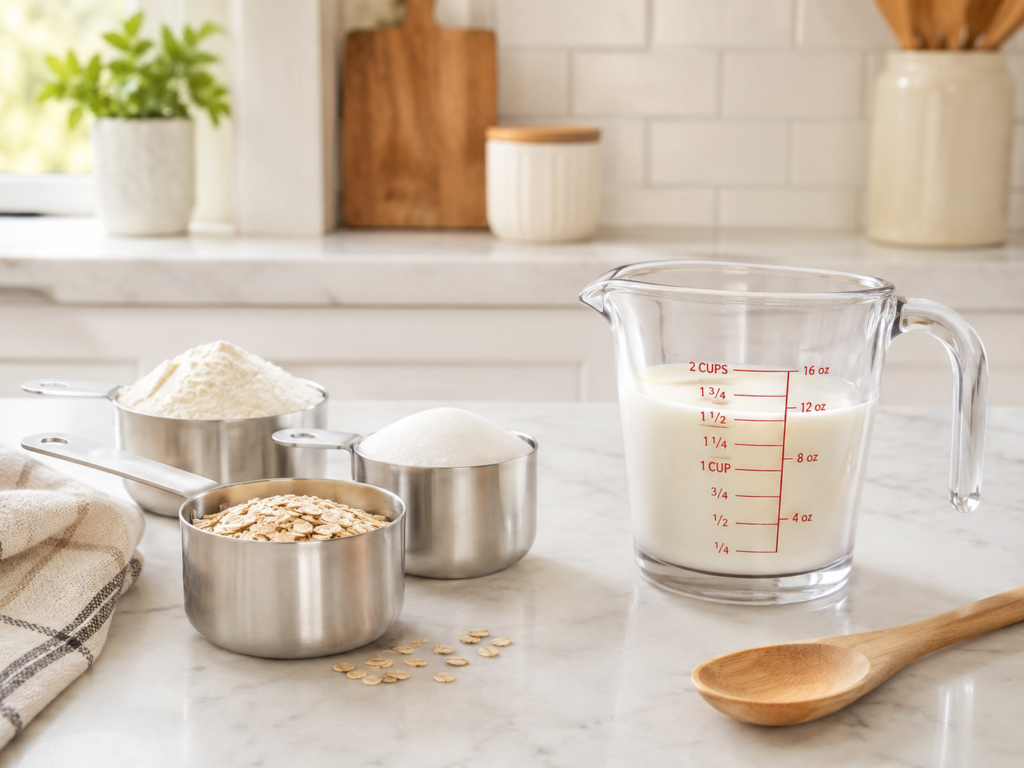
Dry measuring cups are designed to be filled to the top and leveled, while liquid measuring cups have extra space above the measurement lines so liquids can be poured and read without spilling.
In this guide, we’ll explain the difference between dry and liquid measuring cups, how to use each one correctly, which materials and features are most useful, and what to look for if you want a set that will last for years.
What Is a Dry Measuring Cup?
A dry measuring cup is designed primarily for ingredients that can be scooped, spooned, or poured into a cup and leveled across the top.
Common dry ingredients include:
- Flour
- Granulated sugar
- Brown sugar
- Rice
- Oats
- Breadcrumbs
- Nuts
- Cocoa powder
Dry measuring cups usually come as a set of individual sizes.
A typical set includes:
- 1 cup
- 1/2 cup
- 1/3 cup
- 1/4 cup
Because each cup represents a fixed measurement, you can fill it completely and level the ingredient at the rim.
What Is a Liquid Measuring Cup?
A liquid measuring cup is designed for ingredients that pour.
Common examples include:
- Water
- Milk
- Oil
- Broth
- Juice
- Vinegar
- Cream
- Other cooking liquids
Liquid measuring cups usually have measurement markings along the side and a pouring spout.
Unlike a dry measuring cup, the container extends above the measurement lines.
This extra space makes it easier to carry and pour liquids without spilling.
Dry vs Liquid Measuring Cups: Quick Comparison
| Feature | Dry Measuring Cups | Liquid Measuring Cups |
|---|---|---|
| Best For | Flour, sugar, rice, oats, dry ingredients | Water, milk, oil, broth, other liquids |
| Design | Individual cups filled to the rim | Larger container with markings |
| How to Read | Fill and level at the top | Read measurement line at eye level |
| Pouring Spout | Usually no | Usually yes |
| Common Materials | Stainless steel, plastic | Glass, plastic, silicone |
| Typical Sizes | 1 cup, 1/2, 1/3, 1/4 | 1 cup, 2 cups, 4 cups or larger |
| Best Feature | Easy leveling | Easy pouring and visible markings |
Both tools measure volume, but each design makes a different type of ingredient easier to measure correctly.
Why Are Dry and Liquid Measuring Cups Shaped Differently?
The biggest difference is the way the ingredient reaches the measurement point.
With a dry ingredient, you can fill the cup completely to the rim and remove the excess.
For example, when measuring flour, you can spoon the flour into the cup and use a straight edge to level the top.
You cannot do that easily with water or milk.
If you filled a dry cup completely with liquid, you would have to carry it while the liquid was sitting right at the rim. Even a small movement could cause it to spill.
A liquid measuring cup solves this problem by placing the measurement lines below the top of the container.
Can You Use a Dry Measuring Cup for Liquid?
Yes, technically you can measure liquid in a dry measuring cup.
The volume itself does not suddenly change simply because the cup has a different design.
However, it can be inconvenient.
You need to fill the liquid almost to the rim, which makes spilling more likely.
For small amounts, it may work perfectly well. For regular cooking and baking, a liquid measuring cup is usually easier.
Can You Use a Liquid Measuring Cup for Dry Ingredients?
Again, it is possible, but it is usually less convenient.
Imagine measuring one cup of flour in a liquid measuring cup.
You would pour flour until it appeared to reach the one-cup line. Because the measurement line is on the side rather than at the rim, it is much harder to level the ingredient precisely.
That is why dry measuring cups are generally better for ingredients such as flour and sugar.
How to Use a Dry Measuring Cup Correctly
The correct technique depends somewhat on the ingredient.
Flour
For flour:
- Stir or fluff the flour gently.
- Spoon it into the measuring cup.
- Fill the cup slightly above the rim.
- Use a straight edge, such as the back of a knife, to level the top.
Avoid pressing the flour into the cup unless the recipe specifically tells you to do so.
Granulated Sugar
Granulated sugar can usually be scooped or poured into the cup.
Fill it to the rim and level the surface if necessary.
Brown Sugar
Brown sugar is often measured packed.
If a recipe calls for packed brown sugar:
- Add brown sugar to the cup.
- Press it firmly into the cup.
- Continue until the cup is full.
- Level the top.
Always follow the wording of the recipe.
How to Use a Liquid Measuring Cup Correctly
For liquid ingredients:
- Place the measuring cup on a flat counter.
- Pour in the liquid.
- Allow the liquid to settle.
- Lower your eyes to the level of the measurement marking.
- Check that the liquid reaches the correct line.
Do not hold the measuring cup in your hand while trying to read the level.
A flat surface gives you a more reliable reading.
What Is the Meniscus?
When you look at water or some other liquids inside a transparent measuring cup, the surface may curve slightly.
This curved surface is called the meniscus.
For most water-like liquids, measurements are typically read around the bottom of the curve while the cup is resting on a level surface.
For ordinary home cooking, the main goal is simply to place the cup on a flat surface and read it at eye level rather than looking down from above.
Why Eye Level Matters
If you look down at the markings from above, the liquid may appear to line up with a different measurement.
This is a viewing-angle error.
That is why it is better to put the cup on the counter and lower yourself until the measurement line is approximately at eye level.
It takes only a few seconds and can improve consistency.
What About Thick Liquids?
Some ingredients fall somewhere between a typical liquid and a dry ingredient.
Examples include:
- Honey
- Molasses
- Syrup
- Peanut butter
- Yogurt
- Sour cream
The best measuring method may depend on the recipe and ingredient.
For thick ingredients, some cooks prefer specialized adjustable measuring cups or flexible measuring tools that make sticky ingredients easier to remove.
A regular dry measuring cup can also work for many thick ingredients because the top can be leveled.
What Material Is Best for Dry Measuring Cups?
Dry measuring cups are commonly made from stainless steel or plastic.
Stainless Steel
Stainless steel is a strong choice if you want a set that can last for many years.
Advantages include:
- Durable construction
- Resistance to staining
- Easy cleaning
- Good resistance to odors
- Measurements can be permanently engraved or stamped
For a tool you may use for a long time, engraved measurements are especially useful because they are less likely to disappear with repeated washing.
Plastic
Plastic measuring cups can also work well.
Advantages include:
- Lightweight
- Usually inexpensive
- Easy to handle
- Available in different colors
One thing to check is how the measurements are marked.
If the numbers are only printed on the surface, they may become harder to read after years of use.
What Material Is Best for Liquid Measuring Cups?
Liquid measuring cups commonly come in glass, plastic, or silicone.
Glass
Glass measuring cups are popular because the liquid and markings are easy to see.
Advantages include:
- Clear visibility
- Resistance to staining
- Stable on a counter
- Easy-to-read measurement lines
Some glass measuring cups may also be suitable for microwaving, but you should always follow the manufacturer’s instructions.
The main disadvantage is that glass can break if dropped.
Plastic
Plastic liquid measuring cups are:
- Lightweight
- Less likely to break when dropped
- Easy to carry
- Often inexpensive
However, the markings can fade on some models, and plastic may scratch or stain over time.
Silicone
Silicone measuring cups are flexible.
That flexibility can make them useful for pouring ingredients into narrow containers.
However, some people may find a very flexible cup less stable when it is full.
Features That Make a Dry Measuring Cup Better
If you are buying a set that you expect to keep for years, small design details matter.
Engraved Measurements
This is one of the most useful features.
Measurements that are engraved or stamped into the metal are less likely to disappear than painted numbers.
Long Handles
Long handles make it easier to reach into deep containers of flour, sugar, rice, or oats.
Strong Handle Connection
Check where the handle joins the cup.
A thin or weak connection may bend over time, especially when scooping heavier ingredients.
Flat Bottom
A flat-bottomed measuring cup can sit steadily on the counter.
Nesting Design
Cups that fit neatly inside each other save drawer space.
Easy-to-Read Sizes
You should be able to identify the size quickly without examining tiny print every time you cook.
Features That Make a Liquid Measuring Cup Better
A good liquid measuring cup should be easy to read and easy to pour.
Useful features include:
Clear Measurement Markings
Large, high-contrast markings are easier to read.
Measurements Visible From More Than One Angle
Some cups are designed so you can see measurements without bending down as far.
This can be a convenient feature, although traditional side markings also work well when used correctly.
Good Pouring Spout
A well-shaped spout helps direct liquid into bowls and containers without dripping down the side.
Comfortable Handle
A full measuring cup can become heavy.
The handle should feel secure and comfortable.
Stable Base
A wide, stable base reduces the chance of tipping.
Should You Buy a Measuring Cup With Many Units?
Some liquid measuring cups show several measurement systems, such as:
- Cups
- Fluid ounces
- Milliliters
This can be very useful if you follow recipes from different countries.
However, too many markings can also make a cup look crowded.
Choose markings that are large and easy for you to read.
Do You Need More Than One Liquid Measuring Cup?
Not necessarily.
A 2-cup liquid measuring cup is versatile for many everyday recipes.
However, people who cook frequently may find it convenient to have multiple sizes, such as:
- 1 cup
- 2 cups
- 4 cups
A smaller cup can be easier for measuring small amounts accurately, while a larger one is useful for soups, sauces, and baking.
Is Stainless Steel Better for Dry Measuring Cups?
For long-term durability, stainless steel is an excellent choice.
It does not automatically make a measuring cup more accurate, but it can make the tool more durable.
If you want to buy one set and keep it for many years, look for:
- Thick, sturdy metal
- Secure handles
- Clearly engraved measurements
- Smooth edges
- Standard sizes
- A design that nests well
The best set is not necessarily the most expensive one.
Good construction and practical design matter more.
Is Glass Better for Liquid Measuring Cups?
Glass can be an excellent long-term choice because the markings are generally easy to see and the container does not absorb odors easily.
However, durability also depends on how you use it.
If you frequently drop kitchen tools or have children helping in the kitchen, a durable plastic measuring cup may be more practical.
The best material is the one that fits the way you actually cook.
Which Type Is Better for Baking?
For baking, having both types is useful.
Dry measuring cups work well for:
- Flour
- Sugar
- Cocoa
- Oats
Liquid measuring cups work well for:
- Milk
- Water
- Oil
- Cream
For even greater precision, especially with flour and other dry baking ingredients, a digital kitchen scale can also be very useful.
Measuring Cups vs a Kitchen Scale
Measuring cups measure volume.
A kitchen scale measures weight.
Both have a place in a home kitchen.
Measuring cups are fast and convenient for everyday recipes.
A scale can provide greater consistency for ingredients whose volume can change depending on how they are packed.
Flour is a good example.
One cup of flour can contain different amounts by weight depending on whether the flour was spooned gently into the cup or compressed.
We’ll compare these methods in more detail later in this series.
Common Mistakes When Using Dry Measuring Cups
Avoid these common mistakes:
- Packing flour into the cup
- Shaking the cup to compress ingredients
- Forgetting to level the top
- Using a measuring cup with unclear markings
- Confusing 1/3 cup with 1/2 cup
- Using a damaged or bent cup
Small errors can become significant when a recipe uses several cups of an ingredient.
Common Mistakes When Using Liquid Measuring Cups
Common mistakes include:
- Holding the cup in the air while measuring
- Looking down at the measurement from above
- Filling the cup too quickly
- Placing it on an uneven surface
- Using faded measurement markings
- Confusing fluid ounces with weight ounces
Taking a moment to read the measurement correctly can improve consistency.
Which Measuring Cups Should a Beginner Buy?
A beginner does not need a large collection.
A simple setup is enough:
- One durable set of dry measuring cups
- One clear liquid measuring cup
- One set of measuring spoons
For dry cups, stainless steel with engraved measurements is a strong long-term option.
For liquids, choose a cup with clear markings, a comfortable handle, a stable base, and a good pouring spout.
These tools can cover most everyday recipes.
What Should You Look for If You Want Them to Last?
Because measuring cups are tools you may keep for many years, it makes sense to choose carefully the first time.
Look for:
- Durable construction
- Measurements that will not easily fade
- Comfortable handles
- Easy cleaning
- Standard sizes
- A shape that is easy to store
- A stable design
- Materials suitable for the way you cook
A slightly better-designed tool that you enjoy using every day can be more valuable than a large set with unnecessary pieces.
FAQ
Is one cup the same in a dry and liquid measuring cup?
They are both intended to represent the same volume. The main difference is the design of the tool and how easily you can measure different types of ingredients.
Do I really need both dry and liquid measuring cups?
You can manage without both, but having each type makes measuring easier and more convenient. Dry cups are designed for filling and leveling, while liquid cups are designed for pouring and reading measurement lines.
Can I measure milk in a dry measuring cup?
Yes, but you need to fill the cup very close to the rim, which makes spilling easier. A liquid measuring cup is more convenient.
Can I measure flour in a liquid measuring cup?
You can, but it is harder to level the flour accurately at a measurement line. A dry measuring cup is usually the better choice.
What size liquid measuring cup should I buy first?
A 2-cup measuring cup is a versatile size for many home kitchens. You can add smaller or larger sizes later if needed.
What material is best for dry measuring cups?
Stainless steel is a durable long-term option, especially when the measurements are permanently engraved or stamped.
What material is best for liquid measuring cups?
Glass and clear plastic are both popular. Glass is stable and resists staining, while plastic is lighter and less likely to break if dropped.
Why should liquid measurements be read at eye level?
Looking at the measurement from above or below can make the liquid appear to line up with the wrong marking. Eye-level reading reduces this error.
Are expensive measuring cups more accurate?
Not necessarily. Price alone does not guarantee accuracy. Clear measurements, standard sizing, durable construction, and good design are more important.
Should I buy measuring cups with printed or engraved numbers?
For long-term use, engraved or stamped measurements are especially useful because they are less likely to wear away.
Conclusion
Dry and liquid measuring cups measure volume, but their different designs make them better suited to different ingredients.
Dry measuring cups are made to be filled to the top and leveled, making them ideal for flour, sugar, rice, oats, and other dry ingredients.
Liquid measuring cups have measurement lines below the rim, making it easier to measure, carry, and pour liquids without spilling.
For most home kitchens, having both types is worthwhile.
And because measuring cups are tools you may use for many years, it is worth choosing durable, comfortable designs from the beginning. Clear or permanent measurements, sturdy handles, easy storage, and practical shapes can make a bigger difference over time than simply choosing the cheapest set.
Continue Reading Our Measuring Cups & Spoons Series
Explore the other guides in our Measuring Cups & Spoons Series:
- Measuring Cups and Spoons: A Beginner’s Guide — already published
- How to Measure Ingredients Correctly — coming next
- Measuring Cups vs Kitchen Scale: Which Is More Accurate? — coming soon
- How to Choose the Best Measuring Cups and Spoons — coming soon
As each new guide is published, these titles can be connected with internal links to build the complete Measuring Cups & Spoons Series.