Introduction
Measuring cups and spoons are simple kitchen tools, but they are tools you may use for many years.
Because of that, choosing a good set from the beginning can make everyday cooking and baking easier. A poorly designed set may have measurements that fade, handles that bend, cups that tip over, or spoons that are too wide to fit inside spice jars.
A good set should be accurate, durable, comfortable to use, easy to clean, and simple to store.
In this guide, we’ll look at the most important features to consider when choosing measuring cups and spoons, compare common materials, and help you decide which designs are worth buying for long-term use.
What Should You Look for in Measuring Cups and Spoons?
When choosing a set, focus on practical features rather than appearance alone.
The most important things to consider are:
- Accurate measurements
- Clear, permanent markings
- Durable materials
- Comfortable handles
- Useful standard sizes
- Easy storage
- Easy cleaning
- Shapes that work with your ingredient containers
A well-designed basic set is often more useful than a large set filled with sizes you rarely use.
Choose Measurements That Will Not Fade
One of the first things to check is how the measurements are marked.
Some inexpensive measuring cups and spoons use printed numbers that may gradually fade after repeated washing.
For long-term use, look for measurements that are:
- Engraved
- Stamped
- Etched
- Molded permanently into the tool
If the measurement markings disappear, even a perfectly good cup becomes inconvenient to use.
For tools you expect to keep for years, permanent markings are worth looking for.
Make Sure the Numbers Are Easy to Read
Permanent markings are helpful only if you can read them easily.
Look for:
- Large numbers
- Clear fractions
- Good contrast
- Measurements placed where your hand will not cover them
You should be able to quickly tell the difference between:
- 1 cup
- 1/2 cup
- 1/3 cup
- 1/4 cup
The same applies to measuring spoons.
Small, difficult-to-read numbers can become frustrating when you cook frequently.
What Measuring Cup Sizes Do You Really Need?
Most home cooks do not need a huge measuring cup set.
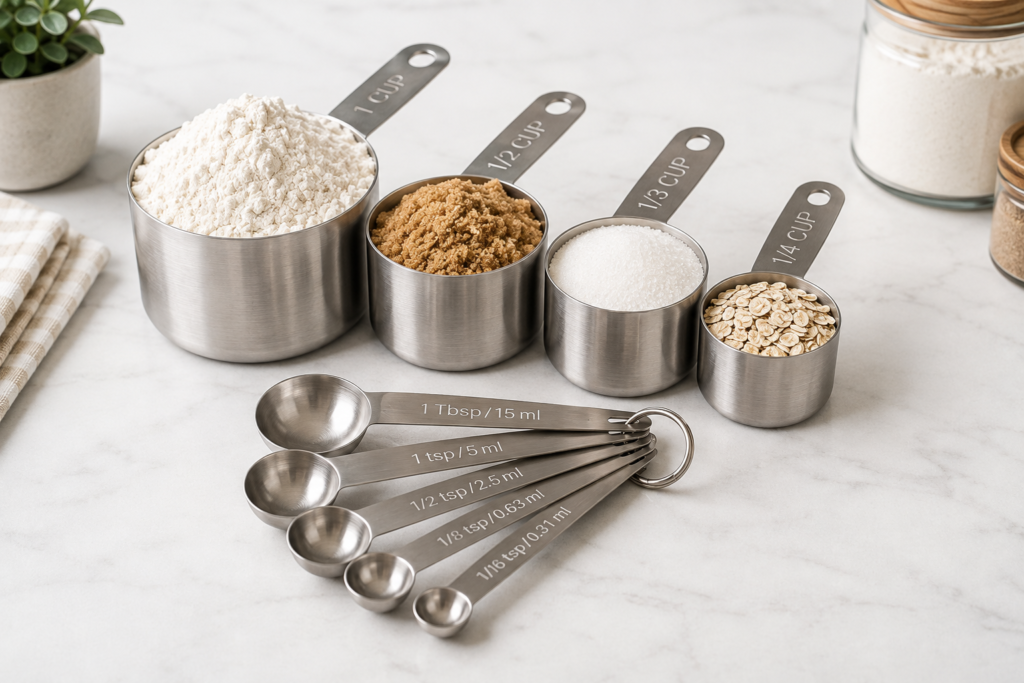
A practical basic set usually includes:
- 1 cup
- 1/2 cup
- 1/3 cup
- 1/4 cup
These four sizes cover most recipes.
Additional sizes such as:
- 3/4 cup
- 2/3 cup
- 1/8 cup
can be convenient, but they are optional.
If you have limited drawer space, a sturdy four-piece set may be better than a large set with many rarely used pieces.
What Measuring Spoon Sizes Do You Need?
A standard measuring spoon set usually includes:
- 1 tablespoon
- 1 teaspoon
- 1/2 teaspoon
- 1/4 teaspoon
Additional useful sizes may include:
- 1/2 tablespoon
- 1/8 teaspoon
- 1/16 teaspoon
Smaller spoons can be useful for spices, baking ingredients, and recipes that require very small amounts.
However, beginners can handle most everyday recipes with the standard four sizes.
Stainless Steel Measuring Cups and Spoons
Stainless steel is one of the best choices for long-term durability.
Advantages include:
- Strong construction
- Resistance to staining
- Resistance to odors
- Easy cleaning
- Long lifespan
- Permanent engraved markings are common
A good stainless steel set can last for many years.
If durability is your priority, stainless steel is an excellent place to start.
What to Check in Stainless Steel Sets
Not every stainless steel set is equally strong.
Before choosing one, look at:
Thickness
Very thin metal may bend more easily.
A slightly heavier cup often feels more stable and durable.
Handle Connection
Check where the handle joins the cup.
A strong connection is important because this area receives a lot of stress when scooping ingredients.
Smooth Edges
The rim and handle should feel smooth and comfortable.
Avoid tools with sharp or rough edges.
Rust Resistance
Quality stainless steel should resist rust well when properly cared for.
Always dry the tools before storing them.
Plastic Measuring Cups and Spoons
Plastic sets can also be practical.
Advantages include:
- Lightweight
- Affordable
- Easy to handle
- Available in many colors
Different colors can make sizes easy to identify quickly.
However, plastic may:
- Scratch
- Stain
- Absorb odors
- Warp with heat
- Develop faded measurement markings
If you choose plastic, look for sturdy construction and permanent molded measurements.
Silicone Measuring Tools
Silicone measuring tools are flexible and lightweight.
Some collapsible measuring cups are especially useful in small kitchens because they take up very little storage space.
Advantages include:
- Flexible construction
- Compact storage
- Lightweight
- Resistant to breaking
Possible disadvantages include:
- Less stability when full
- More difficult leveling for some dry ingredients
- Flexible handles or walls that may feel less precise
Silicone can be useful when storage space is the main concern, but many cooks prefer rigid cups for everyday measuring.
Glass Liquid Measuring Cups
For liquids, glass measuring cups are a popular option.
Advantages include:
- Clear visibility
- Easy-to-read markings
- Stable weight
- Resistance to staining
- Resistance to odors
Some glass measuring cups can also be used in a microwave, depending on the manufacturer.
Always follow the manufacturer’s instructions.
The main disadvantage is that glass can break if dropped.
Plastic Liquid Measuring Cups
Plastic liquid measuring cups are lighter and less likely to break when dropped.
They can be a good choice if:
- You want something lightweight
- Children help in the kitchen
- You are concerned about breaking glass
The biggest thing to watch is the measurement markings.
Printed markings may fade over time, so look for a design where the measurements remain easy to read after repeated washing.
Choose a Good Pouring Spout
For liquid measuring cups, the pouring spout matters more than many people realize.
A good spout should allow you to pour liquid cleanly without:
- Dripping down the side
- Spilling onto the counter
- Pouring too quickly
If you regularly make sauces, soups, pancakes, or baking recipes, a well-designed spout can make a noticeable difference.
Look for a Comfortable Handle
A measuring cup may become heavy when filled with liquid or dense ingredients.
The handle should:
- Feel comfortable
- Provide a secure grip
- Be large enough for your hand
- Remain stable when the cup is full
For stainless steel dry measuring cups, also check that the handle does not flex too much when scooping heavier ingredients.
Long Handles Can Be More Useful
Long-handled measuring cups and spoons can be very convenient.
They are especially useful when reaching into:
- Flour containers
- Sugar containers
- Rice bins
- Coffee containers
- Deep spice jars
A short handle may force your fingers into the ingredient container.
That can be messy and inconvenient.
Choose Measuring Spoons That Fit in Spice Jars
This is one of the most useful features to consider.
Many traditional round measuring spoons are too wide to fit inside narrow spice jars.
Narrow or oval measuring spoons can fit inside smaller containers much more easily.
This means you can scoop spices directly instead of pouring them into the spoon and accidentally spilling them.
For frequent cooking, this small design improvement can be surprisingly helpful.
Round vs Oval Measuring Spoons
Both shapes work.
Round Spoons
Advantages:
- Traditional design
- Easy to fill
- Good for liquids
Disadvantage:
- May not fit inside narrow containers
Oval or Narrow Spoons
Advantages:
- Fit inside spice jars
- Easy to scoop small ingredients
- Often easier to level
If you use a lot of herbs and spices, narrow measuring spoons may be the more practical choice.
What About Double-Ended Measuring Spoons?
Some measuring spoons have two ends.
For example:
- One narrow end for spice jars
- One rounded end for liquids
This can be convenient because a single spoon provides two shapes.
However, double-ended spoons can sometimes be more awkward to store or wash.
Choose them only if the design genuinely makes your cooking easier.
Magnetic Measuring Cups and Spoons
Magnetic sets have become popular because magnets keep the pieces together.
Advantages include:
- Easy organization
- No ring to open
- Easy to remove one size
- Pieces stay together in a drawer
This can be more convenient than traditional sets held together with a metal ring.
However, magnets are a convenience feature rather than a requirement.
A well-designed nesting set without magnets can work just as well.
Ring-Connected Measuring Spoons
Many measuring spoon sets come attached to a small ring.
This keeps the spoons together, which can prevent pieces from getting lost.
However, you may find it inconvenient to wash or use several spoons while they are all attached.
Look for a ring that opens easily so individual spoons can be removed when needed.
Nesting Measuring Cups Save Space
Nesting means each measuring cup fits inside the next larger cup.
This is useful because it:
- Saves drawer space
- Keeps the set together
- Makes storage easier
Before buying a set, make sure the cups nest neatly without becoming stuck together.
Flat Bottoms Are Helpful
Dry measuring cups with flat bottoms can stand on the counter without tipping.
This is useful when measuring ingredients such as:
- Flour
- Sugar
- Rice
- Oats
- Nuts
You can set the filled cup down while preparing other ingredients.
A stable cup is easier and safer to use.
Heavy vs Lightweight Measuring Cups
Neither is automatically better.
Heavier Cups
Can feel:
- More durable
- More stable
- More substantial
Lightweight Cups
Can be:
- Easier to handle
- Easier for children or older adults to use
- Easier to store
The best choice depends on what feels comfortable in your hand.
Dishwasher-Safe vs Hand-Wash Only
Measuring cups and spoons are used frequently, so easy cleaning is important.
If you use a dishwasher, check whether the manufacturer states that the tools are dishwasher-safe.
Stainless steel is often easy to clean.
Plastic may also be dishwasher-safe, but repeated heat can affect some materials and printed markings.
Always follow the care instructions for the particular product.
Choose Tools That Are Easy to Clean
Avoid complicated designs with:
- Deep seams
- Difficult-to-reach joints
- Decorative areas that trap food
- Handles where water collects
Simple shapes are usually easier to clean and dry.
This is especially important when measuring sticky ingredients such as honey, syrup, or peanut butter.
Should You Buy a Large Set?
A bigger set is not automatically better.
Large sets may include many sizes that you rarely use.
Before buying, ask yourself:
- Will I actually use the extra sizes?
- Do I have enough storage space?
- Are the standard sizes included?
- Is the quality good?
- Are the handles comfortable?
Four durable cups that you use constantly may be more valuable than ten lightweight cups that take up extra space.
Accuracy Matters More Than Extra Features
Magnetic handles, attractive colors, and special shapes can be useful, but the basic job of measuring tools is accuracy.
The cups and spoons should represent standard measurements consistently.
If a set looks attractive but is poorly manufactured, it is not a good long-term choice.
Prioritize:
- Accuracy
- Durability
- Readability
- Comfort
- Convenience features
in roughly that order.
Should You Buy Measuring Cups Individually or as a Set?
For most people, buying a set is easier.
A complete set gives you the standard sizes and usually allows the cups to nest together.
Buying individual pieces can make sense if:
- You lost one cup
- You need an unusual size
- You use one size very frequently
- You want a specific specialty cup
For a first purchase, a complete standard set is usually the simplest option.
Do You Need Separate Dry and Liquid Measuring Cups?
Yes, having both is useful.
Dry measuring cups are designed to be filled to the rim and leveled.
Liquid measuring cups provide extra space above the measurement lines, allowing you to pour and read liquids without spilling.
For a well-equipped kitchen, it is useful to have:
- One set of dry measuring cups
- One set of measuring spoons
- At least one liquid measuring cup
Should You Buy a Kitchen Scale Too?
A kitchen scale complements measuring cups and spoons rather than replacing them.
A scale is particularly useful for:
- Baking
- Flour
- Bread dough
- Recipes written in grams
- Portioning food
- Consistent results
You can continue using measuring cups for liquids and quick everyday cooking while using a scale when precision matters.
Best Choice for Someone Who Cooks Often
If you cook frequently and want tools that will last, a strong combination would be:
- Stainless steel dry measuring cups
- Stainless steel measuring spoons
- Engraved measurements
- Long, comfortable handles
- Narrow spoon heads
- Nesting or magnetic storage
- A clear glass or durable plastic liquid measuring cup
This gives you practical tools for almost every everyday recipe.
Best Choice for a Small Kitchen
If storage space is limited, look for:
- Nesting measuring cups
- Magnetic measuring spoons
- Compact liquid measuring cups
- Collapsible silicone cups if necessary
Avoid buying extra sizes you will rarely use.
Best Choice for Beginners
Beginners do not need complicated equipment.
Start with:
- 1 cup
- 1/2 cup
- 1/3 cup
- 1/4 cup
and:
- 1 tablespoon
- 1 teaspoon
- 1/2 teaspoon
- 1/4 teaspoon
Add one clear liquid measuring cup.
These tools will cover most recipes.
When Is It Time to Replace Measuring Cups and Spoons?
Good measuring tools can last for many years.
Consider replacing them if:
- Measurement markings are no longer readable
- Handles are bent or loose
- Cups are cracked
- Plastic has warped
- Sharp edges have developed
- The tool no longer sits level
- Rust or significant damage appears
A well-made stainless steel set may need replacement far less often than lightweight or poorly constructed tools.
How to Care for Measuring Cups and Spoons
To help your tools last:
- Wash them after use
- Remove sticky residue promptly
- Dry them before storage
- Avoid harsh abrasive cleaners
- Keep the complete set together
- Follow manufacturer dishwasher instructions
- Do not expose plastic tools to excessive heat
Simple care can extend the life of a good set considerably.
Common Buying Mistakes
Avoid these common mistakes when choosing measuring tools.
Choosing Only by Price
The cheapest set may work, but it may also have thin handles or markings that quickly disappear.
Buying Too Many Pieces
Extra sizes sound useful but can create unnecessary clutter.
Ignoring Handle Length
Very short handles can be inconvenient when reaching into deep containers.
Ignoring Spoon Shape
Wide spoons may not fit inside spice jars.
Choosing Printed Measurements
If the numbers wear away, identifying sizes becomes difficult.
Buying for Appearance Alone
A beautiful set is not helpful if it is uncomfortable or difficult to use.
A Simple Checklist Before You Buy
Before purchasing measuring cups and spoons, ask:
- Are the measurements permanent and easy to read?
- Are all standard sizes included?
- Does the material feel durable?
- Are the handles strong?
- Are the handles comfortable?
- Will the spoons fit inside my spice jars?
- Do the cups nest easily?
- Are they easy to clean?
- Do I have room to store them?
- Can I imagine using this set comfortably for many years?
If the answer to most of these questions is yes, you probably have a good practical set.
FAQ
What is the best material for measuring cups and spoons?
For long-term durability, stainless steel is an excellent choice. Plastic and silicone can also work well depending on your needs.
Are stainless steel measuring cups worth buying?
For people who cook frequently, they can be. Good stainless steel cups are durable, easy to clean, and can last for many years.
Are magnetic measuring spoons worth it?
They can make storage and organization easier, but magnets are not necessary for accurate measuring.
What measuring cup sizes do I really need?
For most home kitchens, 1 cup, 1/2 cup, 1/3 cup, and 1/4 cup are sufficient.
What measuring spoon sizes do I need?
A basic set should include 1 tablespoon, 1 teaspoon, 1/2 teaspoon, and 1/4 teaspoon.
Are engraved measurements better?
For long-term use, yes. Engraved, stamped, or etched measurements are less likely to disappear than printed markings.
Should measuring spoons be round or oval?
Either works, but narrow or oval spoons are often easier to fit inside spice jars.
Do I need separate dry and liquid measuring cups?
It is highly recommended. Their different designs make each type of ingredient easier to measure correctly.
Is a bigger measuring set better?
Not necessarily. A smaller, high-quality set with the standard sizes may be more useful than a large set filled with sizes you rarely use.
How long should measuring cups and spoons last?
A well-made set can last many years. Durable materials and permanent markings are particularly important if you want to keep the same set for a long time.
Conclusion
Choosing the best measuring cups and spoons is not about finding the largest or most expensive set.
The most useful set is one that is accurate, durable, easy to read, comfortable to use, easy to clean, and convenient to store.
For many home cooks, sturdy stainless steel dry measuring cups and spoons with permanently engraved measurements are an excellent long-term choice. A clear liquid measuring cup completes the basic setup.
Details such as long handles, narrow spoon heads, flat bottoms, and nesting or magnetic storage may seem small, but they can make everyday cooking much more convenient.
Measuring cups and spoons are tools you may use thousands of times over many years. Choosing carefully the first time can be much better than repeatedly replacing tools that are difficult to use or do not last.
Complete Measuring Cups & Spoons Series
This guide completes our Measuring Cups & Spoons Series.
Explore the complete series:
- Measuring Cups and Spoons: A Beginner’s Guide
- Dry vs Liquid Measuring Cups: What’s the Difference?
- How to Measure Ingredients Correctly
- Measuring Cups vs Kitchen Scale: Which Is More Accurate?
- How to Choose the Best Measuring Cups and Spoons
Together, these guides cover the basics of choosing measuring tools, understanding dry and liquid measurements, measuring ingredients correctly, comparing volume and weight, and selecting tools designed to last.
As with our other kitchen tool guides, the goal is simple: choose practical tools carefully, learn how to use them correctly, and keep them for as long as they continue to serve you well.