Introduction
Accurate measuring is one of the simplest ways to make cooking and baking more consistent.
A small measuring mistake may not matter much in some everyday dishes, but it can make a noticeable difference in baking, sauces, dressings, and recipes where ingredient ratios are important.
The key is not just owning measuring cups and spoons. Different ingredients need to be measured in different ways.
Flour should usually be spooned and leveled, brown sugar may need to be packed, and liquids should be measured on a flat surface at eye level.
In this guide, we’ll explain how to measure common ingredients correctly and how the right measuring tools can make the process easier and more reliable.
Why Accurate Measuring Matters
Accurate measurements help recipes turn out more consistently.
Too much or too little of an ingredient can affect:
- Texture
- Flavor
- Moisture
- Thickness
- Rising
- Browning
- Cooking time
Baking is especially sensitive because ingredients such as flour, sugar, fat, and leavening agents work together in specific proportions.
For everyday cooking, there is often more flexibility, but accurate measuring is still helpful when you are trying a recipe for the first time.
Use the Right Measuring Tool
Before measuring an ingredient, choose the right tool.
Dry Measuring Cups
Best for ingredients such as:
- Flour
- Sugar
- Rice
- Oats
- Breadcrumbs
- Nuts
Dry measuring cups are designed to be filled to the top and leveled.
Liquid Measuring Cups
Best for:
- Water
- Milk
- Broth
- Oil
- Juice
- Cream
Liquid measuring cups have markings below the rim so liquids can be measured without filling the container completely to the top.
Measuring Spoons
Useful for small amounts of both dry and liquid ingredients, including:
- Salt
- Baking powder
- Baking soda
- Spices
- Vanilla extract
- Oil
- Vinegar
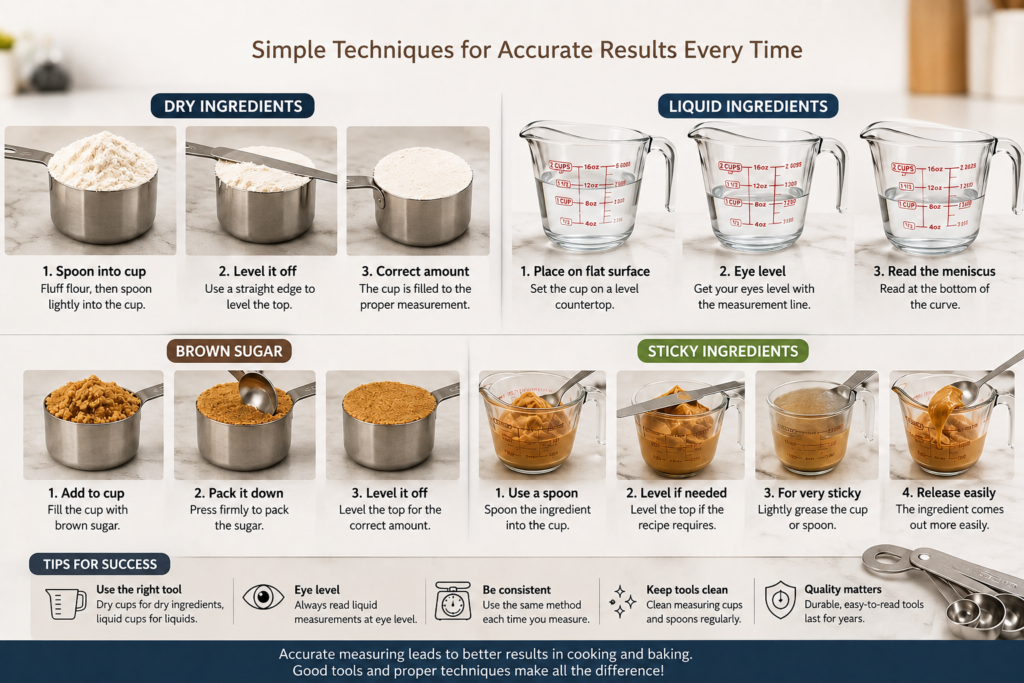
How to Measure Flour Correctly
Flour is one of the easiest ingredients to measure incorrectly.
If flour is compressed into the cup, you may end up using considerably more than the recipe intended.
For the spoon-and-level method:
- Stir or fluff the flour gently.
- Spoon the flour into the measuring cup.
- Fill the cup slightly above the rim.
- Do not press the flour down.
- Use a straight edge to level off the excess.
This method helps prevent the flour from becoming unnecessarily compacted.
Should You Scoop Flour Directly From the Container?
Scooping a measuring cup directly into a flour container is convenient, but it can compress the flour.
That means one cup may contain more flour than it would if the flour were spooned gently into the cup.
For recipes where precision matters, especially baking, spooning and leveling is a better method.
If a recipe provides measurements by weight, using a digital kitchen scale can be even more consistent.
How to Measure Granulated Sugar
Granulated sugar is easier to measure than flour because it does not compress in the same way.
To measure it:
- Scoop or pour the sugar into a dry measuring cup.
- Fill the cup to the rim.
- Level the top if necessary.
Avoid intentionally packing granulated sugar unless a recipe specifically tells you to.
How to Measure Brown Sugar
Brown sugar is often measured differently.
If a recipe calls for packed brown sugar:
- Spoon the sugar into the measuring cup.
- Press it down firmly.
- Add more sugar.
- Continue packing until the cup is full.
- Level the top.
When removed from the cup, properly packed brown sugar often holds the shape of the cup.
If the recipe does not specify packed brown sugar, follow the recipe instructions rather than automatically packing it.
How to Measure Powdered Sugar
Powdered sugar can become compacted and may contain small lumps.
For best results:
- Stir or sift it if the recipe requires it.
- Spoon it gently into a dry measuring cup.
- Do not pack it down unless instructed.
- Level the top.
If the recipe specifically says sifted powdered sugar, pay attention to whether the recipe expects you to sift before or after measuring.
How to Measure Oats, Rice, and Other Grains
Ingredients such as oats and rice are generally straightforward.
- Pour or scoop the ingredient into a dry measuring cup.
- Fill it to the rim.
- Level the top if necessary.
Do not compress the ingredient unless the recipe specifically asks for it.
How to Measure Chopped Nuts
For chopped nuts, the wording of the recipe matters.
For example:
- 1 cup nuts, chopped usually means measure the whole nuts first, then chop them.
- 1 cup chopped nuts usually means chop the nuts first, then measure one cup.
This small difference can change the amount used.
Reading ingredient instructions carefully can be just as important as using the correct measuring cup.
How to Measure Liquid Ingredients
For liquids such as water, milk, broth, and juice:
- Place the liquid measuring cup on a flat surface.
- Pour the liquid into the cup.
- Let the liquid settle.
- Bend down so your eyes are level with the measurement line.
- Check that the liquid reaches the correct marking.
Avoid holding the cup in your hand while reading the measurement.
Why Should Liquid Measurements Be Read at Eye Level?
When you look at the cup from above or below, the liquid may appear to line up with a different measurement line.
This is caused by the viewing angle.
Reading the cup at eye level makes it easier to judge the amount accurately.
What Is the Meniscus?
Many liquids form a slight curve at the surface when they sit inside a measuring cup.
This curve is called the meniscus.
For water and similar liquids, the measurement is generally read around the bottom of the curve.
For ordinary home cooking, the most important habits are:
- Keep the cup on a flat surface
- Read it at eye level
How to Measure Cooking Oil
Cooking oil can be measured in a liquid measuring cup or measuring spoon, depending on the amount.
For larger amounts:
- Place the liquid measuring cup on the counter.
- Pour the oil to the correct line.
- Check the measurement at eye level.
For small amounts, use a measuring spoon and fill it carefully to the rim.
How to Measure Honey, Syrup, and Molasses
Sticky ingredients can be frustrating because some of the ingredient remains in the measuring tool.
To make them easier to remove:
- Use the measuring cup or spoon specified in the recipe.
- Lightly coat the inside with a small amount of neutral cooking oil or cooking spray if appropriate.
- Add the sticky ingredient.
- Level it if needed.
- Transfer it to the recipe.
The ingredient should slide out more easily.
A flexible silicone measuring cup can also be convenient for thick or sticky ingredients.
How to Measure Peanut Butter and Other Thick Ingredients
Ingredients such as peanut butter, nut butter, shortening, yogurt, and sour cream are often easiest to measure with a dry measuring cup.
- Spoon the ingredient into the cup.
- Press it gently into empty spaces.
- Level the top.
- Scrape it out with a spatula.
Some cooks prefer adjustable measuring cups for thick ingredients because the ingredient can be pushed directly out of the container.
How to Measure Butter
Butter can often be measured using markings printed on the wrapper.
Many packaged butter sticks show tablespoon or cup measurements.
If the wrapper markings are clear and accurate, simply cut the amount needed.
For recipes using softened butter, you can also measure it using a dry measuring cup if necessary.
How to Measure Spices
For spices and other small dry ingredients:
- Choose the correct measuring spoon.
- Fill the spoon.
- Level the top unless the recipe says otherwise.
Avoid estimating the difference between a teaspoon and tablespoon when following a new recipe.
One tablespoon is significantly larger than one teaspoon, so confusing them can dramatically change the flavor.
How to Measure Salt
Salt can vary in crystal size.
Fine table salt, kosher salt, and coarse sea salt may occupy different amounts of space even when the volume measurement is the same.
That means substituting one type for another by volume can sometimes change the saltiness of a dish.
Whenever possible, use the type of salt specified in the recipe.
For recipes that provide salt by weight, a kitchen scale can offer greater consistency.
How to Measure Baking Powder and Baking Soda
Leavening ingredients should be measured carefully because small changes can affect baked goods.
To measure:
- Dip the correct measuring spoon into the ingredient.
- Fill it completely.
- Use a straight edge to level the top.
Do not use a heaping spoon unless the recipe specifically asks for one.
How to Measure Vanilla and Other Extracts
Liquid flavorings such as vanilla extract are usually measured with measuring spoons.
Hold the spoon level and pour carefully until it reaches the rim.
It can help to measure over a small bowl rather than directly over your mixing bowl.
That way, if you accidentally pour too much, you will not ruin the entire mixture.
What Does “Heaping” Mean?
A heaping spoon or cup has an ingredient piled above the rim.
This is different from a level measurement.
Modern recipes generally use level measurements unless they specifically state:
- Heaping
- Rounded
- Packed
If a recipe does not specify otherwise, level the ingredient.
What Does “Packed” Mean?
Packed means the ingredient should be pressed firmly into the measuring cup.
Brown sugar is the most common example.
Packing removes empty spaces and increases the amount of ingredient in the cup.
Do not pack ingredients such as flour unless a recipe specifically tells you to do so.
What Does “Scant” Mean?
A scant measurement means slightly less than the full stated amount.
For example, a scant cup is just a little less than one full cup.
Because the term is not very precise, modern recipes may instead provide a specific measurement.
Measuring by Volume vs Measuring by Weight
Measuring cups and spoons measure volume.
A kitchen scale measures weight.
For many everyday cooking recipes, volume measurements are convenient and perfectly practical.
However, weight can be more consistent for some ingredients.
Flour is a classic example because the amount that fits in one cup can change depending on how it is filled.
A kitchen scale avoids much of that variation.
When Is a Kitchen Scale Most Useful?
A digital scale can be especially useful for:
- Bread
- Cakes
- Pastries
- Pizza dough
- Large baking recipes
- Recipes written in grams
- Portioning food
- Repeating a recipe consistently
It also reduces the number of measuring cups that need to be washed.
We’ll compare scales and measuring cups in more detail in the next guide in this series.
Do You Need Perfect Measurements for Cooking?
Not always.
Cooking often allows adjustments based on taste.
You may add a little more garlic, herbs, broth, or seasoning depending on your preferences.
Baking is generally less forgiving because the proportions of flour, fat, sugar, liquid, eggs, and leavening can affect the structure of the finished product.
A useful rule is:
Be especially precise when baking, and use good judgment when cooking.
Common Measuring Mistakes to Avoid
Some of the most common mistakes include:
- Packing flour into the cup
- Measuring liquid while holding the cup in the air
- Looking down at liquid measurement markings
- Confusing tablespoons and teaspoons
- Using heaping measurements when level measurements are intended
- Forgetting to pack brown sugar when the recipe requires it
- Using tools with faded or difficult-to-read markings
- Mixing metric and U.S. measurements without converting properly
Keep Your Measuring Tools Easy to Read
A measuring tool is only useful if you can clearly identify the amount.
Over time, painted measurement markings may fade.
That is why permanent or engraved measurements can be especially useful on measuring cups and spoons that you expect to use for many years.
Before buying a set, check whether the measurements are:
- Large enough to read
- Clearly marked
- Permanently engraved or stamped
- Easy to distinguish from one another
Choose Measuring Tools That Fit Your Ingredient Containers
This is a small detail that can make a big difference.
Wide measuring spoons may not fit into narrow spice jars.
Short measuring cup handles may make it difficult to scoop ingredients from deep containers.
Useful features include:
- Narrow spoon heads
- Long handles
- Strong handles
- Comfortable grips
- Flat-bottomed cups
- Easy nesting
A tool that is easy to use will usually get used more often.
Clean Measuring Tools Between Ingredients
If you use the same measuring spoon for several ingredients, clean or wipe it when necessary.
For example, dipping a wet spoon into a container of baking powder or spices can introduce moisture.
A simple routine is:
- Measure dry ingredients first
- Measure liquids afterward
- Wash sticky tools as soon as practical
This can make preparation easier and keep ingredient containers cleaner.
Develop a Consistent Measuring Routine
Consistency is often more important than trying to measure perfectly every single time.
If you always measure flour using the same spoon-and-level method, your results are more likely to be repeatable.
A simple routine might be:
- Read the recipe completely.
- Gather the correct measuring tools.
- Measure dry ingredients using dry cups.
- Measure liquids in a liquid measuring cup.
- Level ingredients when needed.
- Double-check tablespoons and teaspoons.
- Measure at eye level when appropriate.
Why Good Measuring Tools Are Worth Buying Carefully
Measuring cups and spoons are not tools you necessarily replace every year.
A good set may stay in your kitchen for a very long time.
That makes it worthwhile to choose tools with:
- Durable materials
- Permanent markings
- Strong handles
- Comfortable shapes
- Useful standard sizes
- Easy storage
- Simple cleaning
Buying carefully once can be more practical than repeatedly replacing cheaper tools with faded numbers, bent handles, or inconvenient shapes.
FAQ
What is the best way to measure flour?
For volume measurements, gently fluff the flour, spoon it into a dry measuring cup, and level the top without packing it down.
Should I scoop flour directly with the measuring cup?
It is better to spoon flour into the cup for greater consistency, especially when baking.
Why is brown sugar packed?
Packing removes air spaces and gives the amount intended by recipes that specify packed brown sugar.
Should liquid measurements be read at eye level?
Yes. Place the cup on a flat surface and read the measurement at eye level for better accuracy.
Can I use measuring spoons for both dry and liquid ingredients?
Yes. Measuring spoons are commonly used for both.
What is the difference between a level and heaping tablespoon?
A level tablespoon is filled only to the rim. A heaping tablespoon has ingredient piled above the rim and contains more.
Is a kitchen scale more accurate than measuring cups?
For many dry ingredients, especially flour, weighing can provide more consistent results than volume measuring.
How do I measure sticky ingredients without wasting them?
A light coating of neutral cooking oil or cooking spray can help ingredients such as honey or syrup release more easily from a measuring cup or spoon.
Should I buy measuring tools with engraved numbers?
They are a good choice for long-term use because engraved or stamped measurements are less likely to disappear over time.
Do I need expensive measuring cups to measure correctly?
No. Good technique and clearly marked, accurately sized tools matter more than price alone.
Conclusion
Measuring ingredients correctly is a simple skill that can make recipes much more consistent.
Use dry measuring cups for ingredients that need to be filled and leveled, liquid measuring cups for pourable ingredients, and measuring spoons for smaller quantities.
Pay special attention to ingredients that require different techniques: spoon and level flour, pack brown sugar when instructed, measure liquids on a flat surface at eye level, and handle sticky ingredients in a way that makes them easier to release.
Good technique matters just as much as good equipment.
And because measuring cups and spoons can stay in your kitchen for years, choosing durable tools with permanent markings, comfortable handles, and practical shapes from the beginning can make everyday cooking easier for a long time.
Continue Reading Our Measuring Cups & Spoons Series
Explore the other guides in our Measuring Cups & Spoons Series:
- Measuring Cups and Spoons: A Beginner’s Guide — already published
- Dry vs Liquid Measuring Cups: What’s the Difference? — already published
- Measuring Cups vs Kitchen Scale: Which Is More Accurate? — coming next
- How to Choose the Best Measuring Cups and Spoons — coming soon
As each guide is published, these titles can be connected with internal links to complete the Measuring Cups & Spoons Series.