Introduction
A good kitchen knife can last for many years when it is cared for properly.
Even an expensive knife can become dull, damaged, or rusty if it is washed incorrectly, stored carelessly, or used on the wrong cutting surface. On the other hand, a few simple daily habits can help protect the blade and keep it performing well.
Proper knife care does not have to be complicated. Keeping your knife clean and dry, using the right cutting board, storing it safely, and maintaining the edge can make a big difference.
In this guide, we’ll explain how to care for kitchen knives, keep them sharp, prevent damage, and extend their useful life.
Why Proper Knife Care Matters
Kitchen knives are used almost every day, so they naturally experience wear over time.
Proper care can help:
- Keep the blade sharper for longer
- Reduce the risk of rust and corrosion
- Protect the handle
- Prevent chips and other blade damage
- Make cutting easier and safer
- Extend the life of the knife
Good knife care begins with the way you use, wash, dry, and store the knife every day.
Wash Kitchen Knives by Hand
One of the easiest ways to protect your knives is to wash them by hand.
After using a knife:
- Wash it with warm water and mild dish soap.
- Use a soft sponge or cloth.
- Keep the sharp edge facing away from your fingers.
- Rinse the knife thoroughly.
- Dry it immediately.
Do not leave sharp knives hidden in a sink full of soapy water. Someone could accidentally reach into the sink and touch the blade.
Should Kitchen Knives Go in the Dishwasher?
In general, hand washing is the better choice for quality kitchen knives.
Dishwashers can expose knives to:
- High heat
- Strong detergents
- Extended moisture
- Contact with other utensils
These conditions may dull the cutting edge, damage some handle materials, or contribute to corrosion.
Even when a manufacturer says a knife is dishwasher-safe, hand washing can help preserve it for longer.
Dry Knives Immediately
Do not leave a knife wet after washing.
Water left on the blade can eventually contribute to stains or corrosion, particularly with carbon steel knives.
After rinsing, wipe the blade and handle completely dry with a clean towel.
Then put the knife back into its proper storage location.
Use the Right Cutting Board
The surface you cut on has a major effect on how long the edge stays sharp.
Good everyday choices include:
- Wood cutting boards
- Quality plastic cutting boards
Avoid regularly cutting directly on very hard surfaces such as:
- Glass
- Granite
- Marble
- Ceramic plates
- Metal countertops
These surfaces can dull a sharp edge much faster.
Never Use a Kitchen Knife as a General Tool
Kitchen knives are designed to cut food.
Avoid using them to:
- Open cans
- Pry open containers
- Turn screws
- Cut wire
- Open hard plastic packaging
- Chop materials that are not food
Using a knife as a general-purpose tool can chip, bend, or break the blade.
Use the Right Knife for the Job
Different knives are designed for different cutting tasks.
For example:
- Use a chef’s knife for general chopping and slicing.
- Use a bread knife for crusty bread.
- Use a paring knife for small, precise tasks.
- Use a boning knife for working around bones.
- Use an appropriate cleaver for tasks involving bones.
Trying to force a delicate knife through hard bones or frozen food can damage the blade.
Avoid Cutting Frozen Food
Frozen food can be extremely hard.
Unless your knife is specifically designed for that purpose, avoid using a regular chef’s knife or Santoku knife to cut through frozen ingredients.
The hard surface can chip or damage the cutting edge.
Allow frozen food to thaw sufficiently before cutting whenever possible.
Keep Your Knife Sharp
A sharp knife is easier to control because it requires less pressure to cut food.
A dull knife can slide off the surface of an ingredient and may require excessive force.
There are two important parts of edge maintenance:
Honing
Honing helps realign the knife’s existing cutting edge.
It does not remove much metal and can be done periodically between sharpening sessions.
Sharpening
Sharpening removes a small amount of metal and creates a fresh cutting edge.
If honing no longer restores good cutting performance, the knife may need sharpening.
How Often Should You Hone a Knife?
There is no exact schedule that works for everyone.
Some home cooks hone their knives every few uses, while others do it only when they notice that the knife is beginning to feel less sharp.
How often you need to hone depends on:
- How frequently you cook
- The type of knife
- The blade steel
- The cutting surface
- Your cutting technique
The goal is to maintain the edge before the knife becomes noticeably dull.
How Often Should You Sharpen Kitchen Knives?
Sharpening is usually needed less frequently than honing.
Many home cooks may only need to sharpen their knives a few times per year.
Instead of relying on a strict schedule, watch for signs that the blade is becoming dull.
A knife may need sharpening if it:
- Struggles to slice a tomato
- Tears paper rather than slicing it
- Slips across onion skin
- Requires noticeably more pressure
- No longer cuts cleanly
Sharpen only when necessary because sharpening removes a small amount of metal from the blade.
Store Kitchen Knives Properly
Proper storage protects both the cutting edge and the people using the kitchen.
Good storage options include:
Knife Block
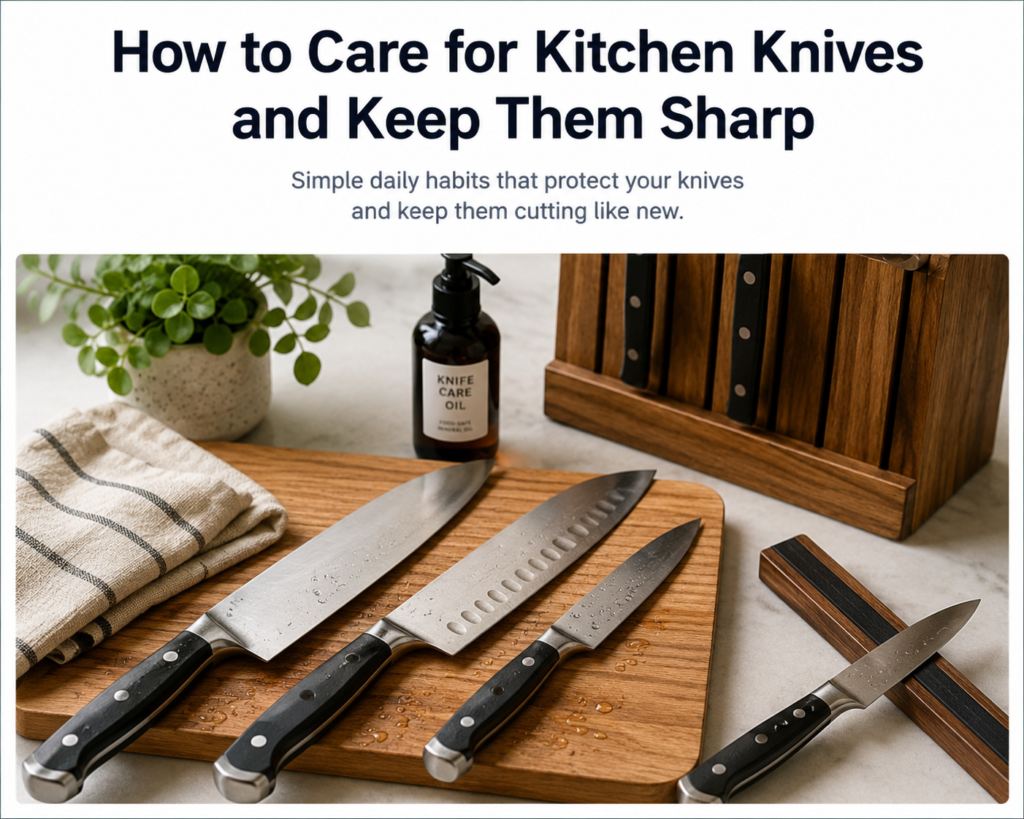
A knife block keeps knives organized and protects the blades.
Make sure knives are clean and completely dry before putting them away.
Magnetic Knife Strip
A magnetic strip keeps knives visible and easy to access.
Place and remove the knife carefully so the blade does not strike the strip forcefully.
In-Drawer Knife Organizer
This is a good choice if you prefer to keep knives out of sight.
The organizer should hold each knife separately so the blades do not rub against other utensils.
Blade Guards
Individual blade guards are useful if you need to store knives in a drawer.
They also help protect knives during transportation.
Avoid Storing Knives Loose in a Drawer
Do not throw sharp kitchen knives loosely into a drawer with forks, spoons, and other utensils.
This can:
- Damage the cutting edge
- Scratch the blade
- Create a safety hazard
- Make the knife harder to find safely
Use a proper organizer or blade guard instead.
How to Prevent Rust on Kitchen Knives
Stainless steel knives resist corrosion well, but they are not completely immune to staining or rust.
To reduce the risk:
- Wash knives soon after use
- Do not leave acidic food on the blade
- Dry knives immediately
- Store them in a dry location
Foods such as lemon, tomatoes, and vinegar can be especially harsh on some blade materials if residue is left for a long time.
Caring for Carbon Steel Knives
Carbon steel knives require a little more attention than most stainless steel knives.
They can react with moisture and acidic foods more easily.
To care for carbon steel:
- Wash the knife soon after use
- Dry it immediately
- Avoid leaving food residue on the blade
- Store it in a dry environment
Some carbon steel knife owners also apply a very thin layer of food-safe mineral oil when the knife will be stored for an extended period.
Carbon steel may naturally develop a patina over time. A patina is different from active rust and can be a normal result of using carbon steel.
What Should You Do If a Knife Starts to Rust?
Small surface rust spots can sometimes be removed.
The appropriate method depends on the blade material and severity of the rust.
After removing surface rust:
- Wash the blade carefully.
- Dry it thoroughly.
- Inspect the blade for deeper damage.
- Store it in a dry place.
If rust is extensive, deeply pitted, or you are unsure whether the knife can be restored safely, consider having it evaluated by a professional knife sharpener.
Protect the Knife Handle
The handle also needs care.
Wooden handles should not be soaked in water for long periods.
Prolonged moisture can cause some wooden handles to:
- Swell
- Crack
- Warp
- Become rough
Wash the handle quickly and dry it immediately.
Depending on the knife manufacturer’s recommendations, some wooden handles may occasionally benefit from a food-safe conditioning oil.
Do Not Leave Knives in the Sink
Leaving knives in a sink is both a maintenance problem and a safety problem.
The blade may:
- Hit other dishes
- Become scratched
- Develop corrosion
- Become difficult to see under water
More importantly, someone reaching into the sink may accidentally cut themselves.
Wash the knife shortly after use and put it away safely.
Avoid Scraping Food With the Sharp Edge
Many people use the cutting edge of a chef’s knife to scrape chopped vegetables across a cutting board.
Doing this repeatedly can dull the edge.
Instead, turn the knife over and use the spine of the blade to move food, or use a bench scraper.
This simple habit can help the edge stay sharp longer.
Do Not Twist the Blade While Cutting
Try to cut straight through food rather than twisting the knife while the blade is embedded in something firm.
Sideways twisting can put unnecessary stress on a thin cutting edge.
If an ingredient is too hard to cut comfortably, stop and use a more appropriate knife or preparation method.
How to Tell If Your Knife Is Still Sharp
You can perform a few simple tests.
Tomato Test
Try slicing a ripe tomato without applying heavy pressure.
A sharp knife should break through the skin easily.
Paper Test
Carefully slice through a sheet of paper.
A sharp blade should cut smoothly rather than tearing repeatedly.
Everyday Cutting Test
Often the best test is simply paying attention while cooking.
If onions, herbs, vegetables, and meat suddenly become harder to cut, the knife may need maintenance.
Never test sharpness by sliding your finger along the cutting edge.
Common Kitchen Knife Care Mistakes
Avoid these habits:
- Putting quality knives in the dishwasher
- Leaving knives wet
- Cutting on glass or stone
- Storing knives loose in a drawer
- Using knives to open cans
- Cutting frozen food with the wrong knife
- Cutting bones with a knife not designed for bones
- Scraping the cutting board with the sharp edge
- Sharpening more often than necessary
- Ignoring rust or blade damage
Small changes in daily habits can significantly extend the life of a kitchen knife.
A Simple Daily Knife Care Routine
Knife care does not need to take much time.
After cooking:
- Wash the knife by hand.
- Rinse it.
- Dry it immediately.
- Check that the blade is clean.
- Put it into proper storage.
During regular use:
- Use a knife-friendly cutting board
- Avoid frozen foods and bones unless the knife is designed for them
- Hone when needed
- Sharpen when the blade becomes dull
These simple habits are enough for most home cooks.
FAQ
What is the best way to keep kitchen knives sharp?
Use a wood or quality plastic cutting board, avoid hard cutting surfaces, hone when needed, sharpen when the blade becomes dull, and store the knife so the cutting edge is protected.
Should I wash kitchen knives immediately after use?
It is a good habit, particularly after cutting acidic or salty foods. Wash the knife by hand and dry it immediately.
Can I leave a kitchen knife to air-dry?
Drying it immediately with a clean towel is better, especially for carbon steel or other blades that may be more susceptible to corrosion.
Is a wooden cutting board good for knives?
Yes. Wood is a popular knife-friendly cutting surface and is generally much easier on a blade than glass or stone.
Does a knife block dull knives?
A properly designed knife block can be a good storage option. Insert and remove knives carefully so the cutting edge does not repeatedly scrape against a hard surface.
How often should kitchen knives be sharpened?
There is no universal schedule. Sharpen when you notice that the knife is no longer cutting cleanly or requires more pressure than usual.
How can I prevent my knife from rusting?
Wash it after use, dry it immediately, avoid leaving food or moisture on the blade, and store it in a dry location.
Can a rusty kitchen knife still be used?
Minor surface rust may sometimes be removable, but deeper corrosion or pitting should be evaluated carefully. If the knife is badly damaged or you are unsure about its condition, professional advice is the safer option.
Should I oil my kitchen knife?
Most stainless steel kitchen knives do not require routine blade oiling. Some carbon steel knives may benefit from a very thin coating of food-safe mineral oil, especially before longer storage.
What is the biggest mistake people make with kitchen knives?
Leaving knives wet, using hard cutting surfaces, putting quality knives in the dishwasher, and storing them loosely with other utensils are among the most common habits that shorten knife life.
Conclusion
Taking care of kitchen knives does not require complicated equipment or a lot of time.
Wash them by hand, dry them immediately, use a knife-friendly cutting board, store them properly, and maintain the cutting edge when necessary.
Avoid using your knives for jobs they were not designed to perform, and pay attention to early signs of dullness, rust, or damage.
With these simple habits, a good kitchen knife can remain sharp, reliable, and enjoyable to use for many years.
Explore Our Complete Kitchen Knife Series
This guide completes our Kitchen Knife Series. If you missed any of the earlier guides, you can explore them here:
- Chef’s Knife: What It Is and How to Use It
- Chef’s Knife vs Santoku Knife: What’s the Difference?
- Types of Kitchen Knives and What They’re Used For
- How to Sharpen a Kitchen Knife at Home
- How to Care for Kitchen Knives and Keep Them Sharp
Together, these guides cover the basics of choosing, using, sharpening, and caring for the kitchen knives you use every day.