Introduction
A sharp kitchen knife is easier, faster, and safer to use than a dull one.
When a knife becomes dull, it requires more pressure to cut food and is more likely to slip. Regular sharpening helps restore the cutting edge so the knife can slice cleanly again.
You do not need professional equipment to sharpen many kitchen knives at home. With the right method, a little patience, and proper technique, you can keep your everyday knives in good condition.
In this guide, we’ll explain how to tell when a knife needs sharpening, the most common sharpening methods, and how to sharpen a kitchen knife safely at home.
How Do You Know When a Knife Needs Sharpening?
A dull knife often gives you several warning signs.
Your knife may need sharpening if:
- It crushes tomatoes instead of slicing them cleanly
- It struggles to cut through onion skin
- You need to use more pressure than usual
- The blade slips across food instead of biting into it
- Paper tears instead of slicing cleanly
- The edge feels noticeably less effective than before
A knife does not have to be completely blunt before you sharpen it.
Sharpening before the blade becomes extremely dull can make maintenance easier.
Honing vs Sharpening: What’s the Difference?
Honing and sharpening are not the same thing.
Honing
Honing helps realign the edge of the blade.
During normal use, the very thin cutting edge can bend slightly out of alignment. A honing rod helps straighten that edge.
Honing removes very little metal.
Sharpening
Sharpening actually removes a small amount of metal from the blade to create a new cutting edge.
If honing no longer improves the knife’s performance, the blade probably needs sharpening.
Both methods are useful, but they serve different purposes.
Common Ways to Sharpen a Kitchen Knife at Home
There are several ways to sharpen a knife at home.
The most common options include:
- Whetstones
- Manual pull-through sharpeners
- Electric sharpeners
- Professional sharpening services
Each method has advantages and disadvantages.
Method 1: Sharpening With a Whetstone
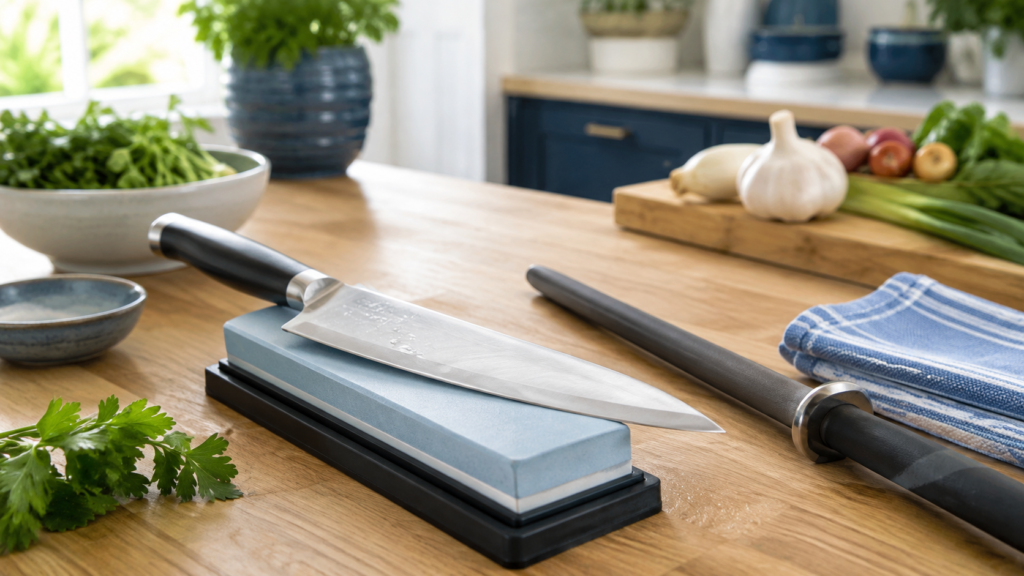
A whetstone, also called a sharpening stone, gives you excellent control over the sharpening process.
It takes more practice than some other methods, but it can produce very good results.
What You’ll Need
- A sharpening stone
- Water or oil, depending on the type of stone
- A stable work surface
- A clean towel
- Your kitchen knife
Always follow the stone manufacturer’s instructions before use.
Understanding Whetstone Grit
Sharpening stones come in different grit levels.
Coarse Grit
Coarse stones remove more material and are useful for repairing very dull or damaged edges.
Medium Grit
Medium-grit stones are commonly used for routine sharpening.
Fine Grit
Fine stones refine and polish the edge after sharpening.
For general home maintenance, many cooks use a combination stone with both medium and fine surfaces.
How to Sharpen a Knife With a Whetstone
Step 1: Prepare the Stone
If your whetstone requires soaking, place it in water for the amount of time recommended by the manufacturer.
Some stones do not require soaking, so always check the instructions first.
Place the stone on a non-slip base or damp towel to prevent it from moving.
Step 2: Find the Correct Angle
Many Western-style kitchen knives are sharpened at roughly 15 to 20 degrees per side.
Japanese knives may use different angles depending on the blade.
If you know the knife manufacturer’s recommended sharpening angle, use that.
If not, focus on maintaining a consistent angle throughout the sharpening process.
Step 3: Place the Blade on the Stone
Hold the knife securely.
Place the edge against the stone at the chosen angle.
Keep your fingers away from the cutting edge.
Step 4: Move the Blade Across the Stone
Using controlled pressure, slide the blade across the stone.
Work from the heel of the knife toward the tip so the entire edge contacts the stone.
Repeat the motion several times while maintaining the same angle.
Step 5: Sharpen the Other Side
Turn the knife over and repeat the same process on the opposite side.
Try to use a similar number of strokes on each side.
Step 6: Refine the Edge
If your stone has a finer side, repeat the process using the finer grit.
Use lighter pressure as you refine the edge.
Step 7: Clean the Knife
Rinse the blade carefully after sharpening.
Dry it completely before storing or using it.
Method 2: Using a Manual Knife Sharpener
Manual pull-through sharpeners are easier for beginners because the sharpening angle is usually built into the device.
To use one:
- Place the sharpener on a stable surface.
- Hold it securely.
- Insert the heel of the knife into the sharpening slot.
- Pull the knife toward you smoothly.
- Do not push the blade backward through the slot.
- Repeat according to the manufacturer’s instructions.
Some sharpeners have separate coarse and fine slots.
Start with the coarse slot only if the knife is very dull, then finish with the fine slot.
Method 3: Using an Electric Knife Sharpener
Electric sharpeners can be fast and convenient.
They usually contain motorized abrasive wheels that sharpen the blade at a predetermined angle.
Follow the manufacturer’s instructions carefully.
Avoid pressing the knife too hard into the machine because excessive pressure can remove more metal than necessary.
Electric sharpeners may not be appropriate for every type of knife, especially specialty Japanese blades.
How to Use a Honing Rod
A honing rod can help maintain the edge between sharpening sessions.
To use one safely:
- Place the tip of the honing rod firmly on a cutting board.
- Hold the rod vertically.
- Place the heel of the knife against the rod at the appropriate angle.
- Draw the blade downward and toward you.
- Move from heel to tip.
- Repeat on the opposite side.
- Alternate sides several times.
Use slow, controlled movements.
There is no need to move quickly like professional chefs sometimes do.
How Often Should You Sharpen a Kitchen Knife?
There is no exact schedule that works for everyone.
How often you need to sharpen depends on:
- How frequently you cook
- What foods you cut
- The type of blade steel
- The cutting board you use
- How the knife is stored
- How carefully the knife is maintained
For many home cooks, sharpening a few times per year may be enough.
Instead of following a strict schedule, pay attention to how the knife performs.
If it stops cutting food cleanly, it may be time to sharpen.
How Often Should You Hone a Knife?
Honing can usually be done more frequently than sharpening.
Some cooks hone their knives every few uses, while others do it when the knife begins to feel slightly less sharp.
Honing helps maintain the edge but cannot restore a blade that has become truly dull.
Simple Ways to Test Knife Sharpness
After sharpening, you can test the knife carefully.
Paper Test
Hold a piece of paper and gently slice downward through it.
A sharp knife should cut through relatively smoothly.
Tomato Test
Try slicing a ripe tomato.
A sharp knife should cut through the skin without requiring heavy pressure.
Onion Test
A sharp blade should easily start cutting through the thin outer layer of an onion.
Never test sharpness by running your finger along the cutting edge.
Common Knife Sharpening Mistakes
Avoid these common mistakes when sharpening your knives.
Using an Inconsistent Angle
Changing the angle repeatedly can create an uneven edge.
Focus on consistency rather than speed.
Using Too Much Pressure
Heavy pressure can remove unnecessary material.
Use controlled, moderate pressure.
Sharpening Only One Side
Most double-bevel kitchen knives should be sharpened on both sides.
Some specialized Japanese knives are different, so check the manufacturer’s instructions.
Using the Wrong Sharpener
Not every sharpening tool works for every knife.
Serrated knives, single-bevel knives, and specialty blades may require different methods.
Sharpening Too Often
Sharpening removes metal.
You should sharpen when necessary rather than sharpening simply because a certain number of days have passed.
Can You Sharpen a Serrated Knife?
Yes, but serrated knives require a different technique.
A standard flat whetstone or pull-through sharpener is usually not ideal.
Serrated knives are commonly sharpened using a tapered sharpening rod that fits inside the individual serrations.
Because the process requires more precision, some people prefer to have serrated knives professionally sharpened.
Can You Sharpen a Santoku Knife?
Yes.
Many Santoku knives can be sharpened using a whetstone.
However, blade angles can vary, so it is a good idea to check the manufacturer’s recommended angle before sharpening.
Can You Sharpen a Chef’s Knife at Home?
Yes.
Chef’s knives are among the easiest kitchen knives to maintain at home.
A whetstone, manual sharpener, or suitable electric sharpener can all work, depending on the knife and your comfort level.
What Is the Best Sharpening Method for Beginners?
For beginners, a manual sharpener can be the easiest method because it helps control the sharpening angle.
A whetstone takes more practice but gives you more control and can be a good long-term skill to learn.
If you own an expensive or specialized knife and are unsure how to sharpen it, professional sharpening may be the safest option.
How to Keep a Knife Sharp for Longer
Good daily habits can reduce how often your knife needs sharpening.
Use the Right Cutting Board
Wood and quality plastic cutting boards are generally easier on knife edges.
Avoid cutting on:
- Glass
- Granite
- Marble
- Ceramic plates
- Metal surfaces
Wash Knives by Hand
Hand washing helps protect the blade and handle.
Dry Knives Immediately
Leaving a knife wet can contribute to corrosion, especially with some types of steel.
Store Knives Properly
Use:
- A knife block
- A magnetic strip
- An in-drawer organizer
- A blade guard
Avoid throwing knives loosely into a drawer.
Use the Right Knife for the Job
Do not use a chef’s knife to cut through hard bones or frozen foods unless the knife is specifically designed for that task.
When Should You Use a Professional Knife Sharpening Service?
Professional sharpening can be useful if:
- The blade has chips
- The edge is badly damaged
- You own expensive knives
- You have a specialized single-bevel knife
- You are uncomfortable sharpening at home
- Home sharpening does not restore the edge
A professional can often repair problems that are difficult to correct with basic home sharpening tools.
FAQ
Is sharpening a knife at home difficult?
It can take some practice, especially when using a whetstone. Manual sharpeners are generally easier for beginners because they help maintain the sharpening angle.
What angle should I sharpen a kitchen knife at?
Many Western-style knives use an angle of roughly 15 to 20 degrees per side, but the correct angle depends on the knife. Check the manufacturer’s recommendation whenever possible.
Is honing the same as sharpening?
No. Honing realigns the existing edge, while sharpening removes metal to create a new cutting edge.
How often should I sharpen my chef’s knife?
Sharpen it when you notice a clear decline in cutting performance rather than following a strict schedule.
Can I sharpen a Santoku knife with a whetstone?
Yes, many Santoku knives can be sharpened with a whetstone. Follow the recommended blade angle for your particular knife.
Are pull-through sharpeners safe for kitchen knives?
They can be convenient, but the results depend on the sharpener and the knife. They may remove more metal than a carefully used whetstone and may not be suitable for specialty blades.
Can I sharpen a serrated bread knife?
Yes, but serrated blades typically require a special tapered sharpening rod or professional sharpening.
Is a sharp knife safer than a dull knife?
A properly used sharp knife is generally easier to control because it requires less pressure to cut food. Safe technique is still essential.
Conclusion
Keeping your kitchen knives sharp makes everyday food preparation easier and more efficient.
For beginners, a manual sharpener can be a simple place to start. A whetstone requires more practice but offers excellent control, while professional sharpening is a good option for damaged or specialized knives.
The most important thing is not to sharpen constantly, but to pay attention to how your knife performs.
Combine occasional sharpening with regular honing, proper cutting boards, careful washing, and safe storage, and your knives can stay sharp and useful for much longer.
Continue Reading Our Kitchen Knife Series
Explore the other guides in our Kitchen Knife Series:
- Chef’s Knife: What It Is and How to Use It — already published
- Chef’s Knife vs Santoku Knife: What’s the Difference? — already published
- Types of Kitchen Knives and What They’re Used For — already published
- How to Care for Kitchen Knives and Keep Them Sharp — coming next
As each guide is published, these titles can be connected with internal links to make it easy to move through the complete Kitchen Knife Series.