Introduction
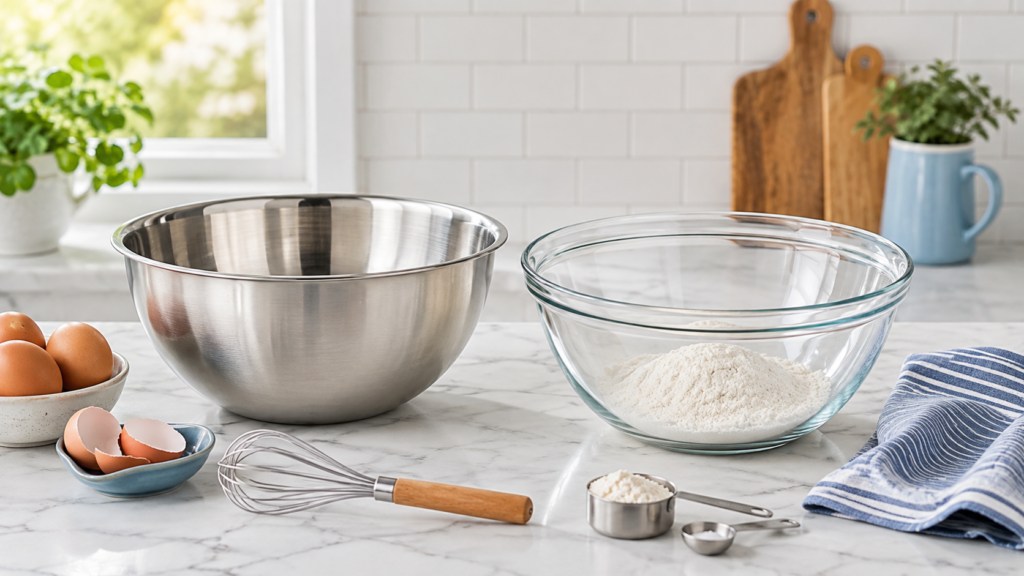
Stainless steel and glass are two of the most popular materials for mixing bowls. Both are durable, versatile, and useful for everyday cooking and baking, but they have some important differences.
Stainless steel bowls are lightweight, strong, and easy to handle, while glass bowls are heavier but allow you to see your ingredients as you mix. Glass bowls can also be useful for microwave tasks, while stainless steel bowls are often preferred for whipping, tossing, and frequent everyday use.
So which one is better for your kitchen?
In this guide, we’ll compare stainless steel and glass mixing bowls so you can decide which material works best for the way you cook and bake.
Stainless Steel Mixing Bowls
Stainless steel mixing bowls are commonly used in both home and professional kitchens.
They are lightweight, durable, and resistant to breaking, which makes them especially convenient for frequent cooking and baking.
Pros of Stainless Steel Mixing Bowls
- Lightweight and easy to handle
- Very durable
- Resistant to breaking and chipping
- Easy to clean
- Often dishwasher-safe
- Easy to stack and store
- Excellent for whisking and mixing
- Can be chilled quickly
One of the biggest advantages of stainless steel is its durability. If you accidentally drop a stainless steel bowl, it is unlikely to break.
Cons of Stainless Steel Mixing Bowls
- Cannot be used in the microwave
- You cannot see ingredients through the sides
- Lightweight bowls may slide while mixing
- May show scratches over time
Choosing a bowl with a silicone or rubber base can help prevent slipping.
Glass Mixing Bowls
Glass mixing bowls are another popular choice, especially for baking.
Because glass is transparent, you can see the ingredients from the sides and bottom of the bowl while mixing.
Pros of Glass Mixing Bowls
- Easy to see ingredients while mixing
- Does not easily absorb odors
- Resistant to staining
- Many are microwave-safe
- Often dishwasher-safe
- Can look attractive enough for serving
Glass bowls are especially convenient when you need to melt ingredients in the microwave before continuing with a recipe.
Cons of Glass Mixing Bowls
- Heavier than stainless steel
- Can break or chip if dropped
- More difficult to handle when filled
- Sudden temperature changes may damage some glass bowls
Always follow the manufacturer’s instructions for microwave, oven, freezer, and dishwasher use.
Stainless Steel vs Glass: Weight
If you prefer a lightweight bowl, stainless steel is the clear winner.
A large glass bowl can become quite heavy once it is filled with dough, batter, or salad.
Stainless steel bowls are much easier to lift, move, and hold while whisking.
Winner: Stainless Steel
Stainless Steel vs Glass: Durability
Stainless steel is extremely durable and difficult to break.
Glass is strong during normal use, but it can crack, chip, or break if dropped.
For busy kitchens or households where bowls are used frequently, stainless steel is usually the safer choice.
Winner: Stainless Steel
Stainless Steel vs Glass: Microwave Use
Glass has an important advantage when microwave use is needed.
Many glass mixing bowls are microwave-safe, allowing you to melt butter, chocolate, or other ingredients directly in the bowl.
Stainless steel should never be placed in a microwave.
Winner: Glass
Stainless Steel vs Glass: Baking
Both materials work very well for baking.
Stainless steel is excellent for:
- Whipping cream
- Beating egg whites
- Mixing dough
- Preparing cake batter
- Combining dry ingredients
Glass is excellent for:
- Mixing batter
- Melting ingredients
- Watching the consistency of mixtures
- Microwave preparation
If you bake frequently, having one of each can be very useful.
Winner: Tie
Stainless Steel vs Glass: Whipping Cream and Egg Whites
Stainless steel is particularly useful for whipping cream because the bowl can be chilled quickly.
A cold stainless steel bowl can help keep cream cool while it is being whipped.
Stainless steel is also lightweight enough to hold comfortably while using a hand whisk.
Winner: Stainless Steel
Stainless Steel vs Glass: Mixing Batter
Both materials work well for cake, muffin, pancake, and cookie batter.
Glass has the advantage of transparency, allowing you to check whether ingredients are fully incorporated.
However, stainless steel is lighter and easier to handle.
For most batters, the choice comes down to personal preference.
Winner: Tie
Stainless Steel vs Glass: Cleaning
Both stainless steel and glass are relatively easy to clean.
Many bowls made from either material are dishwasher-safe.
Glass is especially resistant to stains and odors, while stainless steel also performs very well with oily or strongly flavored ingredients.
Always check the manufacturer’s care instructions.
Winner: Tie
Stainless Steel vs Glass: Storage
Stainless steel bowls are generally easier to store because they are lightweight and often designed to nest closely together.
Glass nesting bowls are also available, but they are heavier and should be handled more carefully.
If cabinet space is limited, a nesting stainless steel set can be especially convenient.
Winner: Stainless Steel
Quick Comparison
| Feature | Stainless Steel | Glass |
|---|---|---|
| Weight | Lightweight | Heavy |
| Durability | Excellent | Good, but breakable |
| Microwave-Safe | No | Often yes |
| Dishwasher-Safe | Usually | Often |
| Easy to Store | Excellent | Good |
| See-Through | No | Yes |
| Whipping Cream | Excellent | Good |
| Baking | Excellent | Excellent |
| Resistance to Odors | Excellent | Excellent |
Which Mixing Bowl Is Better for Everyday Cooking?
For most everyday cooking tasks, stainless steel is the more practical choice.
It is lightweight, durable, easy to clean, and simple to store.
You can use stainless steel bowls for everything from tossing salads and mixing marinades to preparing dough and whisking eggs.
Which Mixing Bowl Is Better for Baking?
Both are excellent for baking, but they offer different advantages.
Choose stainless steel if you want something lightweight and durable.
Choose glass if you frequently use the microwave or like being able to see your mixture through the bowl.
Many frequent bakers find it useful to keep both types in the kitchen.
Should You Own Both?
For many home cooks, owning both stainless steel and glass mixing bowls is the most versatile option.
A stainless steel set can handle most everyday tasks, while one or two glass bowls can be useful when you need microwave-safe preparation or want to see ingredients clearly.
You do not need a large collection. A few carefully chosen bowls in different sizes are usually enough.
FAQ
Are stainless steel mixing bowls better than glass?
Stainless steel bowls are better for people who want lightweight, durable, and easy-to-store bowls. Glass may be better if microwave use and visibility are important to you.
Can you put a stainless steel mixing bowl in the microwave?
No. Stainless steel and other metal bowls should never be placed in a microwave.
Can glass mixing bowls go in the microwave?
Many glass mixing bowls are microwave-safe, but you should always check the manufacturer’s instructions before using one in the microwave.
Which bowl is best for whipping cream?
Stainless steel is an excellent choice because it can be chilled quickly and helps keep the cream cold while whipping.
Which bowl is best for cake batter?
Both stainless steel and glass work well for cake batter. Stainless steel is lighter, while glass allows you to see whether the ingredients are completely mixed.
Do stainless steel mixing bowls absorb odors?
No. Stainless steel is nonporous and generally does not absorb food odors or flavors.
How many mixing bowls do I need?
For most kitchens, three to five bowls in different sizes are enough for everyday cooking and baking.
Conclusion
Stainless steel and glass mixing bowls are both excellent kitchen tools, but they work best in slightly different situations.
Stainless steel is lightweight, durable, easy to store, and especially useful for everyday mixing, whisking, and baking.
Glass is heavier and breakable, but its transparency and microwave compatibility make it useful for many baking and food preparation tasks.
If you want just one set of mixing bowls, stainless steel is usually the most practical choice. If you cook and bake frequently, having both stainless steel and glass bowls can give you the best of both worlds.