Introduction
Hybrid frying pans have become an increasingly visible option for home cooks who want some of the benefits of stainless steel and nonstick cookware in a single pan.
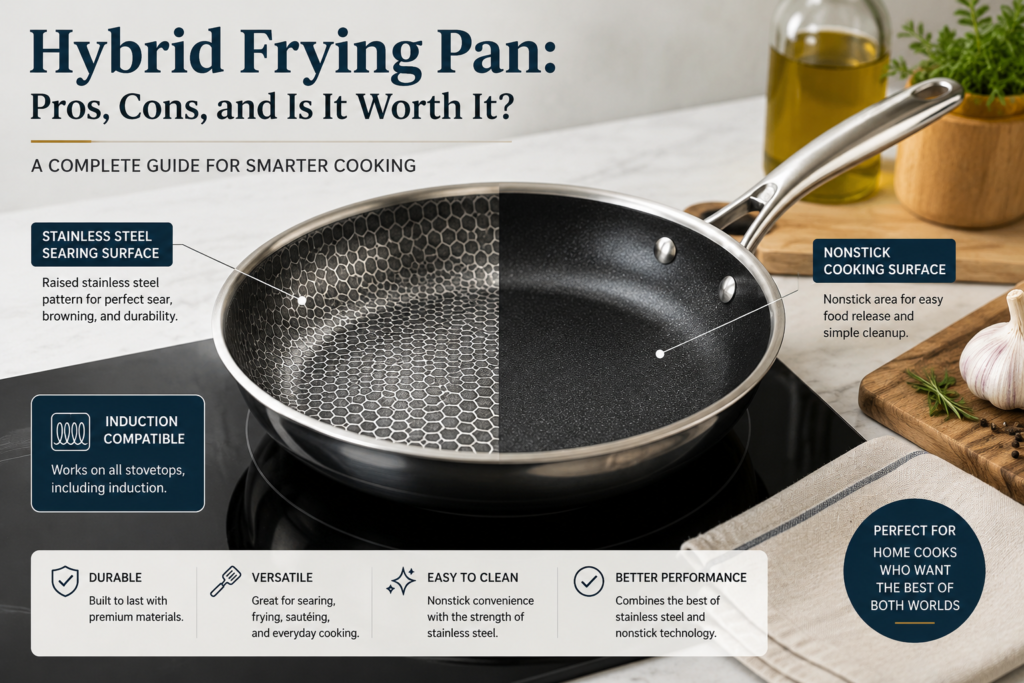
Unlike a conventional nonstick pan with one continuous coated cooking surface, some hybrid pans use raised stainless-steel areas together with recessed nonstick areas. The exact construction varies by manufacturer, so the term “hybrid” does not necessarily mean every product is made in the same way.
The goal is generally to provide better browning and durability than traditional nonstick cookware while retaining easier food release and cleanup.
In this guide, we’ll look at how hybrid frying pans work, their advantages and disadvantages, induction compatibility, and whether one might be worth adding to your kitchen.
What Is a Hybrid Frying Pan?
A hybrid frying pan combines characteristics of more than one type of cookware.
One well-known design uses raised stainless-steel ridges over recessed nonstick areas. For example, current HexClad pans use laser-etched stainless-steel peaks with ceramic nonstick valleys, along with an aluminum core and stainless-steel construction.
However, construction varies between brands. When shopping for a hybrid pan, it is important to look at the actual materials and specifications rather than assuming that every pan labeled “hybrid” performs identically.
Pros of Hybrid Frying Pans
Versatile Cooking
Hybrid cookware is designed to handle a wider variety of cooking tasks than a conventional delicate nonstick pan.
Depending on the model, it may work well for sautéing vegetables, cooking meat, preparing eggs, and everyday stovetop cooking.
Improved Browning
Exposed stainless-steel portions of the cooking surface can provide direct contact between food and metal, which can help with browning and searing.
Easier Food Release
The nonstick areas are intended to make food release and cleanup easier than with an entirely uncoated stainless-steel cooking surface.
Durable Surface Design
Some hybrid designs protect recessed nonstick areas with raised stainless-steel sections. This may make the cooking surface more resistant to everyday wear than a conventional exposed nonstick coating, although durability still depends on the particular product and how it is used.
Available for Induction
Many hybrid pans are made with magnetic stainless steel and are induction compatible. For example, HexClad’s current hybrid pans use a magnetic stainless-steel base and are listed for gas, electric, and induction cooktops.
Cons of Hybrid Frying Pans
Usually More Expensive
Hybrid frying pans can cost considerably more than basic nonstick pans.
You are paying for more complicated construction and, in some cases, premium branding.
Not the Same as Traditional Nonstick
Because parts of the cooking surface may be exposed stainless steel, you should not automatically expect exactly the same food-release behavior as a conventional smooth nonstick pan.
Cooking technique, temperature, cooking fat, and the specific hybrid design can all affect performance.
Still Requires Proper Care
“Hybrid” does not mean indestructible.
Manufacturers may still provide specific instructions concerning heat, cleaning, seasoning, utensils, and storage. Following the instructions for the particular pan is important.
Construction Varies by Brand
There is no single universal hybrid frying-pan design. Two products carrying the word “hybrid” may use different coatings, metal layers, patterns, and manufacturing techniques.
Always check the actual specifications.
Hybrid vs Traditional Nonstick
| Feature | Hybrid | Traditional Nonstick |
|---|---|---|
| Food Release | Very Good | Excellent |
| Browning | Very Good | Moderate |
| Surface | Mixed/structured | Smooth coated surface |
| Durability | Potentially higher, depending on design | Coating requires gentle care |
| High-Heat Use | Depends on manufacturer | Usually more limited |
| Ease of Cleaning | Very Good | Excellent |
| Price | Often higher | Wide price range |
Traditional nonstick remains an excellent option for eggs and other delicate foods when maximum food release is the priority.
Hybrid cookware may appeal more to someone who wants one versatile pan for both delicate cooking and stronger browning.
Are Hybrid Frying Pans Good for Induction?
They can be, but not simply because they are hybrid.
For a frying pan to work on an induction cooktop, its base must contain suitable magnetic material.
Some hybrid frying pans are specifically designed for induction. HexClad, for example, currently lists its hybrid cookware as induction-ready because of its magnetic stainless-steel base.
When buying any hybrid pan for an induction stove, look for “Induction Compatible” or “Induction Ready” in the manufacturer’s specifications.
This is something we should check individually whenever we introduce a particular product.
For a complete comparison of induction-compatible frying pan materials, see our Best Frying Pans for Induction Cooktops: What You Need to Know guide.
What Can You Cook in a Hybrid Frying Pan?
Depending on the particular model, a hybrid pan can be useful for:
- Eggs and breakfast foods
- Vegetables
- Chicken
- Fish
- Burgers
- Steaks
- Sautéing
- Browning
- Everyday one-pan meals
The appropriate heat level will depend on the manufacturer’s instructions.
A Popular Hybrid Frying Pan to Know
One of the best-known examples in this category is HexClad Hybrid Cookware.
Its current hybrid pans use stainless-steel hexagonal ridges with recessed TerraBond ceramic nonstick areas. They have tri-ply construction with an aluminum core and a magnetic stainless-steel base. The company currently lists the pans as induction-ready.
For example, the current Canadian 10-inch Hybrid Pan is listed as suitable for searing, sautéing and sauces, and is induction compatible.
This is an example of the hybrid category rather than a claim that it is the best pan for every cook. Other manufacturers may use substantially different hybrid designs.
What to Look for When Buying a Hybrid Frying Pan
Before buying one, check:
- Cooking-surface materials
- Type of nonstick coating, if any
- Induction compatibility
- Pan weight
- Oven-safe temperature
- Handle design
- Manufacturer’s heat recommendations
- Cleaning instructions
- Warranty
- Pan size
- Price
The construction is especially important because the word “hybrid” alone does not tell you exactly how a pan is made.
Is a Hybrid Frying Pan Worth It?
A hybrid frying pan may be worth considering if you want one pan that provides easier food release than traditional stainless steel while still offering good browning capability.
It can also be attractive to cooks who want cookware that handles several everyday tasks without switching between stainless steel and nonstick pans as frequently.
However, if you primarily cook eggs and delicate foods, a conventional nonstick or ceramic pan may be simpler and less expensive.
If maximum searing performance and long-term simplicity are your priorities, stainless steel, cast iron, or carbon steel may still be preferable.
The value of a hybrid pan therefore depends largely on how you cook and which compromises matter most to you.
Frequently Asked Questions
1. What is a hybrid frying pan?
A hybrid frying pan combines characteristics of different cookware surfaces or materials. Some popular designs combine raised stainless-steel areas with recessed nonstick areas.
2. Is a hybrid frying pan really nonstick?
Many hybrid pans contain nonstick areas, but they do not necessarily behave exactly like conventional smooth nonstick cookware because parts of the cooking surface may be exposed metal.
3. Can you use a hybrid frying pan on induction?
Some can. Induction compatibility depends on the construction of the pan’s base. Always check the manufacturer’s specifications before buying.
4. Is hybrid better than stainless steel?
Neither is automatically better. Stainless steel provides an uncoated, durable cooking surface and excellent browning capability. Hybrid cookware may provide easier food release while still offering useful browning performance.
5. Is hybrid better than traditional nonstick?
It depends on your priorities. Traditional nonstick is generally excellent for delicate foods and easy release. Hybrid cookware may offer greater versatility and stronger browning depending on its construction.
6. Do hybrid frying pans last forever?
No frying pan should be assumed to last forever. Longevity depends on construction, materials, cooking temperature, cleaning methods, frequency of use, and manufacturer recommendations.
Conclusion
Hybrid frying pans offer an interesting middle ground between traditional stainless steel and conventional nonstick cookware.
Their biggest attraction is versatility. A well-designed hybrid pan can provide useful browning performance while making food release and cleanup easier than an entirely uncoated cooking surface.
However, hybrid pans vary significantly between manufacturers, and they can be more expensive than conventional cookware. Buyers should pay close attention to the materials, coating, induction compatibility, care requirements, and warranty rather than relying only on the word “hybrid.”
For home cooks who want a versatile everyday frying pan and are comfortable paying more for a multi-layer construction, a hybrid frying pan may be worth considering.
Related Frying Pan Guides
Stainless Steel Frying Pan: Pros, Cons, and Best Uses
Nonstick Frying Pan: Pros, Cons, and Best Uses