Introduction
A chef’s knife and a Santoku knife are two of the most popular all-purpose knives used in home kitchens. At first glance, they may look similar, and both can handle everyday tasks such as chopping vegetables, slicing meat, and mincing herbs.
However, their blade shapes, cutting styles, sizes, and overall feel are slightly different.
Understanding these differences can help you decide which knife is more comfortable for the way you cook. In this guide, we’ll compare a chef’s knife and a Santoku knife, explain what each one is best used for, and help you decide which is right for your kitchen.
What Is a Chef’s Knife?
A chef’s knife is a versatile Western-style kitchen knife with a broad blade and a pointed tip.
Most chef’s knives are between 6 and 10 inches long, with an 8-inch blade being a popular choice for many home cooks.
The cutting edge usually curves upward toward the tip. This curved shape makes the knife especially well suited for a rocking cutting motion.
Chef’s knives can be used for many everyday kitchen tasks, including:
- Chopping vegetables
- Slicing fruits
- Mincing herbs
- Cutting boneless meat
- Slicing cooked meat
- Crushing garlic
- Chopping nuts
Because of its versatility, a chef’s knife is often considered the main workhorse of a kitchen.
What Is a Santoku Knife?
A Santoku knife is a Japanese-style multipurpose kitchen knife.
The word “Santoku” is commonly associated with three general kitchen tasks: slicing, dicing, and chopping.
Santoku knives are usually shorter than traditional chef’s knives, often measuring around 5 to 7 inches.
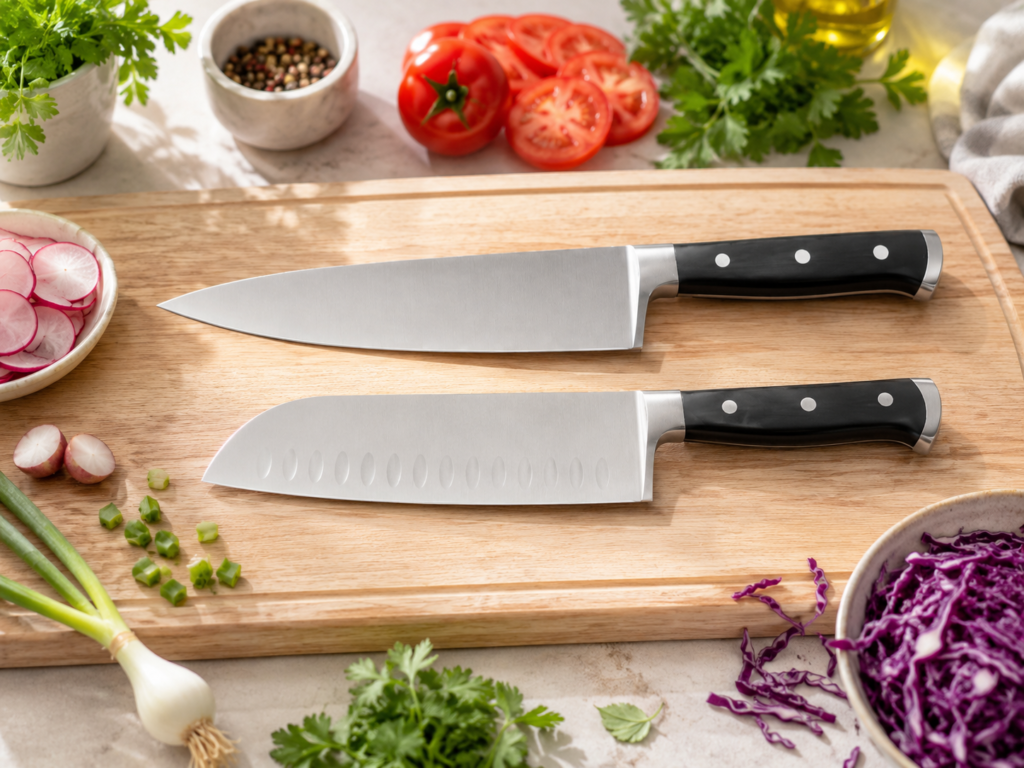
They typically have a flatter cutting edge and a rounded or downward-curving tip rather than the sharp, pointed tip found on most chef’s knives.
Many Santoku knives also have small indentations along the blade. These are often called a Granton edge and may help reduce food sticking to the blade while cutting.
Chef’s Knife vs Santoku Knife: Quick Comparison
| Feature | Chef’s Knife | Santoku Knife |
|---|---|---|
| Typical Blade Length | 6–10 inches | 5–7 inches |
| Blade Shape | Curved with pointed tip | Flatter with rounded tip |
| Cutting Style | Rocking and slicing | Up-and-down chopping |
| Weight | Often heavier | Often lighter |
| Best For | General-purpose cutting | Vegetables, slicing, precise chopping |
| Common Origin | Western/European style | Japanese style |
| Beginner Friendly | Yes | Yes |
Both knives are highly versatile, so the better choice often depends on your personal cutting style and comfort.
Main Differences Between a Chef’s Knife and a Santoku Knife
Blade Shape
One of the easiest differences to notice is the shape of the blade.
A chef’s knife usually has a curved cutting edge that rises toward a pointed tip.
A Santoku knife generally has a flatter edge and a less pointed tip.
The different shapes affect how each knife moves across the cutting board.
Cutting Motion
A chef’s knife is well suited for a rocking motion.
You can keep the tip near the cutting board while moving the handle up and down. This technique works especially well for herbs, garlic, and vegetables.
A Santoku knife is better suited for a more vertical chopping motion.
Instead of rocking the blade, you typically lift it slightly and bring it straight down through the food.
Size
Santoku knives are generally shorter than chef’s knives.
A common Santoku knife may have a blade around 7 inches long, while an 8-inch chef’s knife is a popular all-purpose size.
A shorter knife may feel easier to control, particularly for cooks who prefer a smaller and lighter tool.
Weight
Chef’s knives are often heavier than Santoku knives.
The extra weight can be helpful when cutting larger or firmer ingredients.
Santoku knives tend to feel lighter and more agile, which some cooks prefer for repetitive chopping and detailed cutting.
Tip Design
A chef’s knife usually has a sharp, pointed tip.
This makes it useful for precise cutting and tasks that require the tip of the blade.
A Santoku knife often has a rounded or sheep’s-foot-style tip, which reduces the amount of sharp point at the end of the blade.
What Is a Chef’s Knife Best For?
A chef’s knife is an excellent all-purpose choice.
It works particularly well for:
- Chopping onions
- Cutting carrots and celery
- Mincing herbs
- Slicing fruits
- Cutting boneless meat
- Slicing cooked meat
- Crushing garlic
- Chopping larger vegetables
The longer blade and pointed tip can also make a chef’s knife useful when working with larger ingredients.
What Is a Santoku Knife Best For?
A Santoku knife is especially useful for controlled chopping, slicing, and dicing.
It works well for:
- Chopping vegetables
- Slicing fruits
- Dicing onions
- Cutting herbs
- Slicing boneless meat
- Preparing fish
- Making thin, precise slices
Its lighter weight and shorter blade can make it comfortable for cooks who do a lot of vegetable preparation.
Which Knife Is Better for Vegetables?
Both knives work very well for vegetables.
A Santoku knife may feel especially comfortable for repetitive chopping because of its flatter cutting edge.
A chef’s knife may be better if you prefer a rocking motion when chopping herbs, onions, or other vegetables.
There is no single winner. The best choice depends largely on your preferred cutting technique.
Which Knife Is Better for Meat?
A chef’s knife is often more versatile for working with larger pieces of boneless meat because of its longer blade and heavier construction.
A Santoku knife can still work very well for slicing boneless meat, poultry, and fish.
Neither knife should be used for cutting through large bones. A cleaver or another knife designed specifically for bones is more appropriate for that job.
Which Knife Is Better for Beginners?
Both knives can be excellent choices for beginners.
A chef’s knife may be the better choice if you want one traditional multipurpose knife that can handle a very wide range of kitchen tasks.
A Santoku knife may be more comfortable if you prefer:
- A shorter blade
- A lighter knife
- Straight up-and-down chopping
- Precise vegetable preparation
Comfort and control are more important than choosing one style simply because it is more popular.
Chef’s Knife vs Santoku Knife: Which One Should You Choose?
Choose a chef’s knife if you:
- Prefer a rocking cutting motion
- Want a longer blade
- Regularly work with larger ingredients
- Like a slightly heavier knife
- Want a pointed tip for detailed cutting
Choose a Santoku knife if you:
- Prefer straight chopping motions
- Want a lighter knife
- Prefer a shorter blade
- Prepare a lot of vegetables
- Like making thin and precise slices
For many home cooks, either knife can serve as an excellent primary kitchen knife.
You do not necessarily need both.
Do You Need Both a Chef’s Knife and a Santoku Knife?
Not necessarily.
The two knives overlap significantly in what they can do.
If you already have a chef’s knife that feels comfortable and handles your everyday cooking tasks well, you may not need a Santoku knife.
The same is true in reverse.
However, some cooks enjoy owning both because the different blade shapes and weights are useful for different types of food preparation.
How to Care for Both Knives
Regardless of which knife you choose, proper care will help keep the blade sharp and extend its life.
Follow these basic habits:
- Wash the knife by hand
- Dry it immediately after washing
- Use a wood or quality plastic cutting board
- Avoid glass and stone cutting surfaces
- Do not cut frozen food
- Do not cut bones unless the knife is specifically designed for it
- Store the knife safely
- Hone or sharpen it when necessary
A properly maintained knife is easier and safer to use than a dull one.
Safe Storage Options
Good storage options for both chef’s knives and Santoku knives include:
- Knife blocks
- Magnetic knife strips
- In-drawer knife organizers
- Protective blade guards
Avoid storing sharp knives loosely in a drawer with other kitchen utensils.
This can damage the cutting edge and create a safety risk when reaching into the drawer.
Common Mistakes to Avoid
Whether you use a chef’s knife or a Santoku knife, avoid these common mistakes:
- Cutting on glass or stone
- Using the knife to open cans
- Using the knife as a screwdriver
- Cutting frozen foods
- Cutting hard bones
- Leaving the knife wet
- Putting it loosely into a crowded drawer
- Using excessive force when cutting
A sharp knife should cut food cleanly without requiring heavy pressure.
FAQ
Is a Santoku knife better than a chef’s knife?
Not necessarily. Both are excellent multipurpose knives. A Santoku may be better for cooks who prefer a lighter knife and straight chopping motion, while a chef’s knife may be better for those who prefer rocking cuts and a longer blade.
Can a Santoku knife replace a chef’s knife?
For many home cooks, yes. A Santoku can perform most everyday chopping, slicing, and dicing tasks. However, the shorter blade and different shape may make some larger cutting jobs easier with a chef’s knife.
Can a chef’s knife replace a Santoku knife?
Yes. A chef’s knife can handle most tasks typically performed with a Santoku knife, including chopping vegetables, slicing meat, and mincing herbs.
Which knife is better for chopping vegetables?
Both work very well. A Santoku is particularly comfortable for straight chopping, while a chef’s knife is ideal for cooks who prefer a rocking motion.
Which knife is lighter?
Santoku knives are generally lighter and shorter than traditional chef’s knives, although the exact weight depends on the individual knife.
What size Santoku knife is best for home cooking?
A Santoku knife around 7 inches long is a common and versatile choice for home kitchens.
Should I buy a chef’s knife or a Santoku knife first?
If you are unsure, choose the knife that feels most comfortable in your hand. Either can serve as your primary everyday kitchen knife.
Conclusion
Both the chef’s knife and the Santoku knife are versatile tools that can handle most everyday food preparation.
A chef’s knife generally has a longer, curved blade that works well with a rocking cutting motion. A Santoku knife is usually shorter, lighter, and flatter, making it especially comfortable for straight chopping and precise slicing.
Neither knife is automatically better than the other.
The best choice is the one that feels balanced, comfortable, and easy for you to control.
If possible, try holding both styles before deciding. Once you find a knife that fits your hand and cutting style, it can become one of the most useful tools in your kitchen.
Continue Reading Our Kitchen Knife Series
If you’re learning more about kitchen knives, these guides will help you choose, use, and care for them:
- Chef’s Knife: What It Is and How to Use It — already published
- Types of Kitchen Knives and What They’re Used For — coming next
- How to Sharpen a Kitchen Knife at Home — coming soon
- How to Care for Kitchen Knives and Keep Them Sharp — coming soon
As each new guide is published, these titles can be connected with internal links so you can easily move through the complete Kitchen Knife Series.