Introduction
There are many types of kitchen knives, and each one is designed for a different job. But after using different knives in my own kitchen, I’ve realized that the knife I reach for most often isn’t necessarily the biggest or most versatile one.
For me, it’s actually a small paring knife. Mine is sharp, lightweight, easy to handle, and simple to wash and care for. For many of the small everyday tasks I do, I don’t feel the need to pull out a large chef’s knife.
I also learned that buying a knife because it looks useful does not always mean it will become a favorite. I once bought a large rectangular Chinese-style knife because I was curious about it. I used it several times at first, but over time I found it too heavy for many of the jobs I normally do.
That experience taught me something simple: the best kitchen knife is not always the one that can do the most. It is often the one that feels comfortable and practical for the way you actually cook.
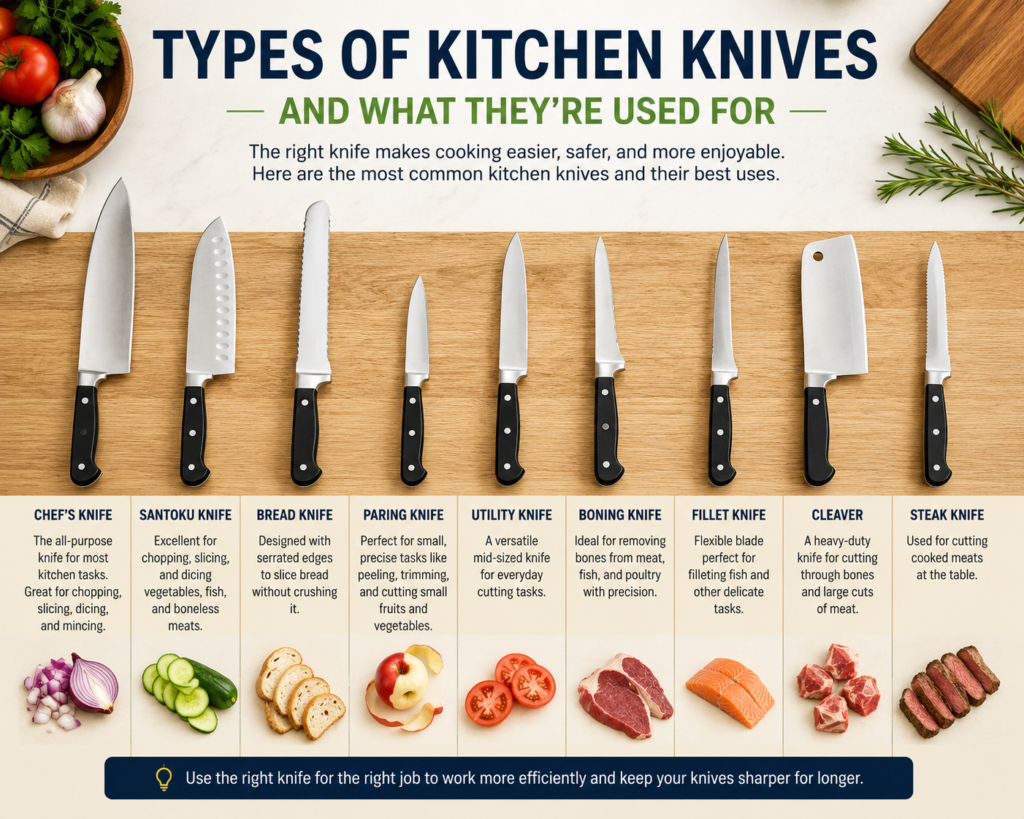
In this guide, I’ll go through some of the most common types of kitchen knives, what they are designed for, and which ones may actually be useful in an everyday kitchen.
1. Chef’s Knife
A chef’s knife is one of the most versatile knives in the kitchen.
It usually has a broad blade and can be used for chopping vegetables, slicing meat, mincing herbs, and many other everyday jobs.
For someone who wants one general-purpose knife, a chef’s knife can be a very practical choice.
But for me, it is not always the first knife I reach for. For smaller jobs, I often find a lighter and smaller knife easier to handle.
Versatility is useful, but comfort matters too.
2. Paring Knife
A paring knife is small and lightweight and is commonly used for peeling, trimming, slicing small fruits and vegetables, and other detailed food-preparation tasks.
This is actually the knife I use most often in my own kitchen.
I like that it is light, sharp, easy to control, and simple to wash and care for. For many everyday tasks, that convenience matters more to me than having a large blade.
I thought about this again when my son was getting ready to move into a college dorm. I wondered what kind of knife would be practical for him to have for simple food preparation.
I eventually decided that a small Henckels paring knife made the most sense for him.
Based on my own experience, I liked that it was lightweight and compact and didn’t feel as cumbersome as a large kitchen knife. In a dorm, where storage space is limited and cooking is usually fairly simple, that seemed practical.
Of course, a small knife is still a sharp tool and should always be handled and stored carefully.
But this experience reinforced something I already knew from my own kitchen:
The knife you use most does not necessarily have to be the biggest one.
3. Santoku Knife
A santoku knife is a Japanese-style multipurpose knife.
It is commonly used for slicing, chopping, and dicing vegetables, meat, and other ingredients.
Compared with some traditional chef’s knives, santoku knives may feel a little shorter and lighter, depending on the model.
That can make them comfortable for people who prefer a more compact knife.
If you do a lot of vegetable preparation, a santoku can be very useful.
For me, though, it still comes down to how the knife feels in my hand and whether I naturally reach for it.
4. Bread Knife
A bread knife usually has a long serrated blade.
The serrations help cut through foods with a firm outside and soft inside without crushing them.
It is useful for:
- bread
- rolls
- cakes
- some soft fruits
- foods with delicate interiors
This is one of those knives that may not be used every day, but when you need it, it can make the job much easier.
5. Utility Knife
A utility knife falls somewhere between a paring knife and a chef’s knife in size.
It can be useful for medium-size tasks such as slicing sandwiches, fruit, vegetables, or smaller pieces of meat.
For someone who finds a chef’s knife too large but wants something bigger than a paring knife, a utility knife can be a good middle ground.
6. Boning Knife
A boning knife is designed for working around bones and trimming meat.
It usually has a narrower blade that allows more precise movement.
This is a more specialized knife, so not every home kitchen needs one.
If you rarely prepare large cuts of meat or debone food yourself, you may not use it very often.
A specialized knife is only useful if you actually have the job it was designed for.
7. Chinese-Style Cleaver
I was curious about the large rectangular knife often used in Chinese cooking, so I bought one for myself.
At first, I used it several times because it felt new and interesting.
But over time, I found myself reaching for it less often.
It feels heavier than the knives I normally use, and when I want very thin slices, I don’t always get the result I want.
That may simply come down to technique and practice, but for my everyday cooking, I usually prefer a lighter knife that feels easier to control.
Where I do appreciate the heavier knife is when I am working with larger or denser pieces of food. The extra weight can sometimes feel useful for certain meat-preparation tasks.
But I do not use it for cutting bones unless the specific knife is designed for that purpose.
For me, this knife was a good reminder that a knife can look impressive and still not be the one I naturally reach for every day.
8. Serrated Utility Knife
A smaller serrated utility knife can be useful for foods that are difficult to slice cleanly with a smooth-edged knife.
It may work well for:
- tomatoes
- small breads
- soft fruits
- sandwiches
It is not essential for every kitchen, but it can be convenient if you often prepare these foods.
Do You Need Every Type of Kitchen Knife?
I don’t think so.
There are many knives available, and it can be tempting to think that a complete kitchen needs a large knife block filled with every type.
But in my own experience, I use a few knives far more often than the rest.
That is why I think it makes more sense to start with the knives that match the foods you actually prepare.
For one person, that may be a chef’s knife and a bread knife.
For someone else, it may be a santoku and a paring knife.
For me, the small paring knife is still the one that gets the most use.
What Matters More Than the Number of Knives?
Comfort
A knife should feel comfortable and balanced in your hand.
If it feels too heavy or awkward, you may not want to use it often.
Size
The largest knife is not always the easiest one to use.
Choose a size that fits your hand and your normal food-preparation tasks.
Sharpness
A dull knife can be more frustrating and less predictable than a sharp one.
Whatever knife you choose, keeping it properly maintained matters.
Ease of Care
I tend to use kitchen tools more often when they are easy to wash, dry, and store.
This is one reason I like my paring knife so much.
I also prefer knives made from one continuous piece of stainless steel, including the handle.
Some knives have handles made from a different material, and I personally don’t like the idea of food residue or moisture getting into the small gaps where the handle meets the blade.
A one-piece stainless steel knife feels simpler and easier for me to keep clean. I can wash and dry the whole knife without worrying as much about seams or joints.
That doesn’t mean every knife with a separate handle is unhygienic, but for my own kitchen, I feel more comfortable with a simple all-stainless-steel design.
What You Actually Cook
Think about your normal meals.
If you rarely bake bread, you may not need a bread knife immediately.
If you do not debone meat, you may not need a boning knife.
Buy for the way you cook, not for the idea of what a complete kitchen should look like.
Which Knife Is Best for Beginners?
There is no single answer.
A chef’s knife is often recommended because it can handle many tasks.
But for someone who feels more comfortable with a smaller knife, a utility knife or paring knife may feel easier for simple food preparation.
The important thing is to choose a knife that feels manageable and to learn how to use it safely.
A knife you feel comfortable controlling is more useful than a knife you avoid because it feels too large or heavy.
FAQ
What is the most useful kitchen knife?
A chef’s knife is one of the most versatile, but the most useful knife depends on how you cook. In my own kitchen, I use a small paring knife most often.
What is a paring knife used for?
A paring knife is useful for peeling, trimming, slicing small fruits and vegetables, and other detailed kitchen tasks.
Is a Chinese cleaver good for everyday cooking?
It can be, especially for people who are comfortable with its size and weight. For me, it feels heavier than the knives I normally use, so I reach for it less often.
Do I need a full knife set?
Not necessarily. A few well-chosen knives that match your cooking habits may be more useful than a large set where several knives are rarely used.
Is a small knife safer than a large knife?
Not automatically. Any sharp knife can cause injury. The important thing is proper handling, storage, and choosing a knife you can control comfortably.
Conclusion
After using different types of kitchen knives, I have learned that the knife I use most is not the biggest or most impressive one.
For me, it is a small paring knife because it is light, sharp, easy to handle, and simple to care for.
I even chose a similar small paring knife for my son when he moved into college housing because I thought it made sense for the kind of simple food preparation he would likely be doing.
On the other hand, I bought a large Chinese-style knife because I was curious about it. I still appreciate it for certain jobs, but its weight and size mean I do not reach for it nearly as often.
That contrast taught me something useful.
A knife can be technically versatile and still not be the right knife for you.
The best kitchen knife is the one that matches your hand, your cooking habits, and the jobs you actually do.
For me, comfort and practicality matter more than having every type of knife in the drawer.
I also tend to choose simple, all-stainless-steel knives because they feel easier for me to clean and maintain.
Continue Reading Our Kitchen Knife Series
Explore the other guides in our Kitchen Knife Series:
- Chef’s Knife: What It Is and How to Use It — already published
- Chef’s Knife vs Santoku Knife: What’s the Difference? — already published
- How to Sharpen a Kitchen Knife at Home — coming next
- How to Care for Kitchen Knives and Keep Them Sharp — coming soon
As each guide is published, these titles can be connected with internal links to create a complete Kitchen Knife Series.