Introduction
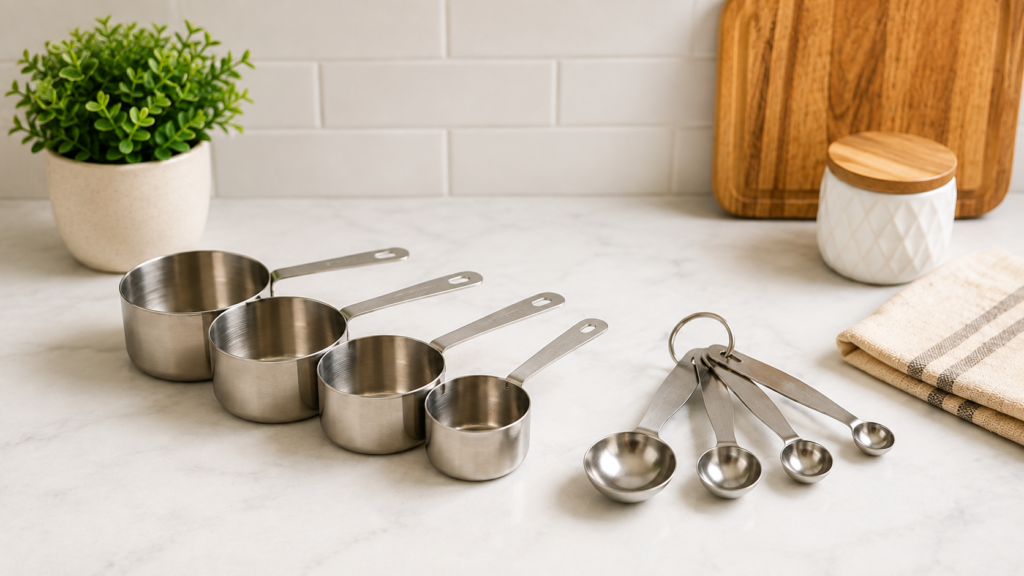
Measuring cups and spoons may look like simple kitchen tools, but accurate measuring can make a big difference in both cooking and baking.
Using too much flour, too little salt, or the wrong amount of liquid can change the texture, flavor, and consistency of a recipe. This is especially important in baking, where ingredient ratios often need to be more precise.
In this guide, we’ll look at the different types of measuring cups and spoons, the most useful sizes, how to use them correctly, and which features can make measuring easier in everyday cooking.
What Are Measuring Cups and Spoons?
Measuring cups and spoons are kitchen tools designed to measure specific amounts of ingredients.
They are commonly used for:
- Flour
- Sugar
- Rice
- Milk
- Water
- Cooking oil
- Spices
- Baking powder
- Vanilla extract
- Sauces and seasonings
Most kitchens use a combination of measuring cups and measuring spoons because recipes often include both larger and smaller quantities.
What Sizes Do Measuring Cups Usually Come In?
A standard set of measuring cups commonly includes:
- 1 cup
- 1/2 cup
- 1/3 cup
- 1/4 cup
Some sets also include additional sizes such as:
- 2/3 cup
- 3/4 cup
- 1/8 cup
Extra sizes are not essential, but they can be convenient when you cook or bake frequently.
What Sizes Do Measuring Spoons Usually Come In?
A typical measuring spoon set includes:
- 1 tablespoon
- 1 teaspoon
- 1/2 teaspoon
- 1/4 teaspoon
Some sets also include:
- 1/2 tablespoon
- 1/8 teaspoon
- A pinch spoon
For most home cooking, the four standard sizes are enough, but smaller measurements can be useful for spices and baking ingredients.
Dry Measuring Cups vs Liquid Measuring Cups
One of the most important things beginners should understand is that dry and liquid measuring cups are designed differently.
Dry Measuring Cups
Dry measuring cups are usually individual cups with flat rims.
They are best for ingredients such as:
- Flour
- Sugar
- Rice
- Oats
- Breadcrumbs
- Nuts
You normally fill the cup to the top and level the ingredient with a straight edge.
Liquid Measuring Cups
Liquid measuring cups are usually larger containers with measurement markings on the side and a pouring spout.
They are best for:
- Water
- Milk
- Oil
- Broth
- Juice
- Other liquids
The extra space above the measurement lines helps prevent spilling.
Can You Use the Same Measuring Cup for Dry and Liquid Ingredients?
Technically, the volume may be similar, but using the correct type usually makes measuring easier and more accurate.
A dry measuring cup can be filled completely and leveled.
A liquid measuring cup lets you pour liquid to a marked line without filling the container all the way to the top.
For occasional cooking, you may be able to manage with one type, but having both is more convenient.
How to Measure Dry Ingredients Correctly
Different dry ingredients may require slightly different methods.
For ingredients such as flour:
- Stir or fluff the flour gently.
- Spoon it into the measuring cup.
- Do not pack it down unless the recipe says to.
- Level the top with a straight edge.
Scooping flour directly from a container can compress it and result in more flour than the recipe intended.
How to Measure Brown Sugar
Brown sugar is often measured differently from flour.
Many recipes specify packed brown sugar.
To measure it:
- Spoon the brown sugar into the measuring cup.
- Press it down firmly.
- Continue adding and pressing until the cup is full.
- Level the top.
When removed from the cup, properly packed brown sugar often holds the shape of the cup.
How to Measure Liquid Ingredients Correctly
For liquids:
- Place the liquid measuring cup on a flat surface.
- Pour in the liquid.
- Bend down so your eyes are level with the measurement line.
- Check the amount at eye level.
Holding the cup in the air while reading the measurement can make it harder to judge accurately.
How to Use Measuring Spoons
Measuring spoons can be used for both dry and liquid ingredients.
For dry ingredients:
- Fill the spoon.
- Level the top unless the recipe says otherwise.
For liquids:
- Fill the spoon carefully to the rim.
- Keep the spoon level while moving it.
For ingredients such as honey or syrup, lightly coating the spoon with cooking spray or oil may make sticky ingredients easier to release.
Stainless Steel Measuring Cups and Spoons
Stainless steel is a popular material for measuring tools.
Advantages include:
- Durable construction
- Resistance to staining
- Easy cleaning
- Long lifespan
- Clearly engraved measurements on many models
High-quality stainless steel sets can last for many years.
Plastic Measuring Cups and Spoons
Plastic measuring tools are often lightweight and inexpensive.
Advantages include:
- Lightweight
- Easy to handle
- Available in many colors
- Usually affordable
However, printed measurement markings may eventually fade, and some plastics may stain or absorb odors over time.
Glass Liquid Measuring Cups
Glass is commonly used for liquid measuring cups.
Advantages include:
- Easy-to-read markings
- Resistance to staining
- Good visibility of liquids
- Often microwave-safe, depending on the manufacturer
The main disadvantage is that glass can break if dropped.
Always follow the manufacturer’s instructions regarding microwave or heat use.
Silicone Measuring Cups
Flexible silicone measuring cups are another option.
They can be useful because they:
- Are lightweight
- Can be squeezed for easier pouring
- Often store compactly
- Are difficult to break
However, very flexible cups may be harder to hold steady when filled with liquid.
Which Material Is Best?
There is no single best material for everyone.
For dry measuring cups and spoons, stainless steel is one of the most durable choices.
For liquids, clear glass or transparent plastic measuring cups make it easier to see measurement lines.
The best option depends on how you cook and which features you find most comfortable.
Features That Make Measuring Cups More Useful
Measuring cups may look similar, but certain design features can make them much easier to use.
Engraved Measurements
Measurements that are stamped or engraved into the handle are less likely to disappear than painted markings.
Long Handles
Longer handles can make it easier to reach into deep containers of flour, sugar, or rice.
Flat Bottoms
A measuring cup that sits steadily on the counter can be easier to fill.
Comfortable Handles
A handle should feel secure even when the cup is full.
Nesting Design
Cups that fit inside one another take up less drawer space.
Magnetic Handles
Some measuring cup and spoon sets use magnets to keep the pieces together while still allowing them to separate easily.
Features That Make Measuring Spoons More Useful
Measuring spoons also come in several useful designs.
Narrow or Oval Spoon Heads
A narrow spoon may fit inside small spice jars more easily than a wide round spoon.
Double-Ended Measuring Spoons
Some measuring spoons have a round end and a narrow end, making them useful for different container shapes.
Magnetic Sets
Magnetic handles can keep spoons organized without requiring a ring.
Clearly Marked Sizes
Choose spoons with measurements that are easy to read and unlikely to wear away.
Long Handles
Long handles can reach deeper into spice jars and ingredient containers.
These small features can make a surprisingly big difference during everyday cooking.
Do You Need a Large Set?
Not necessarily.
For most home cooks, the standard sizes are enough.
A basic measuring cup set with:
- 1 cup
- 1/2 cup
- 1/3 cup
- 1/4 cup
and a spoon set with:
- 1 tablespoon
- 1 teaspoon
- 1/2 teaspoon
- 1/4 teaspoon
will cover the majority of recipes.
Additional sizes are useful but optional.
Measuring Cups or a Kitchen Scale?
Measuring cups measure ingredients by volume.
A kitchen scale measures ingredients by weight.
For many everyday recipes, measuring cups and spoons are perfectly convenient.
However, a kitchen scale can provide greater consistency, especially when measuring ingredients such as flour for baking.
Many experienced bakers prefer weighing ingredients because the amount of flour that fits in one cup can vary depending on how tightly it is packed.
You do not have to choose only one method. Many kitchens use both.
Are Measuring Cups Accurate?
Good-quality measuring cups are generally accurate enough for normal home cooking.
However, your measuring technique also matters.
For example:
- Packing flour can add too much
- Holding a liquid cup at an angle can change the reading
- Using heaping spoons instead of level spoons can add too much
- Worn or unclear measurement markings can cause mistakes
The tool and the technique work together.
How to Choose Measuring Cups and Spoons
When shopping for a set, consider these features:
- Easy-to-read measurements
- Durable material
- Comfortable handles
- Standard sizes
- Easy storage
- Dishwasher-safe construction, if important to you
- Handles that fit inside ingredient containers
- Measurements that will not easily fade
You do not necessarily need the most expensive set.
A simple, durable design that is comfortable to use can be the better choice.
Common Measuring Mistakes to Avoid
Avoid these common mistakes:
- Using a liquid cup for flour and trying to level it
- Scooping packed flour directly from the container
- Measuring liquid while holding the cup in the air
- Using heaping spoonfuls when the recipe expects level measurements
- Confusing teaspoons and tablespoons
- Misreading 1/3 cup and 1/2 cup
- Using measuring tools with faded markings
Taking a few extra seconds to measure correctly can improve the consistency of your recipes.
How to Store Measuring Cups and Spoons
Most sets are designed to nest or stack together.
Useful storage methods include:
- Keeping nested cups in a drawer
- Hanging cups from a hook
- Using magnetic measuring sets
- Keeping spoons together on a removable ring
- Storing frequently used pieces near your baking ingredients
Try to keep the full set together so individual pieces do not disappear.
How to Clean Measuring Cups and Spoons
Most measuring tools can be washed with warm water and dish soap.
Stainless steel, glass, plastic, and silicone sets may also be dishwasher-safe, but always check the manufacturer’s instructions.
Wash sticky ingredients such as honey, syrup, and oil soon after use so residue does not build up.
Dry the pieces completely before nesting them together.
What Should Beginners Buy First?
For a beginner kitchen, a simple setup is enough:
- One complete set of dry measuring cups
- One standard set of measuring spoons
- One clear liquid measuring cup
This combination will handle almost every basic cooking and baking recipe.
Later, you can add specialized sizes or a digital kitchen scale if you find them useful.
FAQ
Do I really need separate dry and liquid measuring cups?
It is highly recommended. They measure the same type of volume, but their different designs make dry and liquid ingredients easier to measure accurately.
What are the four basic measuring cup sizes?
The most common sizes are 1 cup, 1/2 cup, 1/3 cup, and 1/4 cup.
What are the basic measuring spoon sizes?
A standard set usually includes 1 tablespoon, 1 teaspoon, 1/2 teaspoon, and 1/4 teaspoon.
Are stainless steel measuring cups better than plastic?
Stainless steel is usually more durable and often has measurements that will not fade. Plastic can be lighter and less expensive. Either can work well if the measurements are accurate and easy to read.
Should flour be packed into a measuring cup?
Usually no. Flour is normally spooned gently into the cup and leveled unless the recipe specifically gives different instructions.
Should brown sugar be packed?
Many recipes call for packed brown sugar. When they do, press it firmly into the measuring cup before leveling it.
Can measuring spoons be used for both liquids and dry ingredients?
Yes. Standard measuring spoons can generally be used for both.
Is a kitchen scale more accurate than measuring cups?
For many ingredients, especially flour, measuring by weight with a kitchen scale can provide more consistent results.
Are magnetic measuring spoons worth it?
They can be useful if you want the spoons to stay organized while still being easy to separate. They are a convenience feature rather than a necessity.
What should I look for when buying measuring spoons?
Look for clear or engraved measurements, useful standard sizes, comfortable handles, and spoon shapes that fit easily into your ingredient containers.
Conclusion
Measuring cups and spoons are simple tools, but choosing the right ones and using them correctly can make cooking and baking much more consistent.
For most beginners, a basic set of dry measuring cups, measuring spoons, and one liquid measuring cup is all that is needed.
As you cook more often, features such as engraved measurements, long handles, narrow spoon heads, magnetic storage, and extra sizes can make everyday measuring even more convenient.
The most important thing is not owning a complicated set—it is using the right measuring tool and the right technique for each ingredient
“Measuring cups and spoons are tools you may use for many years, so choosing a durable, comfortable set from the beginning can save you from replacing them later.”
Coming Up in Our Measuring Cups & Spoons Series
Continue learning about measuring tools with the next guides in this series:
- Dry vs Liquid Measuring Cups: What’s the Difference? — coming next
- How to Measure Ingredients Correctly — coming soon
- Measuring Cups vs Kitchen Scale: Which Is More Accurate? — coming soon
- How to Choose the Best Measuring Cups and Spoons — coming soon
As each guide is published, these titles can be connected with internal links to build the complete Measuring Cups & Spoons Series