Introduction
Measuring cups and kitchen scales can both help you follow a recipe, but they measure ingredients in very different ways.
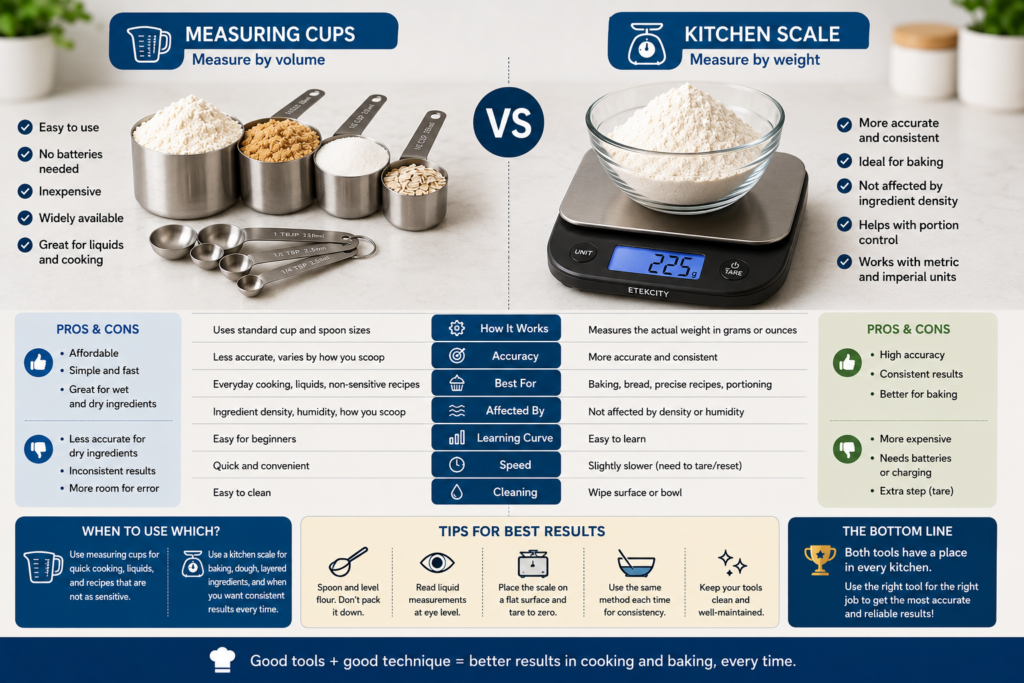
Measuring cups measure by volume, while a kitchen scale measures by weight. For everyday cooking, measuring cups are often quick and convenient. For baking and other recipes where consistency matters, a digital kitchen scale can provide more precise results.
The difference is especially noticeable with ingredients such as flour. One cup of flour can weigh differently depending on how tightly it is packed, while a scale measures the actual weight directly.
In this guide, we’ll compare measuring cups and kitchen scales, explain when each one works best, and help you decide whether you need one or both in your kitchen.
Measuring Cups Measure Volume
Measuring cups tell you how much space an ingredient occupies.
Common measurements include:
- 1 cup
- 1/2 cup
- 1/3 cup
- 1/4 cup
Liquid measuring cups may also show:
- Fluid ounces
- Milliliters
- Cups
Volume measuring is familiar, fast, and convenient for many everyday recipes.
Kitchen Scales Measure Weight
A kitchen scale measures how heavy an ingredient is.
Common units include:
- Grams
- Ounces
- Pounds
- Kilograms
Digital kitchen scales usually display the measurement on a screen.
Because weight does not depend on how tightly an ingredient is packed into a cup, scales can provide more consistent measurements for many ingredients.
Measuring Cups vs Kitchen Scale: Quick Comparison
| Feature | Measuring Cups | Kitchen Scale |
|---|---|---|
| Measures | Volume | Weight |
| Best For | Everyday cooking, liquids, simple recipes | Baking, dough, precise recipes |
| Speed | Very quick | Quick after learning tare function |
| Accuracy | Good for many recipes | Usually more precise |
| Cleanup | Several cups may be needed | Often only one bowl |
| Cost | Usually inexpensive | Requires buying a scale |
| Power | None | Usually batteries or charging |
| Beginner Friendly | Very easy | Easy after basic setup |
Both tools are useful, but they solve slightly different problems.
Why Can Measuring Cups Be Less Consistent?
The main issue is that ingredients do not always fill a cup in exactly the same way.
Flour is a good example.
If you gently spoon flour into a measuring cup, it may be relatively loose.
If you scoop the measuring cup directly into a flour container, the flour may become compressed.
Both cups look full, but one may contain noticeably more flour than the other.
A kitchen scale avoids this problem by measuring the actual weight.
Why Is a Kitchen Scale More Accurate for Flour?
A recipe that says “120 grams of flour” gives you a specific target.
You place a bowl on the scale, reset the display to zero, and add flour until the display reaches 120 grams.
There is much less variation caused by scooping or packing.
This is one reason many bakers prefer weight measurements.
What Is the Tare Function?
The tare function is one of the most useful features on a digital kitchen scale.
It resets the display to zero after you place a container on the scale.
For example:
- Put an empty mixing bowl on the scale.
- Press the tare button.
- The display returns to zero.
- Add the first ingredient.
- Record the weight.
- Press tare again.
- Add the next ingredient.
This allows you to measure several ingredients in one bowl without including the weight of the bowl itself.
Why Is Tare So Useful?
The tare function can reduce cleanup.
Instead of using:
- One cup for flour
- Another cup for sugar
- Another spoon or bowl for another ingredient
you can often measure several ingredients into the same mixing bowl.
That can make baking faster and leave fewer measuring tools to wash.
When Are Measuring Cups Better?
Measuring cups remain very useful.
They are especially convenient for:
- Water
- Milk
- Broth
- Cooking oil
- Rice
- Oats
- Everyday cooking
- Recipes written entirely in cups and tablespoons
If a recipe does not require high precision, measuring cups may be the simplest choice.
When Is a Kitchen Scale Better?
A kitchen scale is especially useful for:
- Bread
- Pizza dough
- Cakes
- Pastries
- Cookies
- Sourdough
- Recipes written in grams
- Portioning ingredients
- Repeating recipes consistently
It is particularly helpful when ingredient ratios affect the final texture.
Which Is Better for Baking?
For many baking recipes, a kitchen scale has an advantage.
Baking often depends on precise ratios between:
- Flour
- Sugar
- Fat
- Liquid
- Eggs
- Leavening ingredients
Too much flour, for example, can make baked goods dry or dense.
Using weight measurements can reduce variation.
That does not mean measuring cups cannot produce excellent baking results. Good measuring technique can work very well, especially when the recipe was developed using cups.
Which Is Better for Cooking?
For everyday cooking, measuring cups are often completely sufficient.
Recipes such as:
- Soup
- Stew
- Sauces
- Rice dishes
- Marinades
- Dressings
usually allow more flexibility than baking recipes.
You may even adjust ingredients by taste.
For this kind of cooking, speed and convenience may matter more than precise weight.
Can You Use Both?
Yes, and that is often the best solution.
You might use:
- A scale for flour and sugar
- A liquid measuring cup for milk
- Measuring spoons for spices
- Measuring cups for broth or rice
You do not have to choose one system for everything.
Using the right tool for each ingredient can be the easiest approach.
Are Kitchen Scales Hard to Use?
No.
Most digital kitchen scales are simple.
Basic steps usually include:
- Turn the scale on.
- Choose the unit you want.
- Place a bowl on the scale.
- Press tare.
- Add the ingredient.
- Stop when you reach the desired weight.
After using the tare function a few times, the process becomes very easy.
What Units Should a Kitchen Scale Have?
A useful kitchen scale should usually support at least:
- Grams
- Ounces
Additional units may include:
- Pounds
- Kilograms
- Fluid ounces
- Milliliters
For baking, grams are particularly useful because they allow small differences to be measured clearly.
How Precise Should a Kitchen Scale Be?
For normal home cooking and baking, a scale that measures in 1-gram increments is usually practical.
Some small specialty scales can measure in finer increments, but most home cooks do not need that level of precision for everyday recipes.
What matters more is that the scale gives stable, repeatable readings.
What Capacity Should You Look For?
A useful kitchen scale should be able to handle both small ingredients and a mixing bowl filled with food.
Many home kitchen scales have enough capacity for standard baking and cooking tasks.
Before buying one, consider whether you often:
- Make large batches of dough
- Weigh heavy bowls
- Portion large amounts of meat
- Prepare bulk ingredients
Choose a capacity that fits the way you cook.
Why Display Size Matters
A scale may be accurate but still frustrating if you cannot read the screen.
Look for:
- Large numbers
- Good contrast
- A bright or easy-to-read display
- A screen that remains visible when a large bowl is placed on top
If the bowl covers the display, measuring becomes unnecessarily difficult.
Why Platform Size Matters
A platform that is too small may feel unstable with large bowls.
A platform that is too large may take up unnecessary counter or drawer space.
A good scale balances:
- Stability
- Storage
- Easy cleaning
- Enough room for your usual bowls
Should a Kitchen Scale Have Physical Buttons?
This depends on preference.
Physical buttons can be convenient when your hands are wet or covered with flour.
Touch controls may look cleaner but can sometimes be more sensitive.
For a tool you expect to keep for years, ease of everyday use is more important than appearance alone.
Battery-Powered vs Rechargeable Kitchen Scales
Kitchen scales may use disposable batteries or rechargeable batteries.
Battery-Powered
Advantages:
- Easy to replace batteries
- No charging cable needed during use
- Long battery life on many models
Rechargeable
Advantages:
- No need to keep replacement batteries
- Can be convenient for frequent use
The better choice depends on your preference.
Auto-Off: Useful or Annoying?
Many digital scales automatically turn off after a period of inactivity to save battery power.
This can be useful, but an extremely short auto-off time may be frustrating when you are slowly adding ingredients.
If you buy a scale, check whether users can work comfortably before the display shuts off.
Can a Kitchen Scale Replace Measuring Cups Completely?
Not always.
A scale can replace many volume measurements when a recipe provides ingredient weights.
However, measuring cups and spoons are still useful for:
- Recipes written only in cups
- Small amounts of spices
- Liquids
- Quick everyday cooking
- Ingredients you do not need to measure precisely
For most kitchens, having both is more practical than eliminating measuring cups entirely.
Can Measuring Cups Replace a Scale?
Yes for many recipes.
People have successfully cooked and baked with measuring cups for generations.
The key is using consistent technique.
For example:
- Spoon and level flour
- Read liquids at eye level
- Use level measuring spoons
- Follow recipe instructions carefully
A scale becomes especially valuable when you want more repeatable results or work with recipes written by weight.
Which Method Is Faster?
At first, measuring cups may feel faster because they are familiar.
Once you learn to use the tare function, however, a scale can be very efficient.
You may be able to place one bowl on the scale and add several ingredients directly into it.
That can save time and reduce dishes.
Which Method Creates Less Cleanup?
A scale often has an advantage.
If you weigh ingredients directly into a mixing bowl, you may not need several measuring cups.
The scale itself can usually be wiped clean.
However, measuring cups remain easy and convenient for liquids orquick everyday measurements, so both tools can be useful depending on the recipe.
Which Method Is Easier for Beginners?
Measuring cups are usually more familiar to beginners because the process is simple: choose the correct cup, fill it, and measure.
A digital kitchen scale may seem unfamiliar at first, but it is also easy to learn.
Once you understand how to use the tare button, measuring ingredients by weight can actually become faster and simpler than using several measuring cups.
What Should You Look for in a Kitchen Scale?
If you are buying a kitchen scale that you expect to use for years, focus on practical features rather than unnecessary extras.
Clear Display
The numbers should be large and easy to read, even when a mixing bowl is sitting on the scale.
Tare Function
A tare button is one of the most useful features because it lets you reset the scale to zero between ingredients.
Useful Units
A good kitchen scale should usually measure in:
- Grams
- Ounces
Some models also include pounds, kilograms, milliliters, or fluid ounces.
Appropriate Capacity
Choose a scale that can handle the weight of your normal mixing bowls plus the ingredients inside them.
1-Gram Increments
For most home cooking and baking, a scale that measures in 1-gram increments is practical and precise enough.
Stable Platform
The scale should sit firmly on the counter without wobbling.
Easy-to-Clean Surface
Flour, sugar, oil, and other ingredients can spill during cooking, so a simple surface that wipes clean easily is useful.
Reasonable Auto-Off Time
Automatic shutoff saves battery power, but a scale that turns off too quickly can be frustrating while you are slowly adding ingredients.
What Should You Look for in Measuring Cups?
A good set of measuring cups can also last for many years.
Useful features include:
- Durable construction
- Engraved or stamped measurements
- Strong handles
- Flat bottoms
- Standard sizes
- Smooth edges
- Nesting design for easy storage
For liquid measuring cups, look for:
- Clear measurement markings
- A comfortable handle
- A stable base
- A good pouring spout
- Measurements that are easy to read
Is an Expensive Kitchen Scale Necessary?
Not necessarily.
A more expensive scale may include additional features, but most home cooks only need a scale that is:
- Reliable
- Easy to read
- Easy to tare
- Stable
- Accurate enough for everyday cooking and baking
- Easy to clean
A simple, well-designed scale can be more useful than a complicated model with features you rarely use.
Where Should You Use a Kitchen Scale?
Always place the scale on a hard, flat, stable surface.
Avoid placing it on:
- A towel
- A soft mat
- An uneven countertop
- A moving surface
An unstable surface can interfere with the reading.
Which Tool Is Better for Everyday Cooking?
For ordinary cooking, measuring cups are often the most convenient choice.
Recipes such as:
- Soups
- Stews
- Sauces
- Marinades
- Dressings
- Rice dishes
usually allow some flexibility.
You may also adjust the seasoning or liquid as you cook.
For these recipes, speed and convenience can be more important than extremely precise measurements.
Which Tool Is Better for Baking?
For baking, a kitchen scale often has the advantage.
Baking depends more heavily on precise ratios between ingredients such as:
- Flour
- Sugar
- Fat
- Liquid
- Eggs
- Leavening ingredients
Too much flour, for example, can make cakes, cookies, or bread dry and dense.
When a baking recipe provides measurements in grams, using a scale can make the results easier to reproduce.
A Scale Is Also Useful for Portioning
A kitchen scale is useful for more than measuring recipe ingredients.
You can also use it to:
- Divide bread dough into equal rolls
- Make evenly sized burger patties
- Portion cookie dough
- Divide cake batter evenly between pans
- Portion homemade pasta
- Divide food into equal servings
Equal portions can help food cook more evenly.
A Scale Makes Metric Recipes Easier
Recipes from many countries use grams rather than cups.
If you own a kitchen scale, you can often follow those recipes directly instead of converting every measurement into cups and tablespoons.
This is especially useful if you enjoy trying international baking recipes.
Do You Need Both Measuring Cups and a Kitchen Scale?
For most home kitchens, having both is the most practical solution.
Use measuring cups when:
- Measuring liquids
- Following a recipe written in cups
- Cooking quickly
- Exact precision is not critical
Use a kitchen scale when:
- Baking
- Making bread or dough
- Following recipes written in grams
- Measuring flour
- Dividing portions evenly
- You want highly repeatable results
The two tools complement each other rather than compete with each other.
Which Should a Beginner Buy First?
If you are setting up a kitchen from scratch, measuring cups and spoons are usually the best place to start because they appear in so many recipes.
A digital kitchen scale is an excellent next purchase, especially if you:
- Bake frequently
- Make bread
- Use international recipes
- Want more consistent results
Because a scale is small and easy to store, it can add a lot of usefulness without taking up much kitchen space.
Common Mistakes When Using a Kitchen Scale
Avoid these common mistakes:
- Forgetting to tare the bowl
- Using the scale on an uneven surface
- Accidentally switching between grams and ounces
- Exceeding the scale’s maximum capacity
- Letting a large bowl cover the display
- Storing heavy objects permanently on top of the scale
- Assuming every liquid has the same weight as water
Always follow the units specified in the recipe.
Common Mistakes When Using Measuring Cups
Common measuring cup mistakes include:
- Scooping compressed flour
- Forgetting to level dry ingredients
- Reading liquid measurements from above
- Using the wrong type of measuring cup
- Using tools with faded markings
- Confusing tablespoons and teaspoons
- Estimating when the recipe requires precision
Good technique can make measuring cups much more consistent.
FAQ
Is a kitchen scale more accurate than measuring cups?
For many dry ingredients, especially flour, a digital kitchen scale generally provides more consistent measurements than measuring by volume.
Do I still need measuring cups if I own a kitchen scale?
Yes. Measuring cups remain very useful for liquids, recipes written in cups, and quick everyday cooking.
Is a kitchen scale worth buying for home cooking?
It can be very useful, particularly if you bake, make bread, use recipes written in grams, or want more repeatable results.
What does tare mean on a kitchen scale?
The tare function resets the display to zero after you place a bowl or container on the scale. This lets you measure only the weight of the ingredient.
Should flour be measured with a scale?
If the recipe gives the flour measurement by weight, a scale is an excellent choice because flour can vary considerably when measured with a cup.
What accuracy should a kitchen scale have?
For most home cooking and baking, a scale that measures in 1-gram increments is usually sufficient.
Can a kitchen scale replace measuring cups completely?
Not necessarily. Measuring cups and spoons remain convenient for liquids, small quantities, and recipes written entirely in volume measurements.
Do I need an expensive kitchen scale?
No. A reliable display, tare function, stable platform, useful measurement units, and easy cleaning are more important than price alone.
Which is easier for beginners?
Measuring cups are more familiar, but a digital scale is also easy to learn. Once you understand the tare function, weighing ingredients becomes very simple.
Which is better for baking?
A kitchen scale usually provides greater consistency for baking, especially when recipes provide ingredient amounts in grams.
Conclusion
Measuring cups and kitchen scales are both valuable kitchen tools, but they are useful in different situations.
Measuring cups are simple, familiar, and convenient for everyday cooking and liquids. A digital kitchen scale provides more consistent measurements for many dry ingredients and is especially helpful for baking.
If accuracy is the main goal—particularly when measuring flour or following a recipe written in grams—the kitchen scale usually has the advantage.
But there is no reason to choose only one.
A durable set of measuring cups and spoons combined with a reliable digital scale gives a home cook the flexibility to handle almost any recipe.
Because these are tools you may use for many years, choosing sturdy, easy-to-read, practical designs from the beginning is usually worth it.
Continue Reading Our Measuring Cups & Spoons Series
Explore the other guides in our Measuring Cups & Spoons Series:
- Measuring Cups and Spoons: A Beginner’s Guide — already published
- Dry vs Liquid Measuring Cups: What’s the Difference? — already published
- How to Measure Ingredients Correctly — already published
- How to Choose the Best Measuring Cups and Spoons — coming next
The next guide will complete the series by looking at the features that matter most when choosing measuring cups and spoons you can use comfortably for many years.