Introduction
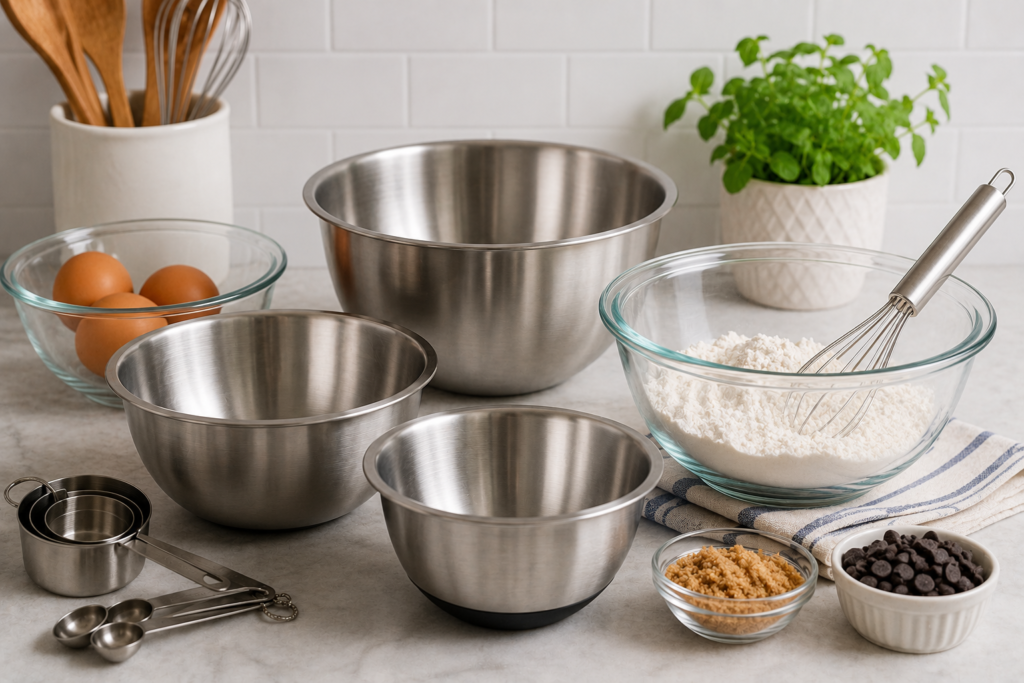
I have used several different kinds of mixing bowls over the years, including glass, plastic, and stainless steel.
At one point, I used glass bowls quite often, but over time I found them too heavy for everyday use. I also personally prefer not to use plastic mixing bowls, so these days I mostly reach for stainless steel.
What I like about stainless steel is that it feels light, practical, and easy to handle. I also feel comfortable using it for food preparation, and because the bowls are usually thin, several sizes can nest inside one another without taking up too much storage space.
That is important in my kitchen because I like having a few extra bowls available. When I am preparing several foods at the same time, I often end up using more than one bowl anyway.
I have also learned that size matters more than I used to think.
For mixing, I usually prefer a bowl that is a little larger than the amount of food I am making because the extra space makes it much easier to stir without spilling. But for very small jobs, a smaller bowl is often easier to use, wash, and put away.
In this article, I’ll look at what to consider when choosing a mixing bowl and why, after trying different materials, stainless steel has become the one I use most often.
Why Stainless Steel Became My Favorite
After using glass, plastic, and stainless steel mixing bowls, stainless steel is the material I now use most often.
The biggest reason is simply that it is easier for me to handle.
Glass bowls can be very useful, but I eventually found them too heavy for everyday mixing, carrying, and washing. Plastic is not a material I personally prefer for mixing bowls, so stainless steel ended up fitting my kitchen habits better.
Stainless steel feels lightweight, practical, and comfortable for everyday food preparation.
Another advantage is that stainless steel bowls can often be fairly thin without feeling bulky. That makes them especially convenient when I have several different sizes.
Why Nesting Bowls Matter in a Small Kitchen
One of my favorite things about my stainless steel bowls is how easily they fit inside one another.
I have several sizes, but because they nest together, they do not take up nearly as much cabinet space as several separate bowls might.
That matters in my kitchen because I do not have unlimited storage space.
With many kitchen tools, I try to keep only what I really use. But mixing bowls are one area where I actually like having a few extras.
Because they stack together so neatly, I can keep several sizes without feeling that they are taking over the kitchen.
Why I Like Having More Than One Mixing Bowl
When I cook, I often prepare several things at the same time.
One bowl may have vegetables in it, another may be holding ingredients that need to be mixed, and I may need another one for something completely different.
In those situations, having several bowls available is much easier than stopping in the middle of cooking to wash and reuse the same bowl.
For me, having extra mixing bowls is not about collecting unnecessary kitchen tools.
It is about having enough bowls to make cooking easier.
And because my stainless steel bowls nest together, I can have several without using much additional storage space.
Choosing the Right Mixing Bowl Size
I have learned that the size of the bowl can make a surprisingly big difference.
When I am mixing ingredients, I usually prefer a bowl that is larger than the amount of food inside it.
If the ingredients nearly fill the bowl, it can be difficult to stir without food spilling over the sides.
A little extra room makes mixing much easier.
This is especially helpful when tossing vegetables, mixing dough or batter, or combining several ingredients together.
I would rather use a slightly larger bowl and have room to work than use a bowl that is technically big enough but feels crowded.
Small Bowls Are Useful Too
That does not mean I always reach for the biggest bowl.
For very small amounts, a small mixing bowl is much more convenient.
If I only need to mix a little sauce, beat an egg, hold chopped ingredients, or prepare a small amount of something, I do not want to pull out a large bowl.
A small bowl is easier to handle, easier to wash, and quicker to put away.
That is why I find myself using all of the different sizes I own, rather than having one favorite size that works for everything.
What About Glass Mixing Bowls?
Glass bowls have some advantages.
They are sturdy, you can see the ingredients through the sides, and they can be useful for many types of food preparation.
I used glass bowls myself.
But for me, the weight eventually became the biggest drawback.
A large glass bowl can feel quite heavy before you even add the ingredients.
Once food is inside, carrying it to the counter, sink, or refrigerator can become even more awkward.
For someone who likes the weight and stability of glass, that may not be a problem.
For me, stainless steel is simply easier to use regularly.
What About Plastic Mixing Bowls?
Plastic mixing bowls are usually lightweight and can be inexpensive.
They can also come in many sizes and colors.
But plastic is not a material I personally prefer for my mixing bowls.
That does not mean everyone needs to avoid it. Material preference is personal, and another home cook may find plastic bowls perfectly practical.
For my own kitchen, I feel more comfortable using stainless steel, so that is what I choose.
What Should You Look for in a Mixing Bowl?
After using different bowls over the years, these are the things I think matter most.
Weight
A bowl should be comfortable enough to lift, move, and wash.
For me, this is one of the main reasons stainless steel works better than glass.
Size
Think about what you normally prepare.
A slightly larger bowl can make mixing much easier, but very small tasks are often easier in a small bowl.
Stability
A bowl that slides around the counter can be frustrating.
Some mixing bowls have silicone or rubber bases that help keep them steady, while others have a wide shape that provides stability.
Storage
If cabinet space is limited, look at how the bowls stack.
Nesting bowls can save a surprising amount of space.
Easy Cleaning
I like kitchen tools that are easy to wash and put away.
The easier a bowl is to clean, the more likely I am to use it regularly.
Do You Need a Mixing Bowl Set?
Not everyone needs a full set.
But in my case, I like having several sizes.
The key is that I actually use them.
A large bowl is helpful when I need room to mix or toss food. Medium bowls handle many everyday jobs. And small bowls are convenient for small amounts and quick preparation.
Because my bowls nest together, having several sizes feels practical rather than excessive.
If you are starting from scratch, you do not necessarily need to buy a huge set.
A few well-chosen sizes may be enough.
Which Mixing Bowl Material Is Best for Baking?
There is no single material that is best for every baker or every kitchen.
Glass can feel sturdy and lets you see the mixture from the side.
Plastic is lightweight.
Stainless steel is lightweight, durable, and easy to nest.
For baking, the best choice often depends on what feels comfortable in your hands, how much storage space you have, and how you normally mix ingredients.
For me, stainless steel wins because it fits the way I actually work in the kitchen.
FAQ
Are stainless steel mixing bowls good for baking?
Yes, stainless steel bowls can work well for many baking tasks. They are lightweight, durable, and available in many sizes.
Are glass mixing bowls better than stainless steel?
Not necessarily. Glass is heavier and transparent, while stainless steel is lighter and easier to handle. The better choice depends on your preferences and how you use the bowl.
What size mixing bowl is most useful?
There is no single best size. I like a bowl that is slightly larger than the amount of food I am mixing, but smaller bowls are more convenient for small jobs.
How many mixing bowls do you really need?
It depends on how you cook. If you often prepare several foods at once, having a few different sizes can be very useful.
Are nesting mixing bowls worth it?
For a small kitchen, I think they can be. Several nesting bowls can take up little more space than one large bowl, which makes storage much easier.
Conclusion
Over the years, I have tried glass, plastic, and stainless steel mixing bowls.
Glass eventually felt too heavy for the way I cook, and plastic is not a material I personally prefer.
These days, stainless steel is the one I reach for most.
It is light enough for me to handle comfortably, easy to clean, and several sizes can nest together without taking up much storage space.
I also like having more than one size because I genuinely use them.
When I am mixing a larger amount of food, a bowl with extra room makes the job much easier. When I only need a small amount, a smaller bowl is quicker to use and wash.
For me, the best mixing bowl is not about choosing one perfect size or material for everyone.
It is about finding the bowls that fit the way you actually cook—and having enough of the sizes you truly use.