Introduction
If you have been following kitchen safety discussions lately, you may have noticed growing concern about the materials that come into contact with our food. We often ask questions about non-stick cookware, plastic food containers, and food storage materials. More recently, plastic cutting boards have also attracted attention.
A 2023 study published in Environmental Science & Technology found that chopping on polyethylene and polypropylene cutting boards can release microplastic particles. The amount varied depending on the type of plastic, the food being cut, and the way the board was used. The study estimated that regular cutting could potentially expose a person to millions of microplastic particles over the course of a year, although the long-term health effects in humans are still not fully understood.
This subject caught my attention because I have used almost every major cutting board material in my own kitchen over the years: wood, plastic, titanium, and silicone.
Interestingly, I did not switch to silicone because of a scientific study. I switched because, after trying the other materials, silicone simply worked better for the way I cook and clean.
Here is what the research says about plastic cutting boards, what I learned from using four different materials myself, and why silicone has become the board I reach for most often.
The Microplastic Concern With Plastic Cutting Boards
Plastic cutting boards became popular because they are inexpensive, lightweight, and easy to wash. Many are also dishwasher-safe.
But the surface changes with use.
Every time a knife cuts into a plastic board, small grooves and scratches can develop. Research has shown that chopping on polyethylene and polypropylene cutting boards can release microplastic particles.
The amount can vary depending on the board material, cutting style, knife pressure, and frequency of use. For that reason, estimates from laboratory studies should not be interpreted as the exact amount every person consumes.
The long-term health effects of microplastic exposure in humans are still being studied.
For me, the research added another reason to reconsider something I already disliked about older plastic cutting boards: the heavily scratched surface.
I also looked into whether kitchen sponges and scrubbers can shed microplastics and what alternatives may be worth considering.
What I Learned After Using 4 Cutting Board Materials
I have not used just one kind of cutting board throughout my life. Over the years, I have tried wood, plastic, titanium, and silicone.
My opinion is based not only on specifications but also on what happened when I actually used them in my kitchen.
1. Wood Cutting Boards
Wood has many qualities I like. It feels comfortable under a knife, looks beautiful, and a good wooden board can last for years.
But I became increasingly concerned about maintenance.
A wooden board needs to dry thoroughly after washing, and I often wondered what might be happening inside the board if moisture remained for too long.
I also owned a colored wooden cutting board. After using it, I noticed color appearing inside some of the knife marks. Once I saw that, I no longer felt comfortable preparing food on it, so I stopped using it.
For someone who enjoys maintaining and oiling a wooden board, wood can still be a very good option. It simply was not the easiest choice for my everyday routine.
2. Plastic Cutting Boards
Plastic boards were convenient because they were lightweight and easy to wash.
But after repeated use, mine developed more and more knife marks. Certain foods also left noticeable stains.
Over time, those scratched surfaces started to bother me even before I learned about the microplastic research.
Now that studies have shown that polyethylene and polypropylene boards can shed microplastic particles during chopping, I pay much more attention to the condition of a plastic board rather than assuming it is fine simply because it can go into the dishwasher.
3. Titanium Cutting Boards
I eventually tried titanium because I was looking for something that would avoid some of the problems I had experienced with wood and plastic.
I bought a good-quality titanium board and expected it to be a long-term solution.
But I was surprised to see noticeable knife marks from the very first use.
That was disappointing because durability was one of the main reasons I had purchased it. I still have the board, but I rarely use it now.
This was a good reminder for me that a material can sound perfect on paper but still not feel right in everyday cooking.
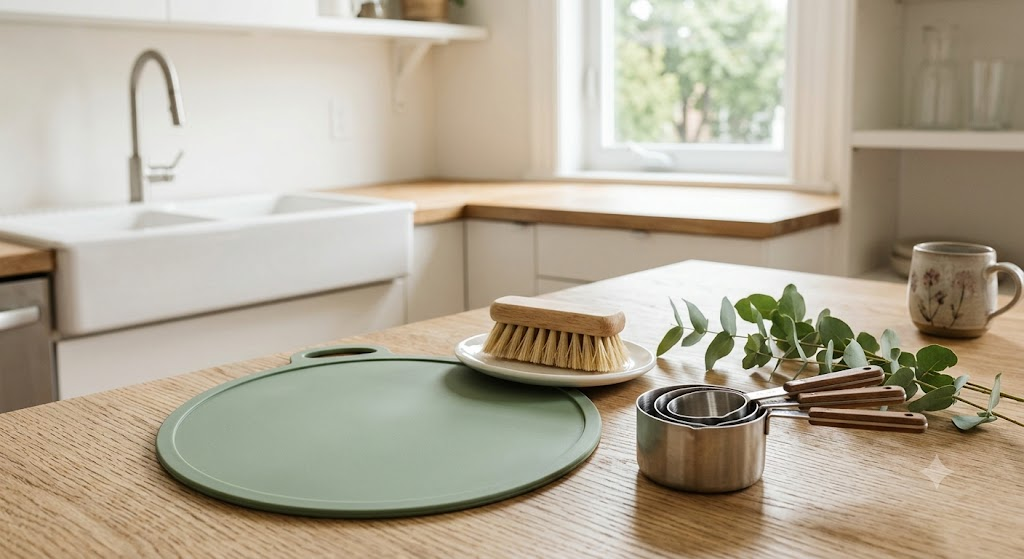
4. Food-Grade Silicone Cutting Boards
Silicone is what I currently use most often.
What I like first is the feel of the surface. I prefer a thicker silicone board rather than a very thin flexible mat. A substantial board feels more stable while still giving slightly under the knife.
The smooth surface is also easy for me to clean, and the board does not slide around the countertop as easily as some lightweight plastic boards I have owned.
Food-grade silicone is widely used for kitchen products because it is flexible, durable, and able to tolerate relatively high temperatures. However, heat limits and cleaning recommendations can vary, so I always recommend following the manufacturer’s instructions.
One point I think is important: I would not claim that a silicone cutting board can never release particles. There is not enough research for me to make that absolute statement.
What I can say is that the polyethylene and polypropylene microplastic shedding documented in cutting-board studies applies specifically to those conventional plastic materials.
My decision to use silicone is based mainly on how it performs in my kitchen and my desire to move away from the heavily scratched plastic boards I used in the past.
Why Silicone Became My Everyday Choice
My switch to silicone was not driven by fear of one particular material.
It happened gradually.
I became tired of stains and deep scratches on plastic. Wood required more drying and maintenance than I wanted. Titanium did not perform the way I expected after I saw marks appearing so quickly.
Silicone ended up giving me the balance I was looking for.
I like that a thicker silicone board feels stable on the counter while still being quieter and more comfortable under the knife than a hard metal surface.
The smooth surface is simple to wash, and the material naturally provides some grip against the countertop.
Most importantly, I actually enjoy using it.
After trying so many different materials, that matters more to me than choosing a cutting board simply because it happens to be the newest trend.
Conclusion
The research on plastic cutting boards has given us another reason to pay attention to something that is easy to overlook.
Studies show that chopping on polyethylene and polypropylene cutting boards can release microplastic particles. At the same time, scientists are still studying what long-term exposure means for human health, so I do not think there is a reason to panic or throw away every plastic item in the kitchen overnight.
But if a plastic cutting board is old, deeply scratched, stained, or difficult to clean, replacing it may be worth considering.
After using wood, plastic, titanium, and silicone myself, I have found that a thick, smooth, food-grade silicone cutting board works best for my everyday kitchen.
It is not because I believe silicone is a perfect material.
It is simply the one that has given me the best combination of easy cleaning, comfortable cutting, stability, and practicality.
And after decades of cooking, I have learned that the kitchen tools I continue reaching for are usually the ones that fit real life—not just the ones that sound best on paper.