Introduction
Choosing the right frying pan can make everyday cooking easier and more enjoyable. But with so many materials, sizes, coatings, and designs available, deciding which pan belongs in your kitchen can be confusing.
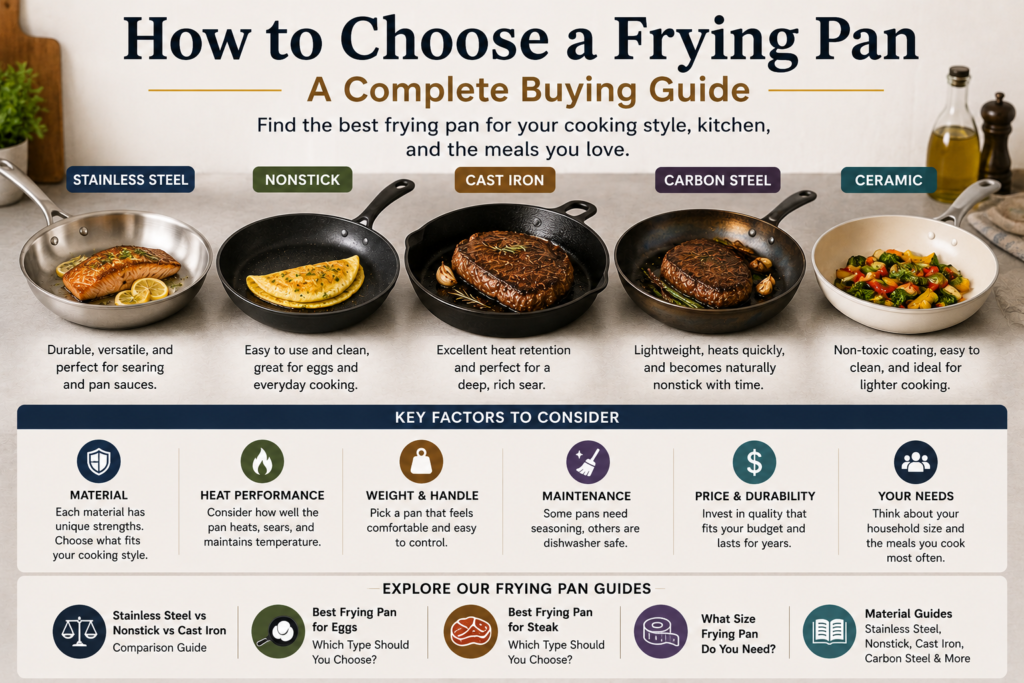
Stainless steel, nonstick, cast iron, carbon steel, and ceramic frying pans each have different strengths. Some are ideal for delicate foods such as eggs, while others perform better for high-heat searing, sautéing, or making pan sauces.
In this guide, we’ll compare the most common frying pan materials, sizes, and cooking uses so you can choose a pan that fits your cooking style and kitchen.
Frying Pan Types: Quick Comparison
| Pan Type | Main Strength | Maintenance | Best For |
|---|---|---|---|
| Stainless Steel | Versatile and durable | Moderate | Searing, sautéing, pan sauces |
| Nonstick | Excellent food release | Easy | Eggs, pancakes, delicate foods |
| Cast Iron | Excellent heat retention | Requires seasoning | Steak, frying, high-heat cooking |
| Carbon Steel | Responsive and durable | Requires seasoning | Searing, sautéing, stir-frying |
| Ceramic | Easy food release | Easy | Eggs, vegetables, everyday cooking |
Stainless Steel Frying Pans
Stainless steel frying pans are durable, versatile, and suitable for many different cooking techniques.
They are particularly useful for browning meat, sautéing vegetables, and creating pan sauces. Because the surface is uncoated, stainless steel can tolerate cooking techniques that may not be appropriate for many coated pans.
Food can stick if the pan is not used properly, so learning how to preheat the pan and manage cooking temperature can improve results.
For cooks who want a durable all-purpose frying pan without a nonstick coating, stainless steel is an excellent option.
Nonstick Frying Pans
Nonstick frying pans are designed to provide easy food release and convenient cleanup.
They are particularly useful for delicate foods such as eggs, pancakes, crepes, and fish. They can also allow you to cook many foods with relatively little added cooking fat.
Traditional coated nonstick pans generally perform best at low to medium temperatures. Avoid overheating the pan and use utensils that will not scratch the cooking surface.
A nonstick pan can be especially useful as a second frying pan dedicated to delicate foods.
Cast Iron Frying Pans
Cast iron frying pans are known for their durability and excellent heat retention.
Once properly heated, cast iron maintains temperature very well, making it particularly useful for searing steaks, frying, and other cooking methods that benefit from steady heat.
Cast iron is heavy and requires some maintenance. The pan should be kept dry and its seasoning maintained to help protect the cooking surface from rust.
With proper care, a quality cast iron pan can last for many years.
Carbon Steel Frying Pans
Carbon steel shares several characteristics with cast iron but is generally lighter and responds more quickly to temperature changes.
It performs very well at high temperatures and can be used for searing, sautéing, stir-frying, and many other cooking techniques.
Carbon steel requires seasoning and careful drying after washing. As the seasoning develops, the cooking surface can become smoother and increasingly resistant to sticking.
It can be a good choice for cooks who want high-heat performance without the weight of traditional cast iron.
Ceramic Frying Pans
Ceramic frying pans usually feature a ceramic-based coating designed to provide easy food release.
They work particularly well for eggs, vegetables, pancakes, and other foods commonly cooked at low to medium temperatures.
Like other coated cookware, ceramic pans benefit from gentle treatment. Excessive heat, abrasive cleaning, and inappropriate utensils can shorten the useful life of the cooking surface.
Ceramic can be a convenient choice for cooks who want an easy-to-use coated pan for everyday meals.
Which Frying Pan Is Best for Eggs?
For easy everyday egg cooking, traditional nonstick is often the simplest choice because of its excellent food-release properties.
Ceramic pans can also work very well, particularly while their cooking surface is in good condition.
A properly seasoned carbon steel pan can become another excellent option for eggs, although it requires more technique and maintenance.
Which Frying Pan Is Best for Steak?
Cast iron, carbon steel, and stainless steel are all strong choices for steak.
Cast iron provides excellent heat retention, which helps maintain a hot cooking surface during searing.
Carbon steel provides excellent high-heat performance while generally being lighter and more responsive than cast iron.
Stainless steel can produce excellent browning and is especially useful when you want to deglaze the pan afterward to make a sauce.
What Size Frying Pan Should You Buy?
The right size depends on how much food you normally cook.
An 8-inch frying pan is useful for small portions, one or two eggs, and individual meals.
A 10-inch frying pan provides a practical balance between cooking space and easy handling and can work well for many everyday meals.
A 12-inch frying pan offers more room for larger portions, steaks, vegetables, and meals for several people.
If you are buying only one pan, think about both the number of people you normally cook for and the amount of usable cooking surface you need.
Consider the Weight and Handle
A frying pan should feel comfortable and secure when you lift and move it.
Cast iron is usually the heaviest option, while carbon steel often provides similar high-heat capability at a lower weight. Stainless steel and coated pans vary considerably depending on their construction.
Handle design also matters. A comfortable handle can make it easier to lift, tilt, and move the pan, particularly when it contains food.
Consider Your Stove
Before purchasing a frying pan, make sure it is compatible with your cooking surface.
Gas and conventional electric ranges work with many types of cookware. Induction cooktops require cookware with a magnetic base.
Cast iron and many carbon steel pans are generally induction compatible, while stainless steel and coated cookware vary by model.
Always check the manufacturer’s specifications if induction compatibility is important to you.
Consider Maintenance
Different frying pans require different levels of care.
Stainless steel generally does not require seasoning and can tolerate relatively robust cleaning.
Traditional nonstick and ceramic pans require gentler utensils and cleaning methods to protect their coatings.
Cast iron and carbon steel require seasoning and careful drying to help prevent rust.
Choosing a pan that matches the amount of maintenance you are comfortable doing can make it easier to enjoy using the cookware long term.
Do You Need More Than One Frying Pan?
For many home cooks, owning two different frying pans can be more practical than expecting one pan to perform every task perfectly.
For example, a nonstick or ceramic pan can handle eggs and delicate foods, while stainless steel, cast iron, or carbon steel can handle stronger searing and higher-heat cooking.
The best combination depends on the foods you prepare most frequently.
Frequently Asked Questions
1. What is the best all-purpose frying pan?
There is no single best pan for everyone. Stainless steel is highly versatile and durable, while carbon steel can also handle a wide variety of cooking techniques. Many cooks keep a separate nonstick or ceramic pan for delicate foods such as eggs.
2. What frying pan is easiest to use?
A traditional nonstick frying pan is often one of the easiest options for beginners because food releases readily from the cooking surface and cleanup is usually simple.
3. What frying pan lasts the longest?
Cast iron, carbon steel, and quality stainless steel pans can potentially last for many years when properly maintained. Coated nonstick and ceramic cooking surfaces generally have a more limited lifespan because their coatings gradually wear with use.
4. Is stainless steel better than nonstick?
Neither is better for every cooking task. Stainless steel is more suitable for high-heat browning and pan sauces, while nonstick is particularly convenient for eggs and other delicate foods.
5. Should I buy a 10-inch or 12-inch frying pan?
A 10-inch pan is easier to handle and can be sufficient for smaller households and everyday meals. A 12-inch pan provides more cooking space and is often more useful when cooking larger portions or meals for several people.
6. What should I look for when buying a frying pan?
Consider the pan material, size, weight, handle comfort, stove compatibility, maintenance requirements, cooking surface, and the foods you prepare most often. A good frying pan should match your cooking habits rather than simply having the most features.
Conclusion
Choosing the right frying pan becomes much easier when you start with the foods you cook most often.
Stainless steel is durable and versatile, nonstick makes delicate foods easy to prepare, cast iron provides exceptional heat retention, carbon steel combines high-heat performance with quicker temperature response, and ceramic offers convenient food release for everyday cooking.
Size is equally important. An 8-inch pan works well for small portions, a 10-inch pan is a versatile everyday size, and a 12-inch pan provides more space for larger meals.
Rather than searching for one frying pan that does everything perfectly, choose cookware that fits your cooking style, household size, stove, and willingness to perform maintenance.
The right frying pan is ultimately the one that makes the meals you cook most often easier to prepare.
Related Frying Pan Guides
Stainless Steel Frying Pan: Pros, Cons, and Best Uses
Nonstick Frying Pan: Pros, Cons, and Best Uses
Cast Iron Frying Pan: Pros, Cons, and Best Uses
Carbon Steel Frying Pan: Pros, Cons, and Best Uses
Ceramic Frying Pan: Pros, Cons, and Best Uses
Stainless Steel vs Nonstick vs Cast Iron Frying Pans
Carbon Steel vs Cast Iron Frying Pan: Which Is Better?
Ceramic vs Nonstick Frying Pan: Which Is Better?
Best Frying Pan for Eggs: Which Type Should You Choose?